|
The Tropicbird
After
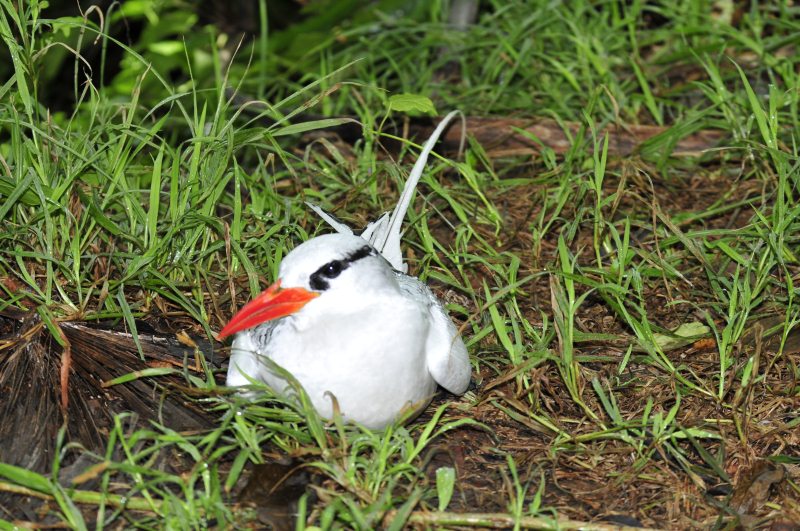
a short downhill but slippery trek we saw this little chap
sitting all alone looking out to sea from the cliff. He seemed unbothered
at our closeness. Tropicbirds are a family,
Phaethontidae, of tropical
pelagic seabirds
now classified in their own order Phaethontiformes. Their relationship
to other living birds is unclear, and they appear to have no close relatives.
There are three species in one genus,
Phaethon. They have
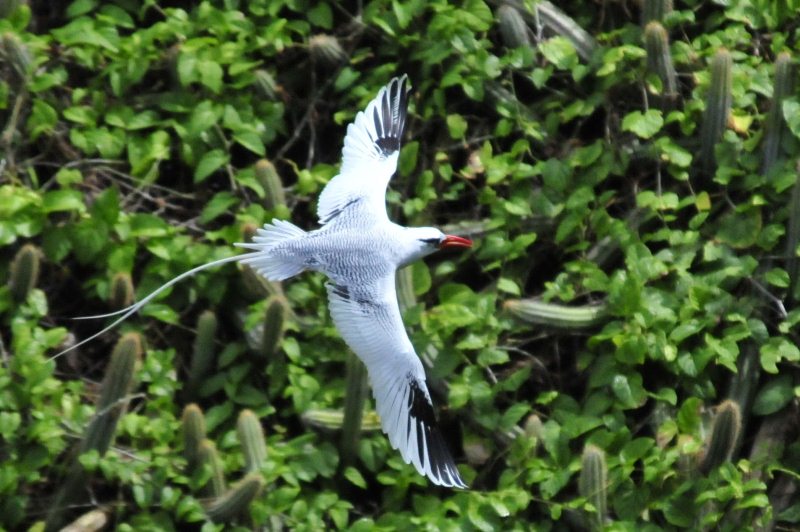
predominately white plumage
with elongated tail feathers and small feeble legs and feet.
Size and Appearance:
Tropicbirds
range in size from 76 cm to 102 cm in length and 94 cm to
112 cm in wingspan (this may be my only attempt with these centimeter
things - they really are not my thing). Their plumage is predominantly white,
with elongated central tail feathers. The three species have different
combinations of black markings on the face, back and wings. Their bills are
large, powerful and slightly decurved. Their heads are large and their necks are
short and thick. They have totipalmate feet (that is,
all four toes are connected by a web). The legs of a tropicbird are located far
back on their body, making walking impossible, so that they can only move on
land by pushing themselves forward with their feet. The
tropicbirds' call is typically a loud, piercing, shrill, but grating whistle or
crackle. These are often given in a rapid series when they are in a display
flight at the colony.

Systematics,
Evolution and Distribution: Tropicbirds
were traditionally grouped in the order
Pelecaniformes,
which contained the pelicans,
cormorants
and shags, darters,
gannets
and boobies and frigatebirds;
in the Sibley-Ahlquist
taxonomy, the Pelecaniformes were united with other groups into a
large "Ciconiiformes". More recently this grouping has been found to be
massively paraphyletic
(missing closer relatives of its distantly related groups) and split again.
Recent research suggests that the Pelecaniformes as traditionally defined are
paraphyletic too. The tropicbirds and the related prehistoric family
Prophaethontidae are considered a distinct order, Phaethontiformes, not closely
related to any other living birds. They are more distantly related to the
Procellariformes.
Family Phaethontidae:
Genus Phaethon.
Red-billed
Tropicbird Phaethon aethereus (tropical Atlantic, eastern
Pacific, and Indian oceans). Red-tailed
Tropicbird, P. rubricauda (Indian Ocean and the western and
central tropical Pacific). White-tailed
Tropicbird, P. lepturus (widespread in tropical waters, except
in the eastern Pacific). Within the group, the Red-tailed and White tailed are
each other's closest relatives, with the red-billed a sister taxon of that
group. Heliadornis
is a prehistoric genus of tropicbirds described from fossils.
Ecology and
Feproduction: Tropicbirds
frequently catch their prey by hovering and then plunge-diving, typically only
into the surface-layer of the waters. They eat mostly fish, especially flying
fish, and occasionally squid. Tropicbirds tend to avoid multi-species
feeding flocks, unlike the frigate
birds, which have similar diets. Tropicbirds are usually
solitary or in pairs away from breeding colonies. There they engage in
spectacular courtship displays. For several minutes, groups of two to twenty
birds simultaneously and repeatedly fly around one another in large, vertical
circles, while swinging the tail streamers from side to side. If the female
likes the presentation, she will mate with the male in his prospective
nest-site. Occasionally, disputes will occur between males trying to protect
their mates and nesting areas. Tropicbirds generally
nest in holes or crevices on the bare ground. The female lays one white egg,
spotted brown, and incubates for forty to forty six days. The incubation is
performed by both parents, but mostly the female, while the male brings food to
feed the female. The chick hatches with grey down. It will stay alone in the
nest while both parents search for food, and they will feed the chick twice
every three days until fledging, about twelve to thirteen weeks after hatching.
The young are not able to fly initially; they will float on the ocean for
several days to lose weight before flight. Tropicbird chicks
have slower growth than nearshore birds, and they tend to accumulate fat
deposits while young. That, along with one-egg clutches, appears to be an
adaptation to a pelagic lifestyle where food is often gathered in big amounts,
but may be hard to find.
ALL IN ALL SO PLEASED TO HAVE BEEN UP CLOSE AND PERSONAL WITH THESE
LITTLE CHAPS.
|