Saba

|
Saba
Saba (pronounced Say-ber not Sab-ber) consists largely of (and because of) Mount Scenery (877 m), the highest point of the Kingdom of the Netherlands, an inactive volcano for hundreds of years. Saba has a land area of five square miles. Its current major settlements include The Bottom, Windwardside, Hell's Gate and St John's. Despite the island's Dutch affiliation, English is the principal language spoken on the island and has been used in its school system since the 19th century. The Netherlands Antillian Guilder (ANG) used to be the official currency, no longer used, the US dollar has taken over and is accepted everywhere on the island. Saba is home to the Saba University School of Medicine, which was established by American expatriates in coordination with the Netherlands government. The school adds over three hundred residents when classes are in session, and it is the prime educational attraction. A.M. Edwards Medical Center is the major provider of healthcare for local residents.

The Netherlands Antilles, an autonomous Caribbean country within the Kingdom of the Netherlands, was dissolved on the 10th of October 2010. It was created originally of communities from various islands in the Caribbean that formed a single autonomous country within the Kingdom of the Netherlands. After dissolution, the islands of Bonaire, Saba and Saint Eustatius became special municipalities of the Netherlands proper, while Curacao and Sint Maarten became constituent countries within the Kingdom of the Netherlands, along the lines of Aruba, which had separated from the Netherlands Antilles in 1986. Sabans now have to pay taxes to Holland, a very unpopular business. One lady told us that the Netherlands must see them as having individual needs and cannot - nor should not be compared to Holland. An example, alcohol is not taxed, soft drinks and water is. Everything is already expensive on Saba as everything HAS to be brought in, by ferry or air, so the extra taxes are crippling.
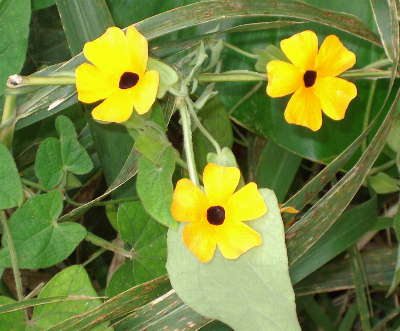 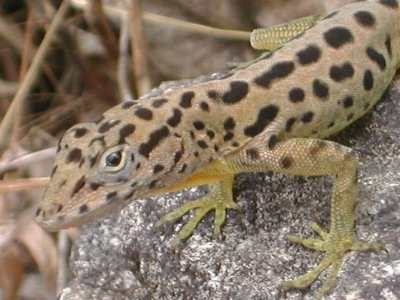
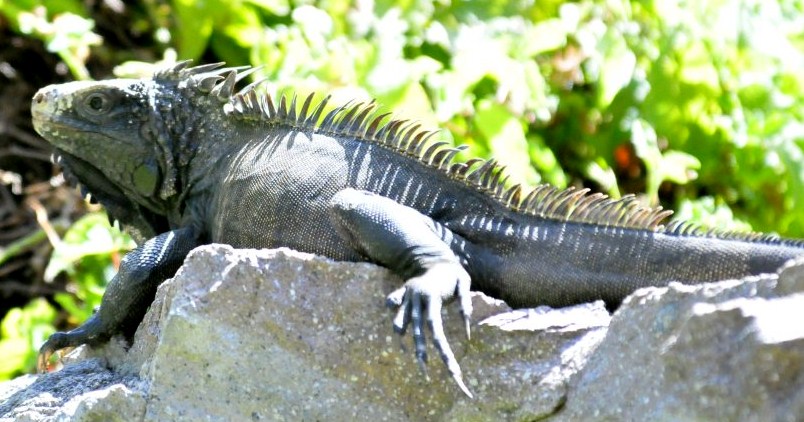
The National flower is the black-eyed Susan. The Saba Lizard
History: The origin of the name "Saba" is believed to be derived from the Arawak Indian word for "rock", which was "siba". Christopher Columbus is said to have sighted Saba on the 13th of November 1493, but he did not land, as the island's perilously rocky shores were a major deterrent to Columbus and his crew. In 1632 a group of shipwrecked Englishmen landed upon Saba; they stated they found the island uninhabited when they were rescued. However, there has been some evidence found indicating that Carib or Arawak Indians may have been on the island. The remains of the 1640 settlements can be found on the west side at Tent Bay. They were destroyed by a landslide already in the 17th century.In 1635 a stray Frenchman claimed Saba for Louis XIII of France and around the year 1640, the Dutch Governor of the neighboring island of St. Eustatius sent people over to colonise the island for the Dutch West India Company. In 1664, these settlers were evicted to St. Maarten by Thomas Morgan, member of the same family as the notorious English buccaneer, Henry Morgan, on one of the very few occasions that the nearly vertical rocky island was successfully invaded. The Netherlands have been in continuous possession of Saba since 1816 after numerous flag changes (British-Dutch-French) during the previous centuries. In the 17th and 18th centuries its major industries were sugar and rum and later fishing, particularly lobster fishing. In the 1600's Saba was believed to be a favorable hideout for Jamaican pirates. England also deported its "undesirable" people to live in the Caribbean colonies. They too became pirates, taking haven on Saba. The most notable native Saban pirate was Hiram Beakes, who famously quipped "Dead Men Tell No Tales." Legitimate sailing and trade later became important and many of the island's men took to the seas, during which time Saba lace became an important product made by the island's women.
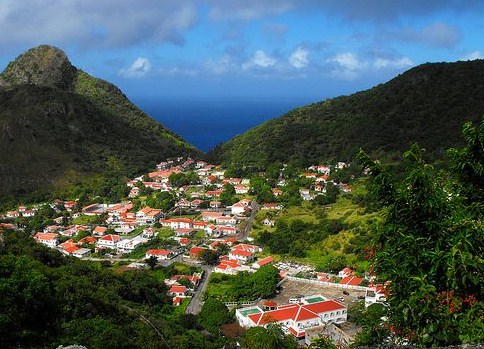
The Bottom
Geography: The environment of Saba is mainly composed of woodland forest with ferns, damp soil and many mango trees. There used to be forests of Mountain Mahogany trees until a hurricane in the 1960's destroyed many of the trees. These are Freziera undulata [Theaceae], and unrelated to other Mahogany species, one of which is, however, planted at lower levels on the island small-leaved mahogany, Swietenia mahagoni [Meliaceae]. The Mahogany trees are considered at risk of going extinct on the island. Visitors refer to Saba's forests as "the Elfin Forest" because of its high altitude mist and mossy appearance. Since then there has been a woodland reserve created and aptly named "Elfin Forest Reserve". Saba's lush plant and animal wildlife are diverse and are looked after by the Saba Conservation Foundation.People and culture: The population of Saba consists of only 1,424 people who come from all over the world. The island's small size has led to a fairly small number of island families, who can trace their last names back to around a half-dozen families. This means that many last names are shared around the island, the most numerous being Hassell and Johnson. Most families are a rich intermixing of Dutch, Scottish and African heritage. The population is also descended from the Irish who were exiled from that country after the ascension of King Charles I of England in 1625; Charles exiled these Irish to the Caribbean in an effort to quell rebellion after he had forcibly procured their lands for his Scottish noble supporters. Historically, the island was traded among the many European nations that fought for power in the region. Slaves were also imported to work on Saba. In more recent years Saba has become home to a large group of expatriates. Sabans are mostly Roman Catholic by faith; however, there is also a Wesleyan Holiness community on the island. Other religions practiced on the island include Anglican, Seventh-day Adventist, Muslim and Jewish faiths.
Due to the very small size of the island, as well as the difficulty with which the steep slopes made farming, many Sabans took to the sea, making their living as legitimate sailors. Their seafaring traditions made it not uncommon for many men to seek better employment in the United States Navy; forging their birth certificates to enter the U.S. Navy without obstruction was also not uncommon. Although the details of his early personal biography are virtually unknown, one of these Saban sailors was possibly Chief Boatswain Edwin J. Hill, who received the United States' highest military honor, the Navy version of the Medal of Honor posthumously, for heroism during the Japanese attack on Pearl Harbour in 1941 in which he died (due to the commonplace practice of one's forging his birth certificate to enter the U.S. Navy, Hill's Saban birth cannot be absolutely proven; however, it is known that his immediate and extended family were Saban).
 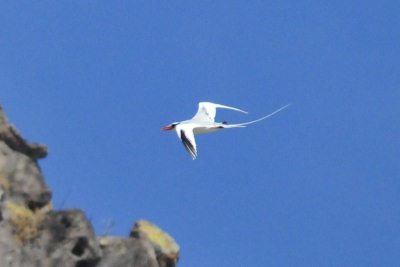
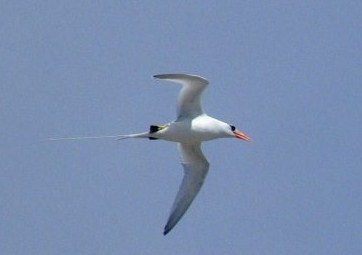
We saw many Tropicbirds
Transport: There is one road, aptly called "The Road". Its construction was masterminded by Josephus Lambert Hassell who, despite the common opinion of Dutch and Swiss engineers, believed that a road could be built. He took a correspondence course in civil engineering, and started building the road with a crew of locals in 1938. After five years of work, the first section of the road, from Fort Bay to The Bottom, was completed. It was not until 1947, however, that the first motor vehicle arrived. In 1951, the road to Windwardside and St. Johns was opened, and in 1958 the road was completed. Driving "The Road" is considered to be a daunting occasion, and the curves in Windwardside are extremely difficult. Driving is on the right hand side. In 1963 the island had built a 400 metre landing strip for easier trips to the island by flight: Juancho E. Yrausquin Airport. It is reputed to be the shortest commercial runway in the world, and as such, only three models of airplane are known to land there regularly. Consistent air service from Sint Maarten and Sint Eustatius is available through Windward Island Airways (Winair). In 1972 a pier was completed in Fort Bay to access the island which has made it easier for visitors to come there. Travel is also provided by ferry services to and from Sint Maarten with the Dawn II and The Edge three times a week.

Economy: Saba lace (also known as "Spanish work") was a major export of Saba. In the 1870's, as a young lady, Mary Gertrude Hassell Johnson, was sent to a Caracas convent in Venezuela for study – where she learned the difficult craft. The lacework spread through the island. The women of Saba began a mail-order business, and would copy addresses of businesses off of shipping containers from the United States, and write to the employees. Often they would get orders for the lacework, and it started a considerable cottage industry. By 1928, the women were exporting around $15,000 (USD) worth of lace products each year. Tourism: The island of Saba is known today for tourism, especially its ecotourism. Because the island is relatively new to the tourism industry, it only sees about 25,000 visitors each year. Saba is increasing in its popularity as a vacation destination because of its excellent scuba diving, climbing and hiking. The scuba diving in particular is deep and somewhat challenging; even though Saba is a small island it actually supports not one, but two hyperbaric chambers in case of diving emergencies. Saba's brilliantly colourful and pristine coral life make it one of the most sublime places to scuba dive in the world, and is often listed as one of the Top ten diving destinations. Many attribute the underwater life's purity to the island's remoteness and the caring of the people. The waters around the island were designated as the Saba National Marine Park in 1987, subject to government regulation to preserve its coral reefs and other marine life. Thus, Saba is known as the "Unspoiled Queen" of the Caribbean Saba has inns, hotels, rental cottages and restaurants.

ALL IN ALL A FABULOUS ISLAND. |