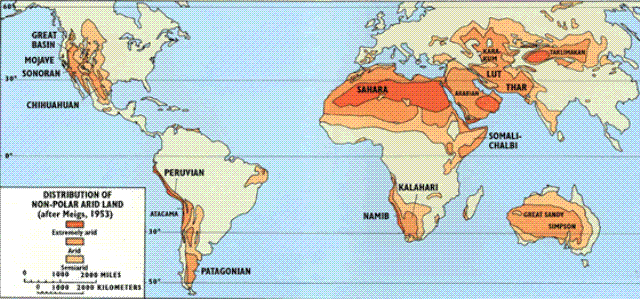
The Sahara Desert

|
The Sahara
Desert
You cannot picture North Africa
without seeing The Sahara Desert. This truly unique place had to have a blog on
its own. Half the Sahara receives less than 2 cms or 0.79 inches rainfall
per year, the rest up to 10 cms or 3.9 inches. Rainfall is very rare, when it
does rain it is usually torrential especially when it occurs after long dry
periods that can last for years. Plymouth, Devon by comparison averages 966 cms
or 38 inches per year.
The Sahara ( Arabic: الصحراء الكبرى, aṣ-ṣaḥrā´ al-kubra, "The Great Desert" ) is the world's largest hot desert and the world's second largest desert after Antarctica. At over 9,000,000 square kilometers ( 3,500,000 square miles ), it covers most parts of Northern Africa; an area stretching from the Red Sea, including parts of the Mediterranean coasts, to the outskirts of the Atlantic Ocean. To the south, it is delimited by the Sahel, a belt of semi-arid tropical savanna separating the Sahara from Sub-Saharan Africa. The Sahara is almost as large as the continental USA, and is larger than Australia. The Sahara has an intermittent history that may go back as much as 3 million years. Mention Sahara and most people immediately think of sand dunes, some of which can reach 180 meters (600 ft) in height. Its name comes from the Tamajaq Tuareg language word Tenere, which means "the desert". Translated into the Arabic it gave Sahara "desert".
PEOPLES and LANGUAGES.
The predynastic Egyptians were the first people to inhabit and build in the Sahara from around 6000 BC, the Nubians from 5000 BC, the Phoenicians between 1200 and 800 BC and the Greeks from 500 BC. Nowadays the Sahara is home to a number of peoples and languages. Arabic is the most widely spoken language in the Sahara, from the Atlantic to the Red Sea. Berber People are found from western Egypt to Morocco, including the Tuareg pastoralists of the central Sahara. The Beja live in the Red Sea Hills of southeastern Egypt and eastern Sudan. The Arabic, Berber, and Beja languages are part of the Afro-Asiatic language family. Speakers of the Nilo-Saharan language family also inhabit the Sahara, including the Fur of Darfur in western Sudan and the Saharan languages of Niger, Chad and Sudan, which includes the Kanuri, Tegeda and Dazaga. FAUNA    

   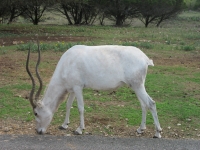 
   There are 207 species of bird that live in and around the Sahara such as African Silverbill, Black-throated Firefinch and the Secretary Bird. MODERN TIMES Egypt became independent of Britain in 1936, although the Anglo-Egyptian Treaty of 1936 allowed Britain to keep troops in Egypt and maintained the British-Egyptian condominium in the Sudan. British military forces were withdrawn in 1954. Most of the Saharan states achieved independence after World War II: Libya in 1951, Morocco, Sudan, and Tunisia in 1956, Chad, Mali, Mauritania, and Niger in 1960, and Algeria in 1962. Spain withdrew from Western Sahara in 1975, and it was partitioned between Mauritania and Morocco. Mauritania withdrew in 1979, and Morocco continues to hold the territory. The modern era has seen a number of mines and communities develop to exploit the desert's natural resources. These include large deposits of oil and natural gas in Algeria and Libya and large deposits of phosphates in Morocco and Western Sahara. A number of Trans-African highways have been proposed across the Sahara, including the Cairo-Dakar Highway along the Atlantic coast, the Trans-Sahara Highway from Algiers on the Mediterranean to Kano in Nigeria, the Tripoli-Cape Town Highway from Tripoli in Libya to Ndjamena in Chad, and the Cairo-Cape Town Highway which follows the Nile. Each of these highways is partially complete, with significant gaps and unpaved sections.
The picture we all conjure up when thinking of the Sahara is the expanse of sand with wind blown-dunes, in reality there is also the snow-capped high Atlas Mountains and the date trees, looking like a weird forest. All in all an amazing place. |