Casablanca

Hassan II Mosque was built between 1987 and 1993, it was intended for
the 60th birthday of former Moroccan king Hassan II.
On his birthday on the 9th of July 1980 the king said "I wish Casablanca to
be endowed with a large, fine building of which it can be proud until the end of
time... .. I want to build this mosque on the water, because
God's throne was on the water. Therefore, the faithful who go there pray, to
praise the creator on firm soil, can contemplate God's sky and sea".
 
 The Hassan II Mosque has space for 25,000 worshippers inside and another
80,000 outside. As that is so many shoes, you carry them in a bag and hide them
in special bags behind where you kneel, each special bag holds about ten pairs.
The 210-meter minaret is the tallest in the world and is visible day and night
for miles around. Many Casablancans have mixed
feelings about Hassan II Mosque. On one hand, they are proud that this beautiful
monument dominates their city. On the other, they are aware that the expense
(estimates range from $500 to 800 million) could have been put to other uses. To
build the mosque, it was necessary to destroy a large, impoverished section of
Casablanca. The residents did not receive any compensation.
   Bear under one of the
walkways, me with one of the entrances. The huge area on which the mosque stands. The surrounding
roads and avenues were supposed to be finished within a decade of the mosque
opening, sadly this has not been realised. A new marina is due to be built
nearby and much regeneration, maybe too much bitten off. Although Hassan II
Mosque was designed by a French architect, it is Moroccan through and through.
Except for the white granite columns and the glass chandeliers, the materials
used to construct the mosque were taken from the Morocco region. 6,000
traditional Moroccan artisans worked for five years to turn these raw materials
into mosaics, stone and marble floors and columns, sculpted plaster moldings,
and carved and painted wood ceilings. The mosque also includes a number of
modern touches: it was built to withstand earthquakes and has a heated floor,
electric doors, a sliding roof, part of floor is glass so worshippers can
kneel directly over the sea; and lasers which shine at night from the top
of the minaret toward Mecca.

  One of the many chandeliers,
the huge area inside and me in the men's ablution room with 41 water
fountains to wash crouched around. Except at prayer times and Fridays you can go
on an hour long tour for 120 Dirhams. We were on a tour, not because I have a
thing about being photographed in the men's !!!!!! On the tour our 37 week
pregnant tour guide, told us that removing shoes has nothing to do with
religion, but like in their homes, it is to keep the carpets clean. Ditto
washing, is only for getting clean before prayers, not part of the Muslim
religion, something we both thought was the case. Below the ablution level are
two beautiful traditional pools ( hammams ) in separate rooms, for separate
sexes. Steam faucets to create the atmosphere of a Turkish Bath, the pools
gently sloping to a depth of 5 feet, surrounded by beautiful lighting and
wall cascades. The water temperature SHOULD be 33 degrees and the steam at
a steady humidity, sadly never been used or opened to the public ( Muslim
and non-Muslim ) as planned.
Rick's Cafe opened in the image of the one "used" in the movie Casablanca - which was shot entirely in Hollywood. We got to Rick's just as it closed, so as it was pouring with rain went to KFC aka Happy Food.
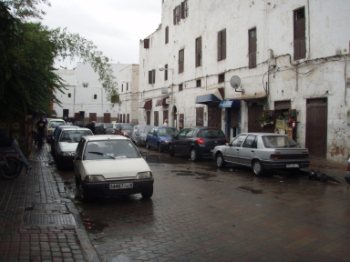
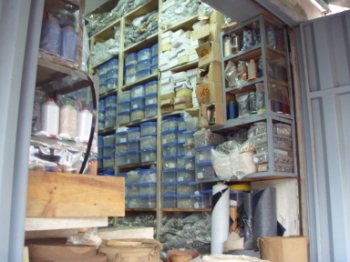
On a pretty ugly street there was a tiny piece of beautifully kept garden. Bear loved the screw shop. Amazing to see a screw shop ONLY selling screws, just like the egg shop ONLY eggs. We left the train station at 6pm and thought 'hot cup of tea, nice cakes and a movie'. I decided we could cut through the Sale medina as it may give us a bit of shelter from the driving rain. WRONG, Bear recognised the jewelers area from our first visit, my gyro was not on and we ended up twice the distance AWAY from Beez than we started from at the station. We eventually escaped the medina and called a taxi. The taxi driver got lost taking us from the where we found him, we got out of the taxi in the building site ( marina extension ) next door, he was so concerned he kept his headlights on until the guard met us at the bollards thinking it was a huge joke, all for the princely sum of 60p. We were now not only wet through but covered in mud. My new scarf proved not to be waterproof.
All in all worth going to see the mosque, but that was it really.
|