The Bridge

|
The Clifton Suspension
Bridge
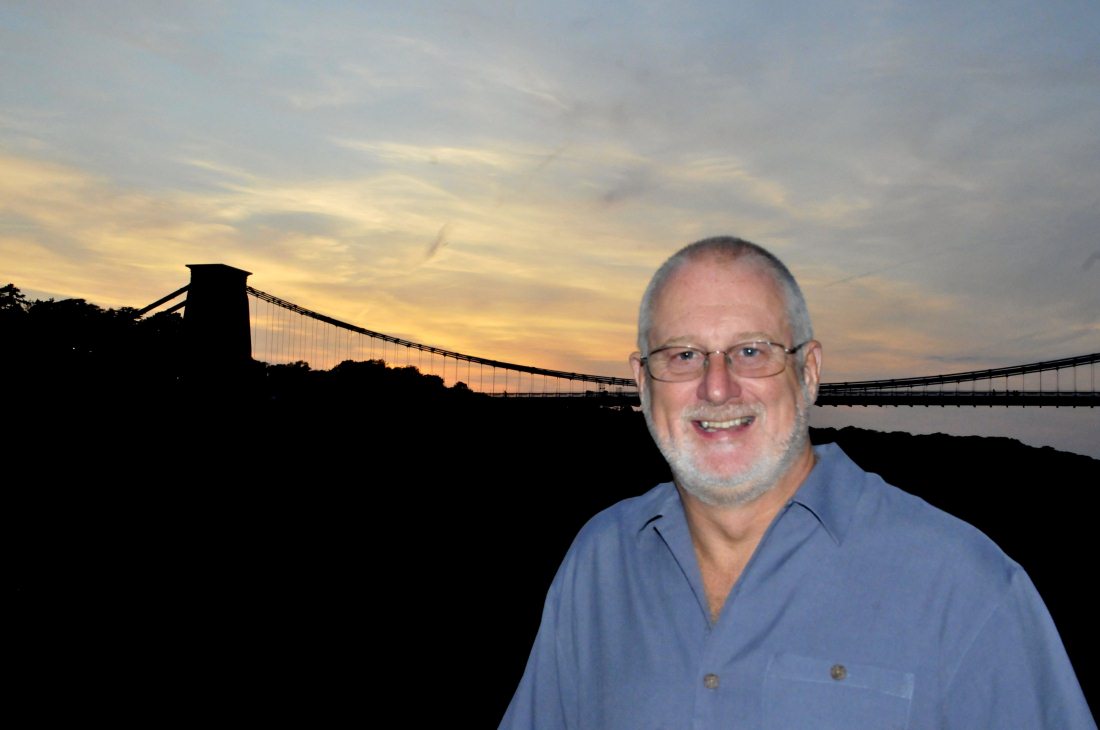 I like this picture of Bear so much
here it is again - showing the sunset over the
bridge
The Clifton Suspension Bridge is a suspension
bridge spanning the Avon Gorge linking Clifton in
Bristol to Leigh
Woods in North
Somerset. Designed by Isambard Kingdom
Brunel, it is a
landmark that is used as a symbol of Bristol. It is a grade I
listed
building.
History The idea of building a bridge across the Avon Gorge originated in 1753, with a bequest in the will of Bristolian merchant William Vick, who left £1,000 invested with instructions that when the interest had accumulated to £10,000, it should be used for the purpose of building a stone bridge between Clifton Down - then in Gloucestershire until the 1830's) and Leigh Woods (then in Somerset)). By 1829, Vick's bequest had reached £8,000, but it was estimated that a stone bridge would cost over ten times that amount. An Act of Parliament was passed to allow a wrought iron suspension bridge to be built instead, and tolls levied to recoup the cost. A competition was held to find a design for the bridge; the judge, Thomas Telford, rejected all designs, and tried to insist on a design of his own - a suspension bridge supported on tall Gothic towers. Telford claimed that no suspension bridge could exceed the six hundred feet span of his own Menai Suspension Bridge. A second competition, held with new judges, was won by Brunel's design on the 16th of March 1831, for a suspension bridge with fashionably Egyptian-influenced towers.
The bridge at dusk
An attempt to build Brunel's design in 1831 was stopped by the Bristol Riots, which severely dented commercial confidence in Bristol. Work was not started again until 1836, and thereafter the capital from Vick's bequest and subsequent investment proved woefully inadequate. By 1843, the towers had been built in unfinished stone, but funds were exhausted. In 1851, the ironwork was sold and used to build the Brunel-designed Royal Albert Bridge on the railway between Plymouth and Saltash. Brunel
died in 1859, without seeing the completion of the bridge. Brunel's colleagues
in the Institution of Civil Engineers
felt that completion of the Bridge would be a fitting memorial, and started to
raise new funds. In 1860, Brunel's Hungerford suspension bridge,
over the Thames
in London, was demolished to make way for a new railway bridge to Charing Cross
railway station,
and its chains were purchased for use at Clifton. A slightly revised design was
made by William Henry Barlow
and Sir John Hawkshaw;
it has a wider, higher and sturdier deck than Brunel intended, triple chains
instead of double, and the towers were left as rough stone rather than being
finished in Egyptian style. Work on the bridge was restarted in 1862, and was
complete by 1864. The
bridge is now managed by a trust set up by Act of Parliament in 1952. A
Toll
of 50p is levied on vehicles but the 5p toll that applies to
cyclists
or pedestrians
is no longer collected. In
2003 the weight of crowds travelling to and from the Ashton Court
Festival
and Bristol International Balloon Fiest
put such great strain on the bridge that it was decided to close the bridge to
all traffic, including pedestrians, during the whole of the Ashton Court
Festival and part of the Balloon Fiesta in 2004. This has continued since
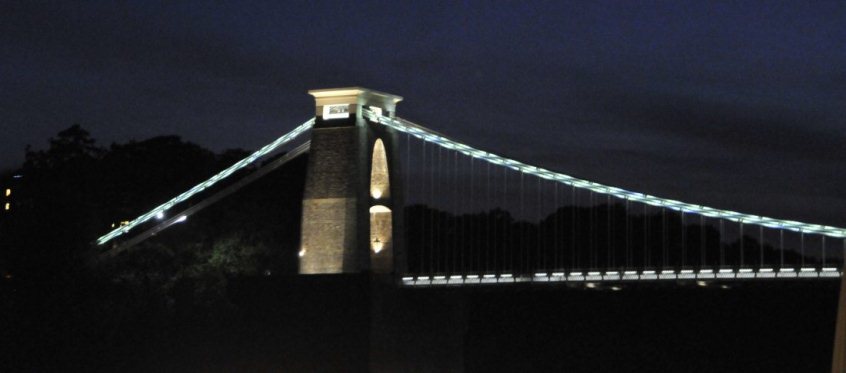
then. On the 26th of November 2003, the last ever Concorde flight (Concorde 216) flew over the bridge before landing at Filton Airfield. It was a symbolic moment which commemorated Bristol's feats in engineering. In April 2006 the bridge was the centrepiece of the Brunel 200 weekend, celebrating the 200th anniversary of the birth of Isambard Kingdom Brunel. At the climax of the celebration a firework display was launched from the bridge. The celebrations also saw the switch on of an LED-based lighting array to illuminate the bridge On the 4th of April 2009 the bridge was shut overnight due to a crack in one of the support hangers. Engineering
Supporting tower
Although
similar in size, the bridge towers are not identical in design, the Clifton
tower having side cut-outs, the Leigh tower more pointed arches. Brunel's
original plan proposed they be topped with then-fashionable sphinxes, but the
ornaments were never constructed. The
85 foot tall Leigh Woods tower stands atop a 110 foot red sandstone
clad abutment. In 2002 it was discovered that this was not a solid structure but
contained twelve vaulted chambers up to 35 feet high, linked by shafts and
tunnels. Roller
mounted "saddles" at the top of each tower allow movement of the
chains
when loads pass over the bridge. Though their total travel is minuscule, their
ability to absorb forces created by chain deflection prevents damage to both
tower and chain. The
bridge has three independent wrought iron
chains per side, from which the bridge deck is suspended by eighty-one matching
vertical wrought-iron rods ranging from 65 foot at the ends to 3 foot
in the centre. Composed of numerous parallel rows of eyebars
connected by bolts, the chains are anchored in tunnels in the rocks 60 feet
below ground level at the sides of the gorge. The deck was originally laid with
wooden planking, later covered with asphalt, which has been renewed in 2009.
The
weight of the bridge, including chains, rods, girders and deck is approximately
one thousand five hundred tons. Dimensions
 Suicides
and accidents Two
men were killed during the construction of the bridge. The
Clifton Suspension Bridge is well known as a suicide bridge
and is fitted with plaques that advertise the telephone number of The
Samaritans.
Between 1974 and 1993, 127 people fell to their deaths from the bridge. In 1998
barriers were installed on the bridge to prevent people jumping. In the 4 years
after installation this reduced the suicide rate from eight deaths per year
to four. Nicolette Powell, the wife of singer Georgie Fame,
formerly the Marchioness of Londonderry, committed suicide from the bridge on
the 13th of August 1993. In 1885, a twenty two year old woman named Sarah Ann Henley survived a fall from the bridge when her billowing skirts acted as a parachute, and subsequently lived into her eighties. Although flying under the bridge has been outlawed since 1911, in 1957 an RAF Vampire jet from 501 Squadron, Filton flew at high speed under the deck, before crashing in Leigh Woods, killing the pilot. The bridge is a distinctive landmark, used as a symbol of Bristol on postcards, promotional materials, and informational web sites such as Visit Bristol. The bridge has featured in scenes of the BBC1 hospital drama Casualty, which is filmed on location in Bristol. It was featured in the first episode, broadcast on the 6th September 1986, when Charlie Fairhead drove his yellow VW Beetle across the bridge on his journey to work. Construction of the bridge was featured in the Channel 4 television series The Worst Jobs in History, as part of an episode entitled The Worst Industrial Jobs in History, first broadcast on the 7th of May 2006. Presenter Tony Robinson climbs the chains over one of the towers during the sequence, tied off to a safety line, to demonstrate what the workers building the span endured. He particularly struggles with the swirling winds and states that during construction the wind blew the platform for the lines seventy feet in the air at one point, yet all the workers survived.
The bridge illuminated with LEDs
ALL IN ALL VERY
SPLENDID
STUNNING ESPECIALLY IN THE
DARK
|