Jost Van Dyke

|
Jost Van Dyke
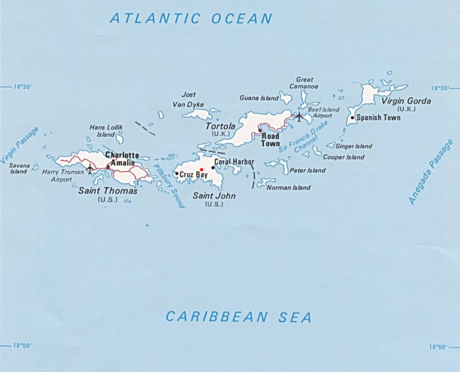
At roughly eight square kilometers, Jost Van Dyke is the smallest of the four main islands of the BVI's, the northern portion of the archipelago of the Virgin Islands. Jost Van Dyke lies about five miles to the northwest of Tortola and five miles to the north of Saint John. Little Jost Van Dyke lies off its eastern end. Like many of the neighboring islands, it is volcanic in origin and mountainous. The highest point on the island is Roach Hill at 1054 ft.
Great Harbour, the main town and one of the ports of entry (Road Town on Tortola is the main one)
History:
Despite
false information circulated throughout the internet that the island's name
comes from that of a 17th century Dutch privateer, Joost van Dyk, who used its
harbours as a hideout, there is no academic foundation to this rumour. The
island was home to one of the Territory's most famous sons, John C. Lettsome (of
Little Jost Van Dyke), founder of the British Medical
Society. Although the
English captured the BVI in 1672, it seems that Jost Van Dyke was ignored for
mostly until the mid-18th century. A map drawn of the BVI in 1717 by Captain
John Walton does not depict either Jost Van Dyke or Little Jost Van
Dyke. The remains
of a sugar works on the ridge above Great Harbour provide archaeological
evidence that some sugar cane was under cultivation and processed, though
probably not in any great quantity. In 1815,
cotton was cultivated on 140 acres, producing 21,000 pounds annually. There was
a population of 428 (25 whites, 32 free persons of colour and 371 slaves). By
1825, cotton production decreased to 17,000 pounds, while the population
increased to 506 (34 whites, 76 free persons of colour and 397
slaves). Similar to
other islands in the region, JVD and the BVI saw gradual and irreversible
economic decline throughout the 18th century, curiously though, the population
of Jost Van Dyke continued to increase (probably due to the freedom of travel
enjoyed by the former slave population after Emancipation in the BVI in 1838).
Thereafter, many BVI islanders regularly sought work at the Royal Mail Steam
Packet Company's coaling wharves in St. Thomas, (today the USVI's). By 1853 the
population was 1,235 residents on Jost Van Dyke, 196 died of a cholera outbreak
in that same year. From the Emancipation Era forward, the community of Jost Van Dyke subsisted mainly on small scale fishing and subsistence agriculture. Charcoal making was a practice that began during the plantation era, when strong fires were vital for sugar and rum production. Between the 1920's and 1960's, an estimated 20,000 tons of charcoal were exported from the BVI to the USVI's. The locals would gather to build the charcoal pits, when the fire was set the women would bake bread while the men played dominos.
Maritime resources were also extremely important historically to the people of Jost Van Dyke, and the island has emerged as a fishing village. The desire for trade and social interaction with nearby islands stimulated the development of seafaring skills. Sailing, fishing, rowing and boat construction flourished. Small, locally constructed sailing vessels the "Tortola Boat" flourished in the BVI until about the 1960's when they were replaced with motorized craft.
A few hundred people live on Jost Van Dyke. (In 1991 - 140; however, the population increased in the late 1990's with the advent of electricity and paved roads.) As of 2008, the population recorded was 297 (though many residents argue that the government-derived population figure is too high and believe that citizens who actually live in St. Thomas may be included in that census). The island has a young population with nearly one-half (46%) of residents under the age of 35 and almost 70% under the age of 50. Jost Van Dyke receives numerous visitors. The island is accessible by private boats and ferry service from Tortola and Saint Thomas (via Saint John). The most frequent destination is Great Harbour. The beach strip around the harbour is lined with small bars and restaurants.
  Foxy's clothing and gift shop to the left, bar and
restaurant to the right
  Bear waiting for our Painkillers. A permanent reminder of
Foxy.
Since the late 1960's, Foxy's Bar in Great Harbor has been a popular stop for Caribbean boaters. Foxy's and the other bars in Great Harbour now host a modest crowd year-round and are filled with thousands of partiers on New Year's Eve (locally known as "Old Year's Night"). Foxy's
saying: I'd rather be in a boat with a fox and a drink on the rocks than in the
drink with a fox and boat on the rocks. Great Harbour is one of the busiest ports in the BVI: in 2008, nearly 7,000 boats cleared through the island's port. Today, tourism, and particularly yachting tourism is the mainstay of the economy. We spoke to one of the Customs ladies who told us 2009 numbers were severely down on 2008, most of the visitors are Americans and their economy hit them very hard. Later in 2009 and so far in 2010 numbers have picked up.
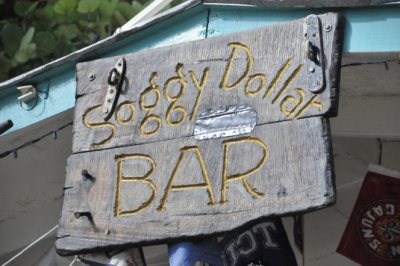
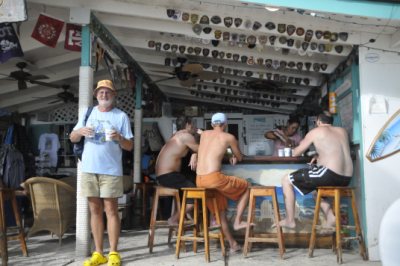
Located in nearby White Bay is the Soggy Dollar Bar, another famous beach bar on the island. The Soggy Dollar is reputedly the birthplace of the popular drink known as the Painkiller. The Soggy Dollar bar is appropriately named because of the difficulty of navigating one's boat over the coral reef to reach the beach where the bar is located. It is a common practice for boaters to anchor beyond the reef, swim to the beach, and pay for their drinks with wet money. When we were here in 2003 we paid with wet dollars when we made a rough beach landing in the charter dinghy. Soggy Dollar saying: A sunny place for shady people. www.soggydollar.com
The country music video for Kenny Chesney's 2002 recording, No Shoes, No Shirt, No Problems (song), was filmed on and around Jost Van Dyke. Included in the video were several scenes at One Love Bar and Ivan's Stress-Free Bar where it is common practice for patrons to walk behind the bar, mix their own drinks, and leave their payment in the register. Chesney also references Jost Van Dyke in his song, Somewhere in The Sun, from his album Be as You Are (Songs from an Old Blue Chair). |