Chinatown

|
Chinatown, Manhattan
Manhattan's Chinatown is home to the largest enclave of Chinese people in the Western hemisphere, it is located in the borough of Manhattan and is one of the oldest ethnic Chinese enclaves outside of Asia. The borders of Chinatown are: Grand Street to the North (bordering Little Italy), Allen Street to the East (bordering the Lower East Side), Worth Street to the South and Lafayette Street to the West. In 2010, Chinatown and Little Italy were listed in a single historic district on the National Register of Historic Places.
Ah Ken and Early Chinese Immigration: Although Quimbo Appo is claimed to have arrived in the area during the 1840’s, the first Chinese person credited as having permanently immigrated to Chinatown was Ah Ken, a Cantonese businessman, who eventually founded a successful cigar store on Park Row. He first arrived around 1858 in New York City, where he was "probably one of those Chinese mentioned in gossip of the sixties (1860’s) as peddling 'awful' cigars at three cents apiece from little stands along the City Hall park fence – offering a paper spill and a tiny oil lamp as a lighter", according to author Alvin Harlow in Old Bowery Days: The Chronicles of a Famous Street (1931). Later immigrants would similarly find work as "cigar men" or carrying billboards and Ah Ken's particular success encouraged cigar makers William Longford, John Occoo and John Ava to also ply their trade in Chinatown eventually forming a monopoly on the cigar trade. It has been speculated that it may have been Ah Ken who kept a small boarding house on lower Mott Street and rented out bunks to the first Chinese immigrants to arrive in Chinatown. It was with the profits he earned as a landlord, earning an average of $100 a month, that he was able to open his Park Row smoke shop around which modern-day Chinatown would grow.
Pell Street
Chinese exclusion period: Faced with increasing discrimination and new laws which prevented participation in many occupations on the West Coast, some Chinese immigrants moved to the East Coast cities in search of employment. Early businesses in these cities included hand laundries and restaurants. Chinatown started on Mott Street, Park, Pell and Doyers streets, east of the notorious Five Points district. By 1870, there was a Chinese population of 200. By the time the Chinese Exclusion Act of 1882 was passed, the population was up to 2,000 residents. By 1900, there were 7,000 Chinese residents, but fewer than 200 Chinese women. The men came over first, got settled and employed, then saved to pay for the passage of their wives, or not in some cases.
Doyers Street depicted on an 1898 postcard
The early days of Chinatown were dominated by Chinese "tongs" (now sometimes neutrally called "associations"), which were a mixture of clans, landsman's associations, political alliances (Kuomintang (Nationalists) vs Communist Party of China) and (more secretly) crime syndicates. The associations started to give protection from harassment due to anti-Chinese sentiment. Each of these associations was aligned with a street gang. The associations were a source of assistance to new immigrants – giving out loans, aiding in starting business, and so on. The associations formed a governing body named the Chinese Consolidated Benevolent Association. Though this body was meant to foster relations between the Tongs, open warfare periodically flared between the On Leong and Hip Singtongs. Much of the Chinese gang warfare took place on Doyers street. Gangs were prevalent until the 1990’s and controlled certain territories of Chinatown. The On Leong and its affiliate Ghost Shadows were of Cantonese and Toishan descent controlled Mott, Bayard, Canal, and Mulberry Streets. The Flying Dragons and its affiliation Hip Sing also of Cantonese and Toishan descent controlled Doyers, Pell, Bowery, Grand and Hester Streets. Other Chinese gangs also existed like the Hung Ching and Chih Kung gangs being of Cantonese and Toishan descent, which were affiliated with each other also had control of Mott Street. Born-to-Kill or known as Canal Boys being of Vietnamese and Chinese descent had control over Broadway, Canal, Baxter Center, and Lafeyette Streets. Fujianese gangs also existed such as the Tung On gang, which affiliated with Tsung Tsin had control over East Broadway, Catherine and Division Streets and the Fuk Ching gang affiliated with Fukien American controlled East Broadway, Chrystie, Forsyth, Eldridge and Allen Streets. At one point, a gang named the Freemasons gang, which were Cantonese descent had attempted to claim East Broadway as their territory.
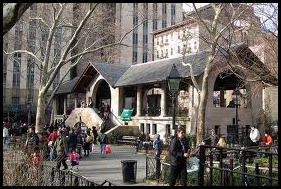
The only park in Chinatown, Columbus Park, was built on what was once the centre of the infamous Five Points neighborhood of New York. During the 19th century, this was the most dangerous slum area of immigrant New York (as portrayed in the book and film Gangs of New York). My favourite quote in a gang movie has to be from The Wanderers, “Don’t F - - k with the Wongs”.
Post-immigration reform: In the years after the U.S. enacted the Immigration and Nationality Act of 1965, allowing many more immigrants from Asia into the country, the population of Chinatown exploded. Geographically, much of the growth was to neighborhoods to the north. In the 1990’s, Chinese people began to move into some parts of the western Lower East Side, which fifty years earlier was populated by Eastern European Jews and twenty years earlier was occupied by Hispanics. Chinatown was adversely affected by 9/11. Being so physically close to Ground Zero, tourism and business had been very slow to return to the area for several years but appears to have rebounded more recently. Another reason was the New York City Police Department closing Park Row – one of two major roads linking the Financial Centre with Chinatown. By 2007 luxury condominiums began to spread from Soho into Chinatown. Previously Chinatown was noted for its crowded tenements and primarily Chinese residents. While some projects have targeted the Chinese community, the development of luxury housing has increased Chinatown's economic and cultural diversity. Currently, the rising prices of Manhattan real estate and high rents are also affecting Chinatown. Many new and poorer Chinese immigrants cannot afford their rents; as a result, growth has slowed, and a process of relocation to the Flushing Chinatown and Brooklyn Chinatown has started. Many apartments, particularly in the Lower East Side and Little Italy, which used to be affordable to new Chinese immigrants, are being renovated and then sold or rented at much higher prices. By 2009 many newer Chinese immigrants settled along East Broadway instead of the historic core west of the Bowery. In addition Mandarin began to eclipse Cantonese as the predominant Chinese dialect in New York's Chinatown during the period. The New York Times says that the Flushing Chinatown now rivals Manhattan's Chinatown in terms of being a cultural centre for Chinese-speaking New Yorkers' politics and trade.
Economy: Chinese green-grocers and fishmongers are clustered around Mott Street, Mulberry Street, Canal Street and all along East Broadway. The Chinese jewelry shop district is on Canal Street between Mott and Bowery. Due to the high savings rate among Chinese, there are many Asian and American banks in the neighbourhood. Canal Street, west of Broadway (especially on the North side), is filled with street vendors selling imitation perfumes, watches and hand-bags. This section of Canal Street was previously the home of warehouse stores selling surplus/salvage electronics and hardware. In addition, tourism and restaurants are major industries. The district boasts many historical and cultural attractions so it is a destination for tour companies like Big Onion and NYC Chinatown Tours. The neighborhood is home to a number of large Chinese supermarkets. In August 2011, a new branch of New York Supermarket opened on Mott Street in the centre district of grocery and food shopping of Manhattan's Chinatown, just a block away is a Hong Kong Supermarket on the corner of Elizabeth and Hester Streets. These two supermarkets are amongst the largest Chinese supermarkets carrying all different food varieties. A Hong Kong Supermarket at East Broadway and Pike Street burned down in 2009, and plans to construct a 91-room Marriott Hotel in its place resulted in community protests. The New York Supermarkets chain, which also operates markets in Elmhurst and Flushing, reached a settlement with the New York State Attorney General in 2008 in which it paid back wages and overtime to workers. Mmmm – no, best not comment.
Demographics: Unlike most other urban Chinatowns, Manhattan's Chinatown is both a residential area as well as commercial area. Many population estimates are in the range of 90,000 to 100,000 residents. Most Fuzhou immigrants were/are illegal immigrants while most of the Cantonese immigrants are legal immigrants in Manhattan's Chinatown. With the coming of illegal Fuzhou immigrants during the 1990’s, there is now a Fuzhou Community within the eastern portion of Manhattan's Chinatown which started on the East Broadway portion during the early 1990’s and later emerged north onto the Eldridge Street portion of Manhattan's Chinatown by the late 1990’s and early 2000’s. The eastern portion of Chinatown became more fully developed when the Fuzhou immigrants began to arrive whereas before it was moderately Chinese populated and it is referred to as the New Chinatown of Manhattan. Now the increasing Fuzhou influx has shifted into the Brooklyn Chinatown in the Sunset Park section of Brooklyn and is replacing the Cantonese population there more significantly than in Manhattan's Chinatown. Brooklyn's Chinatown is quickly becoming the new Little Fuzhou in NYC or Brooklyn's East Broadway. During the late 1980’s and 1990’s, most of the new Fuzhou immigrants arriving into New York City were settling in Manhattan's Chinatown and later formed the first Fuzhou community in the city amongst the waves of Cantonese who had settled in Chinatown over decades; but by the 2000’s, the Fuzhou population growth had slowed within Manhattan's Chinatown and began to accelerate in Brooklyn's Chinatown instead. Although Mandarin is spoken as a native language among only ten percent of Chinese speakers in Manhattan's Chinatown, it is used as a secondary dialect among the greatest number of them and is on its way to replacing Cantonese as their lingua franca. Although Min Chinese, especially the Fuzhou dialect, is spoken natively by a third of the Chinese population in the city, it is not used as a lingua franca because speakers of other dialect groups do not learn Min.
Housing: The housing stock of Chinatown is still mostly composed of cramped tenement buildings, some of which are over 100 years old. It is still common in such buildings to have bathrooms in the hallways, to be shared among multiple apartments. A federally subsidized housing project, named Confucius Plaza, was completed on the corner of Bowery and Division streets in 1976. This 44-story residential tower block gave much needed new housing stock to thousands of residents. The building also housed a new public grade school, P.S. 124 (or Yung Wing Elementary). Besides being the first and largest affordable housing complex specifically available to the Chinatown population Confucius Plaza is also a cultural and institutional landmark, springing forth community organization, Asian Americans for Equality (AAFE), one of Chinatown's oldest political/community organizations, founded in 1974.
Landmarks: For much of Chinatown's history, there were few unique architectural features to announce to visitors that they had arrived in the neighbourhood (other than the language of the shop signs). In 1962, at Chatham Square the Lieutenant Benjamin Ralph Kimlau Memorial archway was erected in memorial of the Chinese-Americans who died in World War II. This memorial, which bears calligraphy by the great Yu Youren (1879 - 1964), is mostly ignored by the residents due to its poor location on a busy car thoroughfare with little pedestrian traffic. A statue of Lin Zexu, also known as Commissioner Lin, a Foochowese Chinese official who opposed the opium trade, is also located at the square; it faces uptown along East Broadway, now home to the bustling Fuzhou neighborhood and known locally as Fuzhou Street. In the 1970’s, New York Telephone, then the local phone company started capping the street phone booths with pagoda-like decorations. In 1976, the statue of Confucius in front of Confucius Plaza became a common meeting place. In the 1980’s, banks which opened new branches and others which were renovating started to use Chinese traditional styles for their building facades. The Church of the Transfiguration (below), a national historic site built in 1815, stands off Mott Street.
Arts and culture: The first Chinese-language theatre in the city was located at 5 – 7 Doyers Street from 1893 to 1911. The theater was later converted into a rescue mission for homeless from the Bowery. In 1903, the theatre was the site of a fundraiser by the Chinese community for Jewish victims of a massacre in Kishinev. During the 1970’s, the Chinese theatres became less attractive due to increasing gang-violence. These theaters now have all gone out of business and closed due to DVD’s being so affordable and the availability of Chinese cable channels, karaoke bars, gambling in casinos providing other options for the once theatre patrons.
Education: Residents are zoned to schools in the New York City Department of Education. PS 124, The Yung Wing School is located in Chinatown. It was named after Yung Wing, the first Chinese person to study at Yale University. Public School 130 Hernando De Soto is located in Chinatown. PS 184M Shuang Wen School, a bilingual Chinese-English School which opened in 1998, is a non-zoned school in proximity to Chinatown.
ALL IN ALL A MASS OF VIBRANT COLOUR |