Sal

|
Sal
The book said “Flat, dry, barren, brown, bare - fortunately for Sal, the fantastic beach at the end of the road in Santa Maria makes up for visitor's first impression as they travel south along the road from the Airport“. Not for us. We thought we had landed on the moon. The road from the airport was a straight duel-carriageway, either side was barren and the left side, for most of the journey, was a rubbish tip.
Our first views from the road just past the airport.
Miles of unfinished projects. "Pedro de Lume is the must-see tourist attraction on Sal (besides the beaches). The starkness of the place confronts the visitor upon approaching the first buildings - the lonely Church, bare earth and the disintegrating 19th and early 20th century wooden buildings and machinery could be straight from a Sergio Leone film set. A dirt-track (parallel to the abandoned cable car) leads up to a tunnel, which was cut through the crater wall to allow access to the crater itself. Sea-water has filtered into the ancient volcanic crater, creating a natural salt pan. Originally, bags of salt were strapped onto pack-animals which would be led up and over the crater walls until the tunnel was built in 1804. The Cable system, built in 1919, increased production considerably and the salt works remained an important part of the local economy until the mid-twentieth century. Nowadays, visitors can float Dead Sea-style in the highly saline water and enjoy a mineral rich mud bath" (again taken from a book). So enticed was I that I didn't insist on the trip at 50 Euros each !!!!!!!! Having done the "float thing" in the Dead Sea, we sat and read a good book instead by the hotel pool.
Water collection point for the
locals. Bear outside yet another part-build.
A hotel with residents on the first floor, the second
floor 'under construction'.
Santa Maria beach, the only time I went to it was to take this photo, broken glass, rocks, stones, building work and dogs barking kept us round the hotel pool. The roundabout showing the semi built Murdeira, supposedly will have two golf courses, a marina, 79 apartments and a few hotels, when it is finished, they say in about 4 years...........................watch this space. Santa Maria. Our hotel The Sab Sab (used to be called the Albatross before being re-decorated?????). Santa Maria is, by far, the biggest and most popular tourist resort in the Cape Verde Islands. The resort attracts a predominantly Italian clientèle, although this is starting to change as more direct flights become available from elsewhere in Europe. The resort is located 18 km south of the Airport on the island's southern coast. The beautiful???? (I didn’t think so) 8 km long white sand beach (another colour blind individual) is the main attraction here with it's warm clear waters. A variety of marine excursions and organised water sports are available here. At the back of our hotel was a dive shop, wind surfing school and beach bar.   
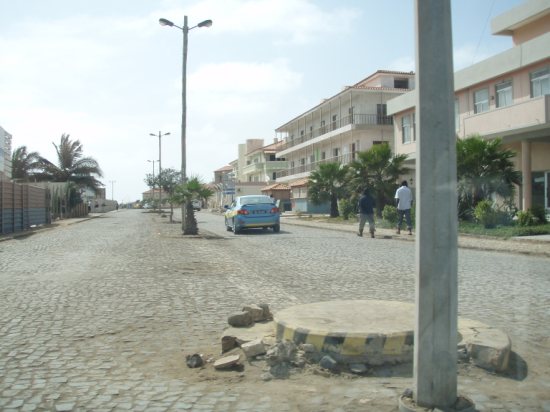
High Street, Santa Maria and a view at the crossroads. Health and safety. There is none. There is
no provision for the disabled tourist that we
found.
Building work, haphazard and in a variety of stages of 'finish'. Espargos There is not much reason to visit Sal's capital, except, perhaps, because it is not a tourist resort. There are a few restaurants, African craft shops and places to stay, but this modest town is not really geared towards the tourist or tourism. Espargos came into existence when the Italians began work on Sal's Airport in 1939, initially as basic accommodation for the construction workers. Nowadays it has a population of somewhere between 6000 - 8000 inhabitants. The name comes from the wild asparagus bushes that are said to have grown here.
Espargos from the road, feeding a sparrow in domestic departures and a queue waiting for the direct flight to Birmingham. (Also Gatwick). In 1939 the Italians, under Mussolini, began the construction of the airport on Sal, having purchased the rights to build the facility from the Portuguese. Sal's location made it an ideal refueling station for flights between Southern Europe and South America. The Portuguese bought the rights back from the Italians after the second world war. Until recently South African Airways used the airport for stopovers and refueling, especially during the Apartheid years, when they were banned from flying over many African countries. The accommodation needs of SAA's flight crews contributed in no small part to the development of tourism on Sal.
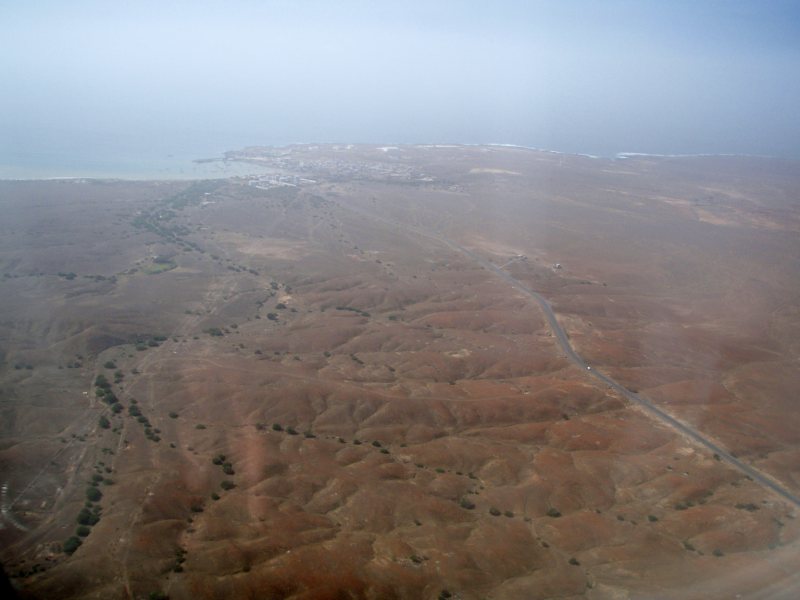
Our leaving view of Sal from the air, the town of Palmeira in the distance. Says it all.
All in all, Sal had been built up to be "better" than Boa Vista, we feel a BIG FAT NO. Boa Vista was beautiful, quaint with friendlier people and with more of a "vision" regarding tourism. I'm pleased we went to Sal and had New Year at the Sab Sab, will I return? Out of interest we would like to see it in ten years or so, to see what has changed???? If the airport opened so long ago methinks not too much. I think it is a haphazard building site with no soul and a dual-carriageway. |