Empire State Building

|
Empire State Building
We jumped up - well some of us started a little slower this morning - as sprightly as a dodgy knee will allow. I had the choice today of tourist attractions and settled for the Empire State Building or ESB; the 102-story landmark in New York City, at the intersection of Fifth Avenue and West 34th Street. Its name is derived from the nickname for New York, the Empire State. It stood as the world's tallest building for more than forty years, from its completion in 1931 until construction of the World Trade Centre's North Tower was completed in 1972. Following the destruction of the World Trade Centre in 2001, the Empire State Building once again became the tallest building in New York City.
Architecture: The Empire State Building rises to 1,250 ft at the 102nd floor, and including the pinnacle, its full height reaches 1,453 feet–8 9/16th inches. The building has 85 stories of commercial and office space representing 2,158,000 sq feet. It has an indoor and outdoor observation deck on the 86th floor. The remaining 16 stories represent the Art Deco tower, which is capped by a 102nd-floor observatory. Atop the tower is the 203 feet pinnacle, much of which is covered by broadcast antennas, with a lightning rod at the very top. The Empire State Building was the first building to have more than 100 floors. It has 73 elevators and there are 1,860 steps from street level to the 102nd floor. It has a total floor area of 2,768,591 square feet. The base of the Empire State Building is about 2 acres. The building houses 1,000 businesses, and has its own zip code, 10118. As of 2007, approximately 21,000 employees work in the building each day, making the Empire State Building the second-largest single office complex in America, after the Pentagon. The building was completed in one year and 45 days. Its original 64 elevators are located in a central core; today, the Empire State Building has 73 elevators in all, including service elevators. It takes less than one minute by elevator to get to the 86th floor, where an observation deck is located. The building has 70 miles of pipe, 2,500,000 feet of electrical wire and about 9,000 taps. It is heated by low-pressure steam; despite its height, the building only requires between 2 and 3 psi of steam pressure for heating. It weighs approximately 370,000 short tons. The exterior of the building was built using Indiana limestone panels. Unlike most of today's skyscrapers, the Empire State Building features an art deco design, typical of pre–World War II architecture in New York. The modernistic stainless steel canopies of the entrances on 33rd and 34th Streets lead to two story-high corridors around the elevator core, crossed by stainless steel and glass-enclosed bridges at the second-floor level. The elevator core contains 67 elevators.
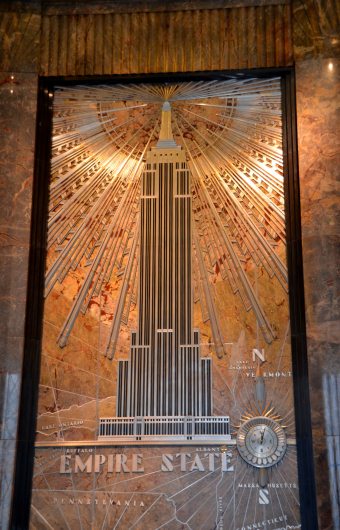
The lobby: An Art Deco masterpiece is three stories high and features an aluminum relief of the skyscraper without the antenna, which was not added to the spire until 1952. The north corridor contains eight illuminated panels, created by Roy Sparkia and Renée Nemorov in 1963, depicting the building as the Eighth Wonder of the World, alongside the traditional seven. The lobby was recently restored to the architects' original vision. On entering the Fifth Avenue entrance, there is a brilliant ceiling mural of the celestial sky in 23-carat gold and aluminium leaf. The lobby incorporates rare varieties of marble from Belgium, France, Germany and Italy.
Opening: The building's opening coincided with the Great Depression in the United States, and as a result much of its office space went without being rented. The building's vacancy was exacerbated by its poor location on 34th Street, which placed it relatively far from public transportation, as Grand Central Terminal, the Port Authority Bus Terminal, and Penn Station are all several blocks away. Other more successful skyscrapers, such as the Chrysler Building, did not have this problem. In its first year of operation, the observation deck took in approximately 2 million dollars, as much money as its owners made in rent that year. The lack of renters led New Yorkers to deride the building as the "Empty State Building". The building would not become profitable until 1950. The famous 1951 sale of The Empire State Building to Roger L. Stevens and his business partners was brokered by the prominent upper Manhattan real-estate firm Charles F. Noyes & Company for a record $51 million. At the time, that was the highest price ever paid for a single structure in real-estate history. The Empire State Building cost $40,948,900 to build.
Dirigible (airship) terminal: The building's distinctive Art Deco spire was originally designed to be a mooring mast and depot for dirigibles. The 102nd floor was originally a landing platform with a dirigible gangplank. A particular elevator, traveling between the 86th and 102nd floors, was supposed to transport passengers after they checked in at the observation deck on the 86th floor. However, the idea proved to be impractical and dangerous after a few attempts with airships, due to the powerful updrafts caused by the size of the building itself, as well as the lack of mooring lines tying the other end of the craft to the ground. Only one blimp was successful (and only for three minutes). A large broadcast tower was added to the top of the spire in 1953.
The view we had toward the Hudson River
from the 102nd floor
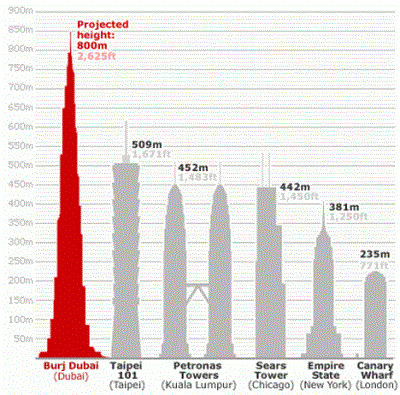
Height records and comparisons: The Empire State Building remained the tallest man-made structure in the world for 23 years before it was surpassed by the Griffin Television Tower Oklahoma (KWTV Mast) in 1954. It was also the tallest free-standing structure in the world for 36 years before it was surpassed by the Ostankino Tower in 1967. The longest world record held by the Empire State Building was for the tallest skyscraper (to structural height), which it held for 42 years until it was surpassed by the North Tower of the World Trade Center in 1973. An early 1970's proposal to dismantle the spire and replace it with an additional 11 floors, which would have brought the building's height to 1,494 feet and made it once again the world's tallest at the time, was considered but ultimately rejected. With the destruction of the World Trade Center in the nine eleven attacks in 2001, the Empire State Building again became the tallest building in New York City, and the second-tallest building in the Americas, surpassed only by the Willis Tower in Chicago. It is currently the third-tallest, surpassed by the Willis Tower and the Trump International Hotel and Tower (Chicago). When measured by pinnacle height, the Empire State Building is also the third-tallest building in the Americas, surpassed by the Willis Tower and the John Hancock Centre. Burj Khalifa also known as Burj Dubai, is a supertall skyscraper in Dubai, United Arab Emirates, and is the tallest man-made structure ever built, at 2,717 feet. Construction began on the 21st of September 2004, with the exterior of the structure completed on the 1st of October 2009 - the building officially opened on the 4th of January 2010.
Height comparison of buildings in New York City (under construction and existing) and the world
Suicides: Over the years, more than thirty people have committed suicide from the top of the building. The first suicide occurred even before its completion, by a worker who had been laid off. The fence around the observatory terrace was put up in 1947 after five people tried to jump during a three-week span. On the 1st of May 1947, 23-year-old Evelyn McHale leapt to her death from the 86th floor observation deck and landed on a United Nations limousine parked at the curb. Photography student Robert Wiles took a photo of McHale's oddly intact corpse a few minutes after her death. The police found a suicide note among possessions she left on the observation deck: "He is much better off without me ... I wouldn’t make a good wife for anybody". The photo ran in the 12th of May 1947 edition of LIFE Magazine and is often referred to as "The Most Beautiful Suicide". It was later used by visual artist Andy Warhol in one of his paintings entitled Suicide (Fallen Body). On December 2, 1979, Elvita Adams jumped from the 86th floor, only to be blown back onto the 85th floor and left with a broken hip. On the 24th of February 1997, a Palestinian gunman shot seven people on the observation deck, killing one, then fatally wounding himself. No penny thrown from the top of the Empire State Building has ever killed anyone walking below; The building has an updraft, so a coin dropped from the observation deck would either be substantially slowed or blown by wind gusts back up against the structure, where it would most likely land on the 81st floor balcony.
Observation decks: The Empire State Building has one of the most popular outdoor observatories in the world, having been visited by over 110 million people. The 86th-floor observation deck offers impressive 360-degree views of the city. There is a second observation deck on the 102nd floor that is open to the public. It was closed in 1999, but reopened in November 2005. It is completely enclosed and much smaller than the first one; it may be closed on high-traffic days. Tourists may pay to visit the observation deck on the 86th floor and an additional amount for the 102nd floor. The lines to enter the observation decks, according to the building's website, are "as legendary as the building itself:" there are five of them: the sidewalk line, the lobby elevator line, the ticket purchase line, the second elevator line, and the line to get off the elevator and onto the observation deck. For an extra fee tourists can skip to the front of the line.
Communications devices for broadcast stations are located at the top of the Empire State Building.
Broadcast stations: Broadcasting began at Empire on the 22nd of December 1931, when RCA began transmitting experimental television broadcasts from a small antenna erected atop the spire. They leased the 85th floor and built a laboratory there, and—in 1934—RCA was joined by Edwin Howard Armstrong in a cooperative venture to test his FM system from the Empire antenna. Many changes occurred over the years until the World Trade Center was being constructed, it caused serious problems for the television stations, most of which then moved to the World Trade Center as soon as it was completed. This made it possible to renovate the antenna structure and the transmitter facilities for the benefit of the FM stations remaining there, which were soon joined by other FMs and UHF TVs moving in from elsewhere in the metropolitan area. The destruction of the World Trade Center necessitated a great deal of shuffling of antennas and transmitter rooms to accommodate the stations moving back uptown. The Empire State Building Run-Up: is a foot race from ground level to the 86th-floor observation deck
that has been held annually since 1978. Its participants are referred to both as
runners and as climbers, and are often tower
running enthusiasts. The race covers a vertical distance of 1,050 feet
and takes in 1,576 steps. The record time is 9 minutes and 33 seconds,
achieved by Australian professional cyclist Paul
Crake in 2003, at a climbing rate of 6,593 feet per hour. In popular culture: Perhaps the most famous popular culture representation of the building is in the 1933 film King Kong, in which the title character, a giant ape, climbs to the top to escape his captors but falls to his death after being attacked by airplanes. In 1983, for the 50th anniversary of the film, a huge 90 foot tall inflatable King Kong was placed on the building mast above the observation deck as a skyscraper sculpture by artist Robert Keith Vicino. In 2005, a remake of King Kong was released, set in 1930s New York City, including a final showdown between Kong and biplanes atop a greatly detailed Empire State Building. (The 1976 remake of King Kong was set in a contemporary New York City and held its climactic scene on the towers of the World Trade Center.) Also Love Affair in 1939, remade in 1957 as An Affair to Remember and again in 1994 as Love Affair. 1964 Andy Warhol’s silent film is one continuous, eight hour shot of the Empire State Building, shot in black-and-white. In 1993, Sleepless in Seattle. The film Independence Day features the Empire State Building as the focal point for the aliens' attack on New York City. The building is destroyed in an extraordinary explosion by the aliens' primary weapon, which proceeds to destroy the entire city. Other films include Knowing, When Worlds Collide, The Day After Tomorrow, Elf, Fail-Safe and many more. The deck was also the site of a Martian invasion in an old episode of I Love Lucy.
ALL IN ALL A SPECIAL PLACE TO BE ON MY
BIRTHDAY |