Saratoga Springs

|
Saratoga Springs, New York
 The Racing Museum for a bimble around Saratoga Springs, also known as simply Saratoga, in Saratoga County, New York State. The population was 26,186 at the 2000 census. The name reflects the presence of mineral springs in the area. While the word "Saratoga" is known to be a corruption of a Native American place name, authorities disagree on what the exact word was, and hence what it meant.
History: Fort Saratoga was built in 1691 on the west bank of the Hudson River about a mile south of the current village of Schuylerville, New York, which was settled shortly thereafter and was known as Saratoga until 1831. In 1767, Sir William Johnson, British soldier and a hero of the French and Indian Wars, was brought about ten miles west of the village, to what would become the city of Saratoga Springs - by Native American friends - to treat war wounds at a spring thought to have medicinal properties. The spring is now known as High Rock Spring. The first permanent settler at the springs arrived around 1776 and a tourist trade swiftly grew, with hotels being constructed starting with Gideon Putnam. Putnam laid out the roads and donated land for use as public spaces. Saratoga Springs was established as a town in 1819 from a western portion of the Town of Saratoga. Its principal community was incorporated as a village in 1826 and the entire region became a city in 1915. In the 19th century, the noted doctor Simon Baruch encouraged bringing European style spas to the US, and thus Saratoga Springs; with its wealth of mineral waters developed as a spa. Many hotels were built, including the Grand Union Hotel that was, in its day, the largest hotel in the world and the United States Hotel. In 1863, Saratoga Race Course opened and moved to its current location the following year, greatly expanding the city's reputation as a tourist destination. In addition the area became known for its gambling - after the first years of the 20th century was illegal - but still widespread. Most gambling facilities were located on Saratoga Lake, on the southeast side of the city. After the closing and demolition of many of the town's premier hotels, including the Grand Union and United States in the 1940’s and 1950’s, Saratoga Springs experienced a significant economic downturn. During the 1950s’, the famed gambling houses were also shut down, which hurt Saratoga Springs' popularity even more. The city's rebirth began in the 1960’s with the completion of the Adirondack Northway (Interstate 87), which allowed visitors from the New York City area much easier access. In addition, the construction of the Saratoga Performing Arts Center in the late 1960’s, which features classical and popular music and dance, furthered the city's renaissance.
The Battle of Saratoga: The turning point of the Revolutionary War, did not take place in Saratoga Springs. Rather, the battlefield is 15 miles to the southeast in the town of Stillwater. There is a museum dedicated to these two battles located on the fields where the battles were fought. The British encampment before the surrender at Saratoga took place 10 miles east of the city, in Schuylerville and there are several historical markers delineating points of interest. The surrender of the sword took place where Fort Saratoga had been, south of Schuylerville.
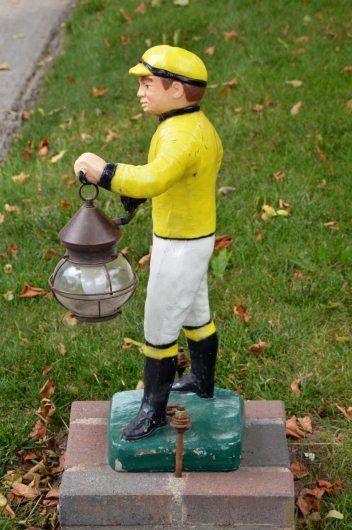
Many houses have statues and garden ornaments that have an equine or racing theme
Business: Though Saratoga Springs relies heavily on tourism as its main source of income, especially during the Summer months while Saratoga Race Course is open, there is plenty of industry that keeps this culture-rich city's economy booming. Saratoga Springs is home to Quad Graphics, offset printers of Time Magazine, Newsweek, People Magazine, Sports Illustrated and many others. Ball Corp., makers of the Mason Jar as well as aluminum cans for companies such as Pepsi and Anheuser-Busch InBev, has a large manufacturing plant in Saratoga County.
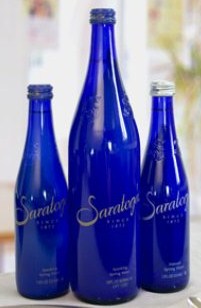
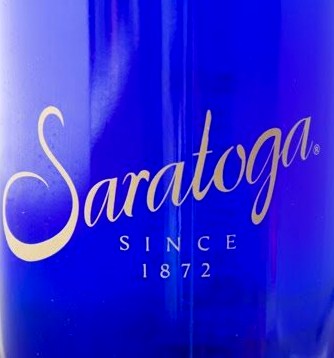
Perhaps the most recognised of all businesses is the Saratoga Spring Water Co. Since 1872 Americans have been enjoying this popular mineral water whose blue glass bottle is still its trademark.
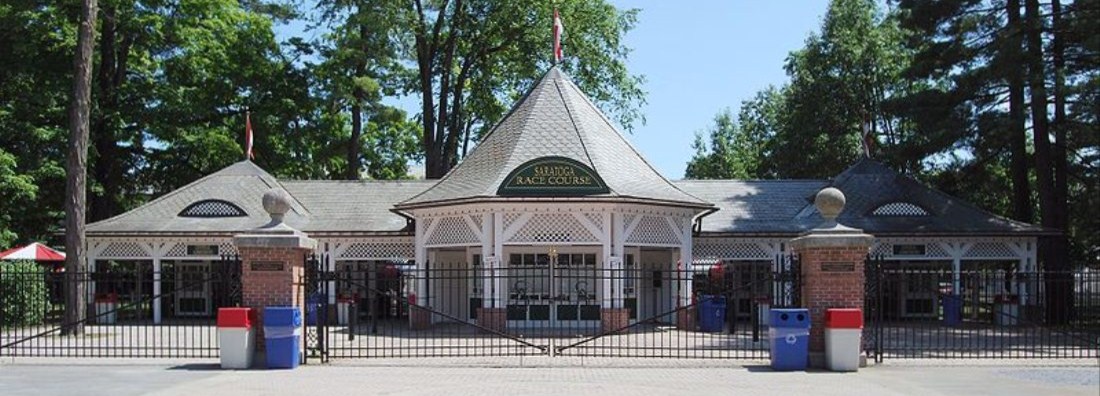
Horse Racing: The city is perhaps best known for the Saratoga Race Course which opened on the 3rd of August 1863. The first track was located across Union Avenue from the present Saratoga Race Course, which opened the following year. Founded by John Hunter and William R. Travers, the thoroughbred track is the oldest continuously-operating sporting event of any kind in the United States. The track holds a summer meet lasting six weeks, from late July to Labor Day, that attracts the top horses, jockeys, and trainers in America. The meet features a number of major stakes races, with the Travers Stakes, a Grade I race, being the most important of America's summer horseraces. Known as the "Summer Derby" . The track season sees a dramatic influx of people into the city. Hotels fill to capacity, and many Saratogians rent out their homes. The hot dog, pretzel and drink lady at the race track earns over a million dollars in the six month season.
The Springs: Before racing began in Saratoga, the area's natural mineral springs had been attracting summertime visitors for many decades. These springs were believed to have healing powers. The Lincoln Baths was one such place people would go to be treated with the waters. The bath house has since been transformed into an office building, but still exists and can still be visited. Spa treatments in the Spa State Park called the Roosevelt Baths are also popular. Most of the springs are covered by small pavilions and marked by plaques; others are less conspicuous, some just a spigot in a rock. The springs are famous for their varied and distinct tastes: some are clear freshwater, others are saltier and some taste strongly of minerals such as sodium bicarbonate or sodium chloride. There is a sulphur odour in some but mineral analysis of the water consistently shows almost no presence of dissolved sulphur, because it from the gas hydrogen sulphide, which degasses from the water very quickly. Visitors are welcome to bottle the spring water for personal consumption. The springs are called Big Red, Charlie, Columbian, Congress, Deer Pack, Empire, Geyser Island, Geyseer, Governor, Hathorn 1, Hathorn 3, Hayes Well, High Rock, Old Iron, Old Red, Orenda, Patterson, Polaris and State Seal.
Bear tries one of the many public springs, as a friend watches Arts and Entertainment: The Saratoga Performing Arts Center (known by its acronym "SPAC," rhymes with "snack") is a covered outdoor amphitheatre on the grounds of the Saratoga Spa State Park, with a capacity of 5,000 in reserved seating and 20,000+ on its general admission lawn area. SPAC is the summer home of the Philadelphia Orchestra and the New York City Ballet, and has hosted a weekend-long jazz festival for several decades. It is a stop for touring national recording artists: over 20 popular bands grace the stage every summer. There are several museums in the area, including the National Museum of Dance and Hall of Fame, and the National Museum of Racing and Hall of Fame (own blog). There are more than 20 golf courses. The city is also notable for its vibrant night life. Caffè Lena was one of the first venues in the Eastern US at which Bob Dylan performed in 1961. Arlo Guthrie played the Caffè early in his career and has returned for occasional benefit concerts. Singer Don McLean is said to have composed his "American Pie" sitting at a table in the Tin & Lint, a bar on Caroline Street. A plaque marks the table today. Numerous other establishments exist on Broadway, Caroline Street, and the redeveloped Putnam Street.
Two of 34 fibreglass horses - Equus Dreaming and Handi-cap (covered in bottle tops) on display around downtown Saratoga Springs
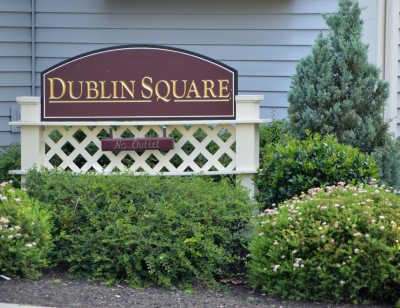
Recently: Beekman Street (four blocks west of Broadway), once the centre of a lower class residential neighborhood, has become an art district, housing four galleries, a restaurant, a pub / teahouse and a bistro. Artists live and work in co-ops and arrange social events. When new houses are built care is taken to have them 'fit in' with the traditional clapboard finish, we walked past Dublin Square. If people with older houses get fed up with the finish needing upkeep and replacement, the local Government will help out, even pay for the wood to be replaced as not to lose any of the areas history.
Everywhere we looked we saw all colours of tiger lilies, in gardens and wild. They are well loved and cared for; a natural 'weed'.
Yaddo: Saratoga Springs is also home to Yaddo, a 400-acre artists' community, founded by the great Wall Street financier, Spencer Trask and his wife, the author Katrina Trask. Since its inception in 1900, Yaddo has been home to 60 Pulitzer Prize winning authors and one Nobel Prize winner. Sylvia Plath, Truman Capote, and David Sedaris have all been artists-in-residence. The Yaddo grounds are adjacent to the backstretch of the Saratoga Race Course.
Films: Saratoga Springs has graced the silver screen since the days of Clark Gable and Edward G. Robinson in the film Saratoga in 1937. Others include - Lolita in 1962. The Way We Were in 1973. Paul's Case in 1980. Ghost Story in 1981. Billy Bathgate in 1991. Nobody's Fool in 1994. - The Horse Whisperer in 1998. The Time Machine in 2002. Seabiscuit in 2003. The Skeptic in 2009. A Dog Year in 2009 and Ass Backwards in 2011.
ALL IN ALL
A LOVELY MINI-BREAK FROM NEW YORK
|