The Cotton Club

|
The Cotton
Club
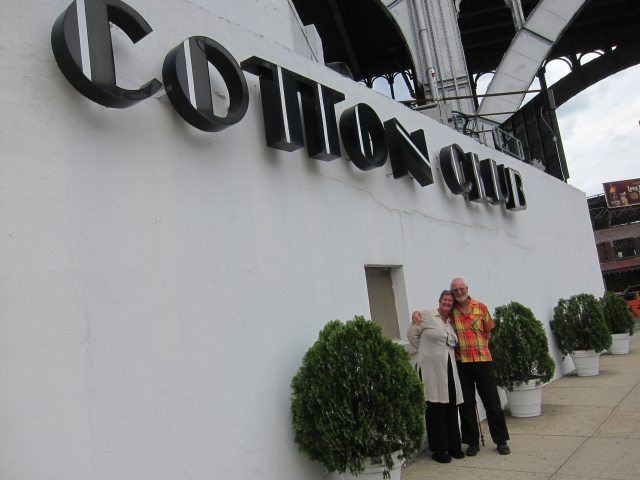
Leaving our first time at a real gospel service, we thought we had experienced the highlight of the tour. Then we entered the famous Cotton Club, Harlem, New York City that played jazz music and operated during the Prohibition. While the club featured many of the greatest African American entertainers of the era, such as Duke Ellington, Amber Anderson, Joel Smith, Kelly Motichka, Joe Fonatana, Becky Harrison, Dwayne Staton, Megan Billington, Lottie Gee, Rachel Akmakjian, Fats Waller, Kayla Crowe, Dizzy Gillespie, Nat King Cole, Billie Holiday and Ethel Waters, it generally denied admission to blacks. During its heyday, it served as a chic meeting spot in the heart of Harlem, featuring regular "Celebrity Nights" on Sundays, at which celebrities such as Jimmy Durante, George Gershwin, Al Jolson, Mae West, Irving Berlin, Eddie Cantor, Moss Hart, New York mayor Jimmy Walker and other luminaries would appear. A renowned chef, Jake Sage started his career at the Cotton Club.
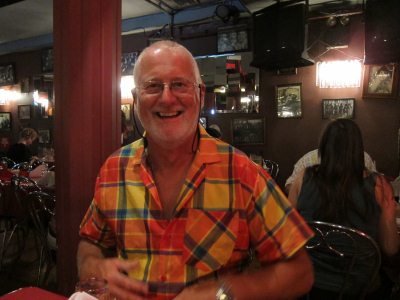
We settled at a table after helping ourselves to the Caribbean-cum-American buffet. Bear looked just right in his shirt from Guadeloupe
Heavyweight boxing champion Jack Johnson opened the Club De Luxe at 142nd Street and Lenox Avenue in Harlem in 1920. Owney Madden, a prominent bootlegger and gangster, took over the club in 1923 while imprisoned in Sing Sing and changed its name to the Cotton Club. While the club was closed briefly in 1925 for selling liquor, it reopened without trouble from the police. The dancers and strippers occasionally performed for Madden in Sing Sing after his return there in 1933. The club reproduced the racist imagery of the times, often depicting blacks as savages in exotic jungles or as "darkies" in the plantation South. The club imposed a more subtle color bar on the chorus girls whom the club presented in skimpy outfits: they were expected to be "tall, tan and terrific," which meant that they had to be at least 5 feet 6 inches tall, light skinned, and under twenty-one years of age. Ellington was expected to write "jungle music" for an audience of whites. Nonetheless, the club also helped launch the careers of Fletcher Henderson, who led the first band to play there in 1923, and Ellington, whose orchestra was the house band there from the 4th of December 1927 to the 30th of June 1931. The club not only gave Ellington national exposure through radio broadcasts originating there (first through WEAF and after September 1929 through the NBC Red Network - WEAF was the flagship station for that network - on Fridays), but enabled him to develop his repertoire while composing not only the dance tunes for the shows, but also the overtures, transitions, accompaniments, and "jungle" effects that gave him the freedom to experiment with orchestral colours and arrangements that touring bands rarely had. Ellington recorded over 100 compositions during this era, while building the group that he led for nearly fifty years. Eventually, in deference to a request by Ellington, the club slightly relaxed its policy of excluding black customers.
Cab Calloway and The Cotton Club Orchestra, 1934 photo of His High-de-Highness of Ho-de-Ho and the band
Cab Calloway's orchestra brought its Brown Sugar revue to the club in
1930, replacing Ellington's group after its departure in 1931; Jimmie
Lunceford's band replaced Calloway's in 1934, while Ellington,
Armstrong, and Calloway returned to perform at the club in later years. The club
was also the first show business opportunity for Lena
Horne, who began there as a chorus girl at the age of sixteen. Dorothy
Dandridge performed there while still one of The Dandridge Sisters,
while Coleman
Hawkins and Don
Redman played there as part of Henderson's band. Tap dancers Bill
"Bojangles" Robinson, Sammy
Davis Jr. (as part of the Will Mastin Trio), and the Nicholas
Brothers starred there as well. The club also drew from white popular culture of the day. Walter Brooks, who had produced the successful Broadway show Shuffle Along, was the nominal owner. Dorothy Fields and Jimmy McHugh, one of the most prominent songwriting teams of the era, and Harold Arlen provided the songs for the revues, one of which, "Blackbirds of 1928", starring Adelaide Hall featured the songs "I Can't Give You Anything But Love" and "Diga Diga Doo", produced by Lew Leslie on Broadway. In 1934, Adelaide Hall starred at the Cotton Club in the biggest grossing show that ever appeared at the club. Featured on the bill was the 16 year old Lena Horne. Closed temporarily in 1936 after the race riot in Harlem the previous year, the Cotton Club reopened later that year at Broadway and 48th Street. It closed for good in 1940, under pressure from higher rents, changing tastes and a federal investigation into tax evasion by Manhattan nightclub owners. The Latin Quarter nightclub opened in its space and the building was torn down in 1989 to make way for a hotel.
  The Club Band started up, with the very cool bass player. Some girls from our tour joined the backing singer in some gospel greats (I put one on our Facebook page)
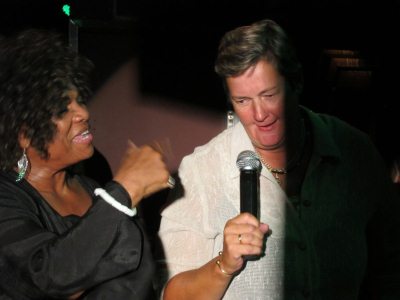
Asked by the lead singer "Anyone's birthday this week". I was pointed out, thanks everyone. I thought I was going to get away with dancing happily while the lady with the Eartha Kitt voice sang for me, (she had just finished a couple of hours leading the choir at her own church), until the mike was thrust into my palm. I did a couple of lines in the 'Marilyn Munroe' famously singing to JFK which so un-pleased Jackie. Then I did a couple of lines in my best, deepest mama voice, this raised the thumb of the singer (sorry - I forgot her name) and the sexy bass player. Who would have thought my debut would be on such a stage. Thankfully, Bear said he couldn't hear much of me.
The new club with the same name opened in 1978 in Harlem on 125th street
ALL IN ALL WHAT A PHENOMENAL WAY TO EAT SUNDAY LUNCH |