Tulips

|
Tulips All Out for
Bear's Birthday
   A birthday hug
from Anthony, our source of knowledge and help at the hotel. Bear's main
present today was a tour of all the major attractions here in Niagara.
Time for the boys to chew some fat awaiting our coach.
 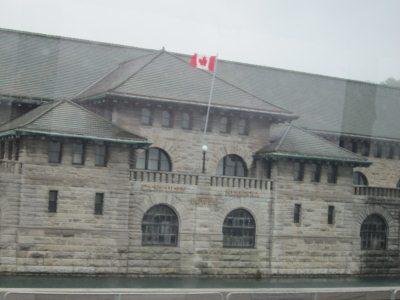   Stan, our driver pointed out a
few important buildings en route to our first stop. There
are tulips everywhere, Stan told us why.
The Canadian Tulip Festival is a tulip festival, held annually in May in Ottawa and Gatineau, Canada. The festival claims to be the world's largest tulip festival, displaying over one million tulips, with attendance of over 500,000 visitors annually. Large displays of tulips are planted throughout the city, and the largest display of tulips is found in Commissioners Park on the shores of Dow's Lake, and along the Rideau Canal with 300,000 tulips planted there alone. As well as tulip displays, the festival also includes music performances, speakers and exhibits of international cuisine.
History: In 1945, the Dutch royal family sent 100,000 tulip bulbs to Ottawa in gratitude for Canadians having sheltered Princess Juliana and her daughters for the preceding three years during the Nazi occupation of the Netherlands, in the Second World War. The most noteworthy event during their time in Canada was the birth in 1943 of Princess Margriet to Princess Juliana at the Ottawa Civic Hospital. The maternity ward was declared to be officially a temporary part of international territory, so that she would be born in no country and would inherit only her Dutch citizenship from her mother. In 1946, Juliana sent another 20,500 bulbs requesting that a display be created for the hospital, and promised to send 10,000 more bulbs each year.
Princess Margriet returns to Ottawa to attend the Canadian Tulip
Festival in May 2002. In the years following Queen Juliana's original donation, Ottawa became famous for its tulips and in 1953 the Ottawa Board of Trade and photographer Malak Karsh organized the first "Canadian Tulip Festival". Queen Juliana returned to celebrate the festival in 1967, and Princess Margriet returned in 2002 to celebrate the 50th anniversary of the festival.

The Man with the Two hats
During 1945, the First
Canadian Army was responsible for liberating the Netherlands, which
they did through battles such as the Battle of
the Scheldt and the Liberation
of Arnhem. The liberation of the Randstad,
one of the most densely populated areas in the world, is especially notable
because the civilian population there was still suffering from the horrific
effects of the Hongerwinter
('Hungerwinter'). It was cut off from food that was available in the rest of the
Netherlands, after Canadian liberation. German forces in the Netherlands would
finally surrender in Wageningen,
on the 5th of May 1945, but not before some 18,000 Dutch civilians
died as a result of starvation and malnutrition (desperate coordinated air drops
of food had already been staged by the Royal
Canadian Air Force over German-occupied Dutch territory in Operation
Manna. Civilians wrote "Thank You Canadians!" on their rooftops in
response). Immediately following the surrender, Canadian units were able to move
into the Randstad and rapidly distribute desperately needed food supplies,
causing many to see the Canadians not only as liberators but as
saviours.  After the butterflies Stan took us around the park. Bear jumped out in
the pouring rain to get this picture of the clock -
this is made up of 16,000 plants.
   The park also holds every type of lilac tree,
sadly the rain fell so hard it spoilt any more pictures from on the coach of the
stunning flower displays
ALL IN ALL A LOVELY
STORY
|


