White Water Walk

|
White
Water Walk
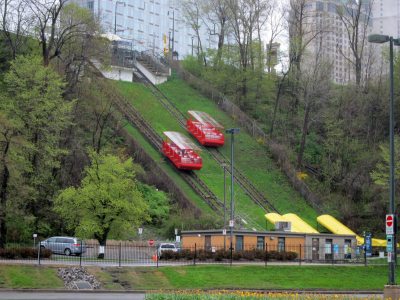
After a little lie in it was time to venture once again on the Falls Incline Railway down to the People Mover. These are a series of very efficient shuttle buses that allow tourists to park their cars at some distance preventing 'clogging' in the hub of things; also for the likes of us to use with a coupon supplied by Gloria at the tourist desk in the hotel. The driver announces at each stop what attractions are nearby. We met a really sweet 'Service Dog' who hated water and had had an awful experience on the maid of the Mist. Soundo in seconds. 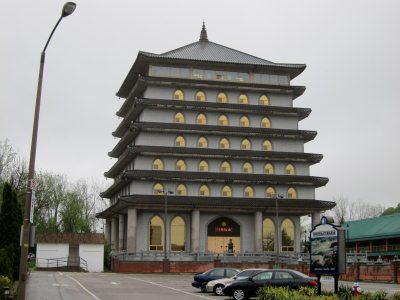   
We got off the bus outside the Buddhist Temple - sadly not open to visitors, crossed the road saying 'hello' to Terry one of the local policemen and into the souvenir shop over the White Water Walk. W e took the lift down some two hundred and fifty feet, walked a tunnel a similar length and out onto the Boardwalk. This quarter of a mile construction beside the rapids and stairs lead to two observation areas at the edge of the River. The
water travels at different speeds along the length of the Niagara River. South
of the Falls where the river is wide and slow, the maximum speed is about 40
km/h. Near the brink of the Falls, a speed of 109 km/h has been recorded. As the
water travels through the Whirlpool Rapids at White Water Walk, it is traveling
at about 30mph, creating the Whirlpool Rapids - "Class 6 white-water
rapids". Rivers
are rated on a scale of 1 to 6 in eastern North America, and 1 to 10 in western
North America. The Colorado River is the benchmark for white-water, where some
sections are Class 5 and 6 and the flow is 60,000cfs. White
Water Rapids - Class Definitions Class
1: Little to no current. Small waves with no obstacles.
 The
Whirlpool Rapids consist of 4 kilometers of 3-5 meter standing waves, making
this stretch of whitewater the largest/finest series of standing waves in North
America. These standing waves are thought to be caused not by rock obstructions
on the bottom of the river, which is probably swept clean here, but by the sheer
force (volume and speed) of the water being forced through the narrowing of the
gorge at this point. From
here the water races into a part of the river called the Eddy Basin, which in
turn opens out into the Whirlpool. The
90-degree turn in the river is the point at which a geological catastrophe began
4,500 years ago. Here the Falls intersected the ancient St. David’s Gorge. The
Whirlpool Rapids were created in just a few days, possibly hours, by the event
that started at the Whirlpool 4,500 years ago. Having turned into the more
ancient/pre-existing riverbed, the falls then tore out the glacial debris that
filled the older gorge, re-establishing as a falls again only when it reached
the area of the Whirlpool Rapids Bridge. Today
the 90-degree turn in the river provides a unique view of two world-class
whitewater rapids: upriver, the Class 6 Whirlpool Rapids, and downriver, the
Class 5 Devil’s Hole Rapids.
 ALL IN ALL FROZEN TO THE BONE - TIME FOR
LUNCH
|