Cooktown 15 27S 145 40E

|
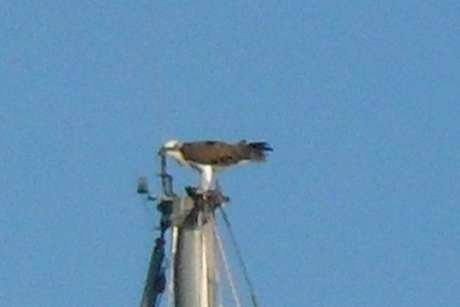
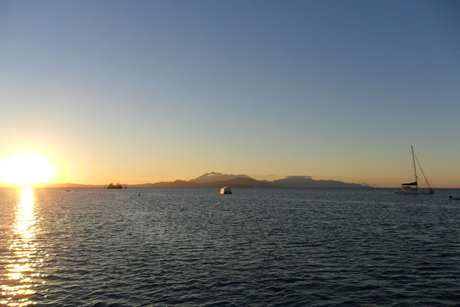
Passage to Cooktown There are some great names on this stretch of Queensland coast dating back to Captain James Cook's unfortunate escapades when his ship Endeavour came close to disaster: Mount Cook, of course, Endeavour River and Endeavour Reef, Misery Mount, Cape Tribulation, Mount Sorrow, Weary Bay. Sad names. Cook's stranding happened because he wanted to avoid what he saw as danger ahead, this danger was the Hope Islets. He detailed the site but there was some question as to his accuracy. However, lots of ballast and a kedge anchor from the Endeavour where found on the reef by the Academy of Natural Sciences, Philadelphia using a magnometer. Divers had explored the site for years previously but found nothing. 04/06/2011 Our first anchorage after Cairns was at Low Islets, north west of Port Douglas, where we anchored with 3 other boats. This was lovely and we probably could have been swimming except for our anxieties about the opportunist wildlife. As we anchored a black tipped reef shark swam around the boat, only about 5 feet long but enough to put us off; annoying as this is the last place without crocodiles on the journey north. The bird life kept us entertained. A fish eagle complete with fish landed on the top of the mast of the boat in front of Gryphon II. It then spent at least 2 hours devouring its catch with great delicacy, tossing unwanted morsels onto the deck below. This aroused the interest of passing terns and others that alighted to pick up the spoils, goodness knows what state the boat was in, there was no one on board whilst this was happening.
In
1928, The Great Barrier Reef Expedition comprised of British scientists was
established on Low Islets. They undertook one of the earliest studies of coral
reefs and associated marine life. It would be interesting to know the impact of
their findings. Aborigines in their wisdom made no impact on the balance of
wildlife, these people who knew how to live with the land have been
marginalised, manipulated and their wisdom ignored. One can be sure that they
would not have exploited the fisheries, or anything else, in the way that has
happened since white Europeans assumed control here.
05/06/2011
This proved not to be such a great anchorage as rolling set in at high tide. The morning found us a little weary but from here we sailed for 9¾ hours to arrive at Cooktown on the south bank of the Endeavour River at dusk in very shallow water. It took time to find an anchoring spot that would allow us to swing with the tide without going aground. We managed to find just the place adjacent to the public wharf where the evening fishermen were coming down to cast their lines. Cooktown
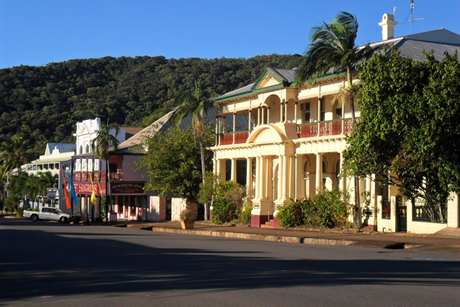
Cooktown is the last town on the Queensland coast before the top of Australia is reached at Cape York and Thursday Island. It couldn't be more different to Cairns. A much smaller town steeped in the history of Captain Cook and gold mining, rather fine older style architecture hints of busier and wealthier times.
With big wide roads, which seem unnecessary, the place seems empty. It has a small airport and one main road out which eventually winds south to Cairns. It really has geared up and invested to provide the visitor with excellent street and museum information on the history of the town and the Queensland area but as it is so difficult to get to there is hardly anyone there.
An account of Aborigines being moved across the country during world war 2 to an area they didn't know or understand. This is part of the very comprehensive street displays which detail the history of Cook, the gold mining era and the effects and outcomes on the land and the aboriginal people. It is extremely well done.
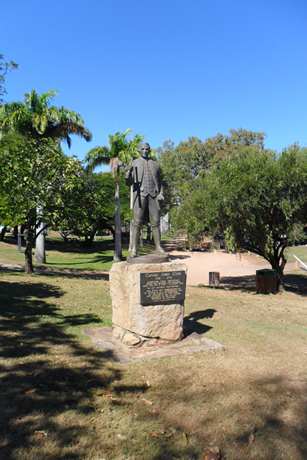
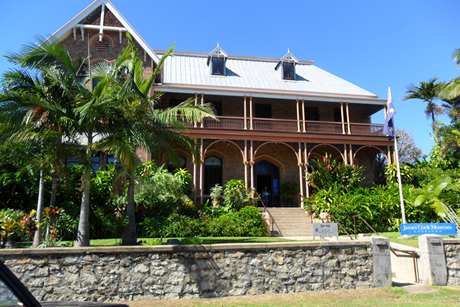
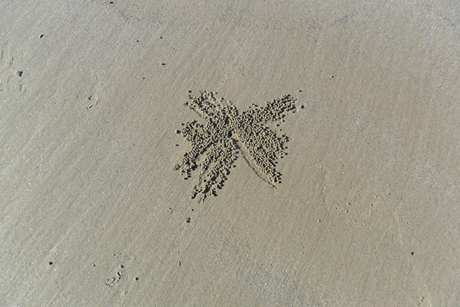
The James Cook Museum housed in an old convent which ran a private girls' boarding school for moderately wealthy families. The girls saw their parents at Christmas and sometimes birthdays otherwise the nuns, from Waterford in Ireland, raised and educated them. After getting his ship off Endeavour Reef with a boulder of coral firmly wedged in the timbers, which is probably what saved her from sinking, Captain Cook and crew managed to get the Endeavour into the river now named after the ship. They careened the ship on a steep to bank and spent 48 days repairing and reprovisioning. No Englishman had ever spent more than a few days on Australian soil before, the first true contact with Australian Aborigines occurred and the kangaroo was sighted and named, the Aboriginal word is gangaruu. Some hundred years later Cooktown became the main port for the Palmer River gold fields, the population, which included European and Chinese fortune seekers and entrepreneurs, reached as much as 30,000 with the new wealth and facilities providing all the busy goldminer could desire! This didn't last, the gold dwindled to non-commercial levels and by the middle of last century Cooktown became a ghost town. It now capitalizes on its past and has become a viable small town. The botanic gardens were a major place for getting out and socializing in the past, they now include a good exhibition and information centre for the town. 'Solander's Garden' is an area where specimens can be seen of some of the plants discovered, collected and/or recorded by Daniel Solander and Joseph Banks, the botanists who sailed with Cook. These gardens also lead to enjoyable, if muddy, walks down to the beach where we found these unusual markings, anybody know whose they are?
|