Tuesday 1st May - Reflections on Cartagena and onward to the San Blas Islands

|
09:35.36N 78:40.52W Tuesday 1st May
- Reflections on On arrival at
As regards facilities for
yotties there, the extremely useful information on cruising in “Who doesn’t want to see this jewel
of Spanish Colonial and Baroque architecture and seasonal playground of the
world’s wealthy? It is surprising how unappealing the options for bringing your
boat to
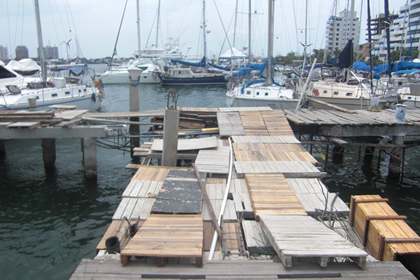
One section of the dock – no H & S concerns here,
then!
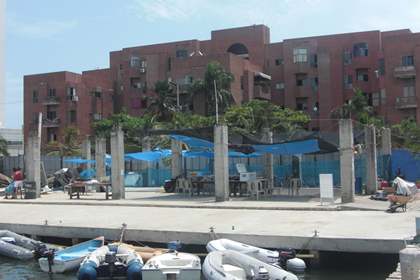
The Club House bringing a new meaning to the term
“airy”! Armed with that information we
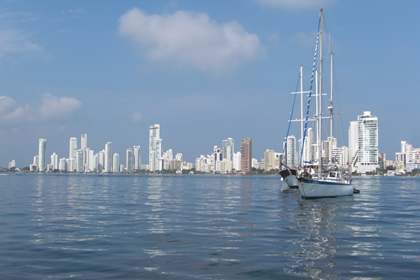
chose not to go into the Club Nautico marina but to anchor off it. We joined a fair number of other boats
in doing so. That was fine and we’d
recommend it. But, it’s worth
pointing out the surprising speed at which boats’ bottoms seem to become fouled
in the harbour. We were able to
confirm at first hand the accuracy of the assessment above regarding the Club
Nautico facilities. Apparently some
long-running dispute over planning or some such has resulted in its becoming
extremely run down although there were signs of a small amount of work being
done to at least make the docks themselves safer. The club house is a building site on
strike and consists of a series of pillars designed to hold up roofs and walls,
presumably. However, there are no
roofs or walls. Plastic
agricultural mesh strung atop the pillars provides a degree of shade to a few
wooden tables and filthy plastic chairs beneath. There is an office which occasionally
opens, two primitive showers and two chemical portaloos. Electrical sockets on flying leads lie
in pools of rain water, but treated with respect allow use of the surprisingly
available WiFi. As might, perhaps,
be anticipated in such a bomb site, the staff generally were pretty
under-motivated. There were some
exceptions. Their dinghy dock
is adequate and those at anchor can contract to use it for $20US a week. That’s necessary since there is nowhere
else very obvious that you can take your dinghy – it appears that there are no
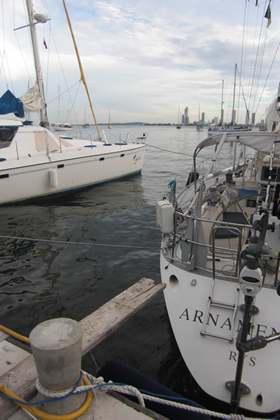
facilities for docking such anywhere nearer town. We did bring Arnamentia into the marina
dock for our last two nights because we wanted to take on water and boost the
batteries. Our draught (2.4m or 8’)
limited the options here and our berth was, frankly, dangerous (to
Arnamentia). So were the
arrangements for getting on and off the boat (to us). As for the dockmaster and his
electrician sidekick . . . wow!
However, Arnamentia survived and so did her crew despite having to “walk
the plank”!
The sophisticated boarding method On the upside, as our American
cousins would say, there is a very good, large and well-stocked supermarket
within 200 yards of the marina.
That got our custom. It also
provided a bit of practice at mental arithmetic and the accurate placing of
decimal points given that there were around 2,750 Pesos to the £. So, a 50,000 Peso note was worth about
£18 and a total individual worth of around £365 made you a Peso
millionaire. Provided, of course,
that you could get the Pesos. The
cash machines were temperamental with regard to our Visa cards. Some didn’t like them at all; some
picked and chose when they did. No
idea why. There is an alternative marina –
Club Pesco – half a mile further up-harbour and similarly closer to town. It’s beautiful, it’s chi chi, it’s got a
marina dock that looks the business (unsure about draught here and it may vary
quite a bit from berth to berth), security up the Ying Yang, smartly dressed and
attentive staff, a lovely restaurant and club house and all the rest of it. But, it doesn’t cater for scruffy
cruising yotties – although happy to take their money in the restaurant and
bar. The marina facilities are part
of a very up-market club – not the other way around. It is just about possible that there
may, occasionally, be a berth to spare but not this time. A fellow cruiser at Club Nautico did
tell us what he’d gathered the Club Pesca membership joining fee was (leave
aside the annual subscription). It
was outrageous – far too large to be repeated here with any hope of retaining
credibility with our esteemed reader. Customs and immigration clearance
in We’d come to On the cultural side, a
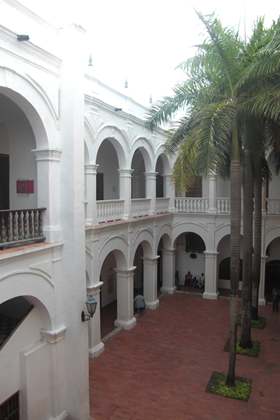
Pleasant Interior of the Palacio de la Inquisiciòn
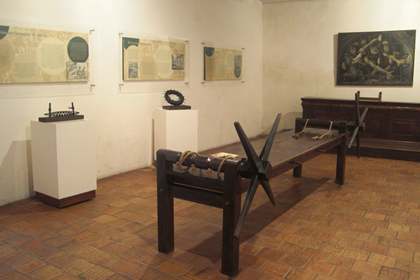
……
……. and some of the not so pleasant exhibits Across the delightfully shady Plaza
del Bolivar, a far less grizzly display of exquisite ornaments was to be found
in the Museo del Oro. Dating from
about 2000 years ago were beaten and cast gold buckles, brooches and earrings of
the finest filigree alongside a variety of funerary figures. Breastplates figured highly in this
latter category – the size and shape related to how important one had been – and
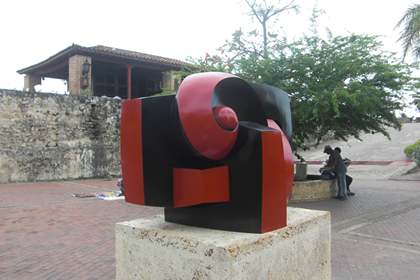
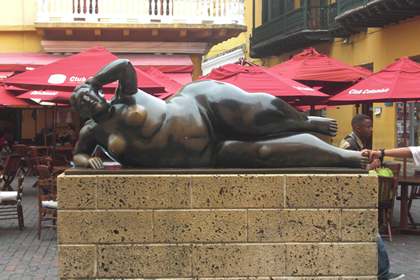
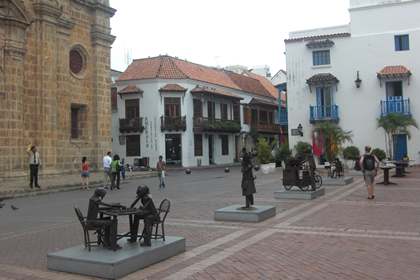
bore no relation to one’s actual physique. The Cartagenians are big on street
art, in one case, literally, as can be seen below!
What is really quite interesting is
the way in which the features of most locals reflect the extensive inter-mixing
of African, Spanish and Amerindian blood.
This contrasts starkly with the distinctly Spanish features shown in all
of the many marble busts in Plaza de los Martires commemorating the city
gentlemen who were put to the firing squad in 1816 for daring to declare
independence from There was much more we might have
seen given time. We knew perfectly
well that we’d merely scratched the surface of ONWARDS TO THE SAN BLAS
ISLANDS At around 1840 on Saturday
28th April we hauled up our anchor, slipped our stern lines and
headed off for the San Blas Islands on the Caribbean Sea coast of
For the first 24 hours the journey
was as frustrating as we’d anticipated.
Initially the wind was light and from dead aft. We dug out Percy the Parasailor but no
sooner had we got him on deck but the wind took fright and ran away
completely. So, Mr Perkins was
awakened from his slumbers and asked in the nicest possible way if he could
please get on with it. Moreover,
could he please do so for an extended period without running a temperature,
bleeding, being sick or depositing any other bodily fluids in the engine bilge
that might indicate the need for medical attention. Incidentally, he was as good as gold –
by the end of the voyage his bilge was as dry as it had started. During the afternoon of Sunday the
29th the wind gradually filled in from the NNE allowing us to
persuade the sails to fill on a reach and give Mr Perkins an easy time in
keeping our speed above about 5 knots.
By 1900 we had around 10 knots of breeze from the NNE. That gave us a 5 knot reach under sail
alone (“Thank you, Mr P, you may now sleep awhile again in your hot little
artisan’s cubby hole”) with the apparent wind on or a little abaft the beam and
with about 70NM to go. So, provided
it stayed that way, we’d be on our final approach to the Cays at about 0900 the
following morning. That looked
perfect and so it turned out. At
1010 on Monday 30th April, having woven our way through the various
reefs on the approach, we dropped the hook in clean white sand in the most
beautiful anchorage imaginable with one foot of crystal clear water beneath the
keel. It was barely necessary to
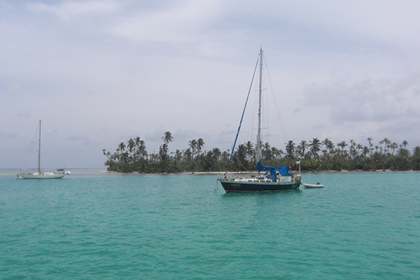
put on the mask and snorkel to check that the anchor had dug in. We are surrounded on 3 sides by tiny
uninhabited islands (none much more than about half a mile long or wide – mostly
less) covered with palm trees. Our
bow points to the fourth side where we look NE, to windward, out over the
The view to starboard of the
anchorage off Banedup islet
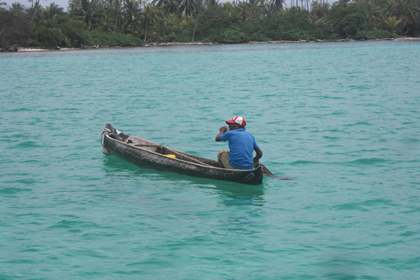
Dues duly collected, the Harbour Master paddles off in his dugout |