Porto Santo to Las Palmas

|
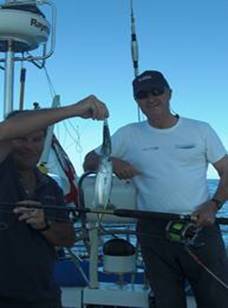
28:07.72N 15:25.57W Thursday 27th October – We departed Porto Santo at around 1300 on Saturday 22nd October. A pretty serious low pressure system was on its way to the Madeiran islands and the options were either to get well south and out of its way or accept being locked in for a time and then deal with the inevitable lumpy seas following the passage of the low. So, somewhat reluctantly, we ran away south. The wind, of course, took umbrage. Either we wanted to play – in which case we knew the date and place of the big party – or we didn’t. It was not going to show up in a more moderate mood at any other time and place we might have in mind. So, ever the stoic, Mr Perkins carted us south for the next day and more until, at about 1730 on Sunday 23rd , we began to feel the effects of the deep low pressure system closing in on Madeira – now some 200NM to our north. The wind showed up from the west; a lovely Force 4 (what Nelson’s sailors would have called a “soldiers’ wind”) and it was right on the beam. Up went the sails and off we went apace. The night, when it fell, was cloudless; the sky was a mass of stars and the sea a jumble of seething phosphorescence. Enter stage left: Hector the Hydrovane. You haven’t met Hector before and there has been quite a lot of discussion about his/her name. One school of thought favoured Hyacinth; another Hagrid, or, maybe . . . or, there again, . . .. Many and lengthy were the discussions that were held upon this issue and much was the heat generated thereby. Often, rather less light. And, then, like magic, it happened. The boy (for boy, it now had been agreed, it was) had been christened. The relief was boundless. Hector’s job is to steer the boat. Which, of course, is precisely what Orville the autohelm does. But, they operate in quite different ways. Orville’s brain is the size of a planet and he is essentially a whizzkid, smartarse, technocrat. He spends his life processing data from instruments and doing hard sums. Having worked out what the hard sums mean, he then arranges for the rudder to be given a bit of a push or pull via an electric motor and a hydraulic linkage. You can ask him to steer the boat on a given compass bearing or at a given angle to the wind or to some point on the world’s surface. Whatever; he will do it. But, like many whizzkid, smartarse, technocrats he is inclined to over-complicate matters on occasions. Often, what is required is a bit of gut feel, instinct and commonsense rather than a scientifically defensible wrong (or, sometimes, a little late) answer. But, don’t knock him. He’s a good guy. However, he is pretty high maintenance. He consumes a lot of electrical energy, because he is constantly driving the hydraulics connected to the rudder. That energy has to be replaced and re-charging batteries is a serious issue aboard any sailing boat at sea. So, the less we have to do it, the better. Hector is a quite different kettle of fish. He has no brain at all. And, because that is so, he can’t begin to work out whether having one might be a good thing or not. All he knows is that you align his nose (vane) with the wind and tell him to keep it there. Such is his construction that as soon as his vane is out of line with the wind he cannot fail but turn his small integral rudder to correct it. He asks for no power and, unlike Orville, consults nobody else. He does require much more in terms of understanding in setting him up and balancing the sails. But, the reward of being aboard a boat trucking along under sail in starlight at 7-8 knots; no hands, no whirring of electric motors, completely silent – all entirely mechanical . . . Whoa! And, that’s how we made Marina Rubicon in Lanzarote at around 0600 on Monday 24th October. But; not so fast! We are in some danger of being carried away here by the euphoria of night sailing and failing to report really important stuff. It must be recorded that, at 1130 on Sunday 23rd October, we successfully caught what must, surely, be a record-breaking 2lb skipjack tuna/atlantic bonito/arctic bonito/have it your own way/call it what you like fish. See the photo below. Not for the first time have we wished for a Hemingway type fighting chair. The monster fish made a pretty good (if rather small) starter for four of us.
Mr Fish, what were you thinking? That lure is nearly as big as you! So, what of Marina Rubicon in Lanzarote? One or two minor issues with wifi but it
is difficult otherwise to fault it.
It has pretty much everything you might want and isn’t particularly
expensive – at least compared with
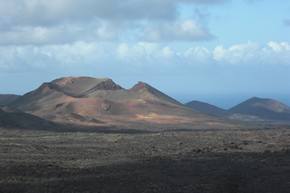
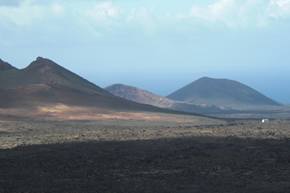
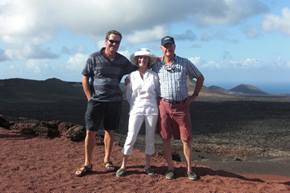
As Chris Copeland Remarked “Challenging Terrain” Lanzarote has a lot to offer. Inevitably, some of the south coast has been developed into a typical Brit-oriented tourist trap. But there is much more to it than that. The volcanic terrain is stunning and the interior is largely unspoilt. There are excellent opportunities for water sports of all sorts and the associated developments have not been allowed to impinge unduly on the rest of the surroundings. On an architectural note, virtually every building is painted bright white with all the paint work in the same shade of dark green – someone must have negotiated a good deal on a tanker load of gloss paint. A lot of time and effort has gone into landscaping the centres of the little villages and towns – there is an unexpected abundance of palm trees and other greenery which can cope with the arid conditions to be found there. There have even been successful attempts at growing vines and the production of some pretty reasonable wine.
Embryo Vineyard Three Grockles We Saw We knew that following the passage of the low pressure
system to the north, there would be very little wind for a couple of days. But, Chris and Penny were due to fly
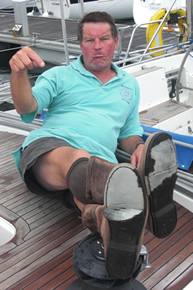
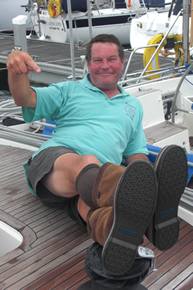
back to the Just before the Copelands left we resolved the thorny issue of the leather sea boots. The soles of Jon’s (which, it has to be admitted, were not in their first flush of youth) had decided that enough was enough and had fallen off. Chris had brought out a new pair but these had yet to be christened and the fate of their predecessors decided. The new ones fitted perfectly and were taken on strength. After some heart-searching, the old ones were subjected to some savage butchery to recover some useful leather before being consigned to the skip. Poor ol’ boots.
Tread wearin’ a bit thin Now we’re talkin’ There is plenty for the Duttons to be getting on with during the run-up to the start of the ARC. The boat is now in pretty good shape but there is inevitably servicing to be done on some of the systems. There are plenty of ARC boats here already and the whole jamboree begins to assemble properly on Monday 7th November with an opening ceremony on Sunday 13th. Apparently the latter involves parading around the place in national contingents behind a national flag bearer. This is followed by an international rubber dinghy rowing race. We know that Chris and Penny Copeland and Tim Dumas will be heartbroken to have missed that by a day by the time they arrive. However, they will be in time for the fancy dress party on Wednesday 16th when we are all bidden to appear as cartoon characters. Meanwhile, Carol continues to puzzle about the appropriate collective noun for a group of retired Royal Artillery colonels – all three of whom, inevitably, are slightly deaf and speak rather loudly. How does a cacophony sound? I SAID “A CACOPHONY”, COLONEL. |