Senegal – A Culture Shock

|
Position: 14:39.93N
017:25.68W Date:
The forecasts were right, On Tuesday afternoon the wind died. We were trickling along. But we were still keen to maintain our record of sailing all the passages without the “benefit” of the motor so we persisted, constantly trimming the slatting sails to maintain some headway. During the evening VHF radio net all the boats were reporting that they had resorted to being “en moteur”. When it came to our turn I announced “vitesse: deux neud : a la voile” (“speed: two knots: under sail”). “Ah” said Jean the net controller and hardy veteran of two MiniTransats “un puriste!” We had a crew discussion. It appeared that there were only two boats ahead of us: “Tog Gwen” a 54 ft Super Marimu which had started five hours before us and had motored most of the way in order to meet up early with some technicians in Dakar, and “Flying Kefi”, Dieter’s super-fast trimaran which we were never going to be able to beat (at one point he was surfing down the waves at 15 knots!). All the boats were motoring. The “race”, to the extent that there was one, was over, and we were the leading monohull. Meanwhile the constant slatting of my sails was not doing them any good, so after more than a thousand miles of sailing we too turned on the motor. After 2 ½ hours the wind came round to the south rather stronger than forecast and we were able to beat into Dakar through Tuesday night (which the rest of the fleet, much further east, were unable to do, so the strategy of going a long way west had paid off after all). Sailing along the coast on the approach to
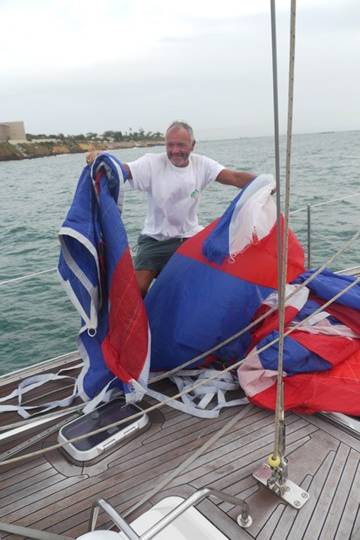
I had been in contact with Nicolas by email en route (there I go again) about the spinnaker and he had a (the only?) sailmaker standing by to receive our blown out spinnaker. We pulled an assortment of torn rags of sailcloth and luff tapes out of the sail locker and stuffed them into a sail bag. Later in the day the sailmaker reported back that it would be three days work to repair the sail (I’m surprised it wasn’t more) but he could complete it before we left for Sine Saloum. We agreed a price and off he went to start the work. I spent the whole afternoon with my head in the
murderously hot engine room trying to sort out the problems with the water maker
and the generator. I identified that it was the electric motor of the water
maker that was not working, so Nicolas helped again by sending over to the boat
an absolute mountain of a Senegalese electrician (“He used to be karati champion
of Senegal” said Nicolas. “Well, I won’t be quibbling about his bill then!” I
replied). He took the motor ashore and later came back to show me that the work
carried out in
As for the generator, I had been in email contact with
the manufacturers in So, subject to the water maker motor working properly after its repair, all the significant problems have been resolved. Hallelujah! It is in the nature of sailing boats for all the component parts to break down, at best in sequence but sometimes in batches and I am by no means alone in having to sort problems out here. For example, on “Flying Kefi” the autopilot packed up half way here and they had to hand steer solidly for two days. After the maintenance work we all went ashore in the evening in the water taxi which had been laid on by the rally organisers to ferry us to and from the luxury hotel which was hosting our stay here. On our way in the little open ferry stopped off at “Minnie B” to collect Phil and Norma. We were surprised when Phil boarded the ferry wearing only a pair of boxer shorts and clutching a bag. “Remarkably informal wear for an evening out on the town” I commented. “Ah” said Phil, “so you haven’t heard then”. The wind had been coming from the south with waves coming into the anchorage. The surge at the hotel pontoon made it unsafe to disembark there so the ferry was backing into a beach, timing the swell, surfing down a breaker and whilst the two crew leapt out and held the boat, the passengers stormed off the back and rushed up the beach before the next breaking wave came crashing in, surging waist high up the beach in wet pursuit of the spruced up sailors. Sometimes they made it but often they didn’t. Apparently David from “Suzie Too”, dressed in all his finery for the evening found himself literally up to his neck in a foaming wave. As we approached the beach, the truth of Phil’s description became blindingly obvious. Lawrence, Tom and I got our trousers and shoes off in about five seconds flat as the ferry hurtled backwards down a crashing wave onto the beach. We went out to dinner to a typical Senegalese restaurant
recommended by Nicolas.
When Lawrence and Tom went ashore yesterday afternoon,
they befriended Mamabu, a young musician who showed Tom & Lawrence round,
taking them to a clothes factory and a friendly bar. He then sold
Tom arranged for Mamabu to come out with us yesterday
evening and take us to a restaurant and to somewhere where we could hear some
Senegalese music which is world-renowned. Things didn’t pan out quite as
planned. We ended up in an extremely basic restaurant and had one plate of
extremely basic chicken in an (admittedly very tasty) onion sauce with rice. No
alcohol so we drank Coca-Cola and bottled water. We had asked what the cost
would be in advance and had been told by Mamabu that for the eight of us it
would be about 45,000 Senegalese Francs (about £8 per head) Compared with the
evening before this seemed distinctly pricey, but we were there and we were
running out of time before the last ferry to get back to the boat. Having
finished our meal we were then presented with a one line bill for 85,000 – more
expensive than your average Tomorrow we are planning to take a ferry over to the
island about a mile away which was used as a holding camp for the tens of
thousands of slaves who were shipped from here over to the
But meanwhile there remains a long list of routine
maintenance work and re-provisioning to be done. The blog is likely to resume on
Sunday when we will have arrived in the Sine Saloum delta 60 miles south of
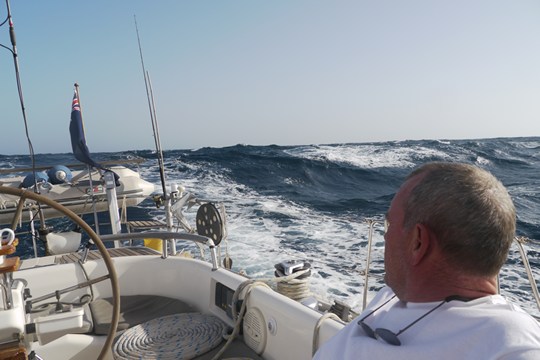
Big Seas
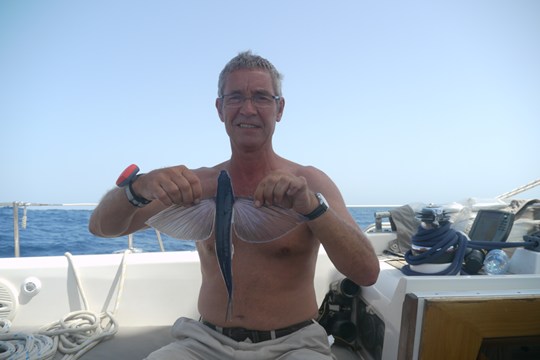
Kamikaze flying fish….
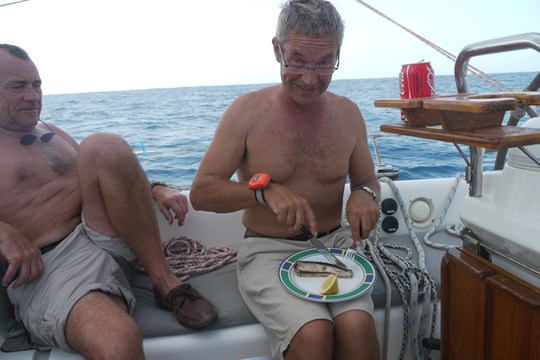
… gets its come uppance –
yummy!
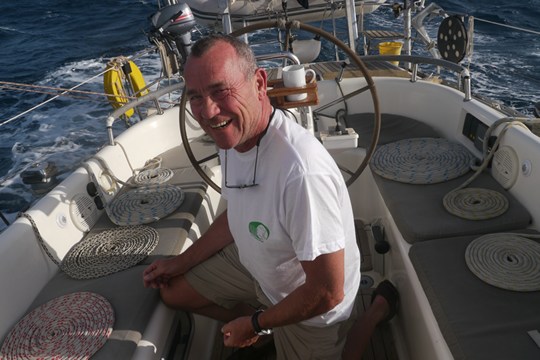
Tom keeps a tidy cockpit – but we weren’t allowed to sit anywhere or adjust any of the sails!
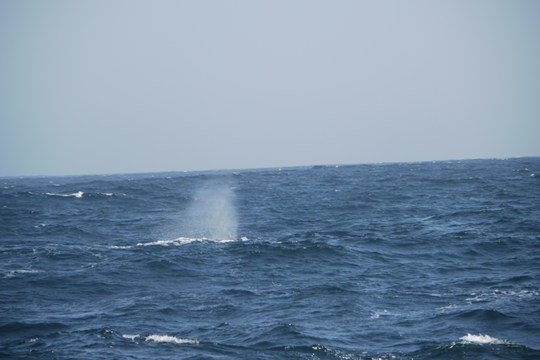
Thar she blows!
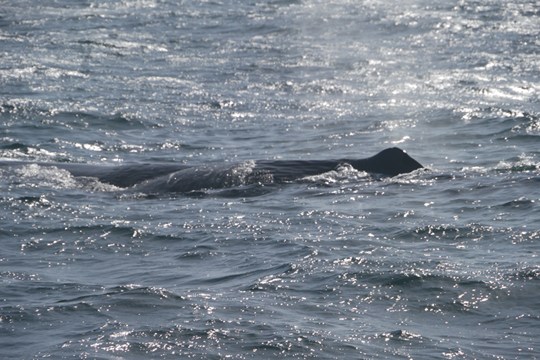
Humpback whale as long as
Mina2
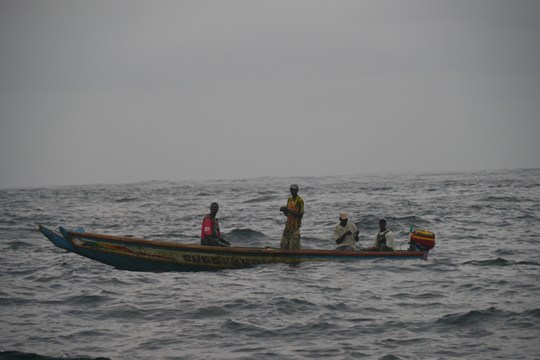
Cheery welcome from the local fishermen on an overcast
morning
Shredded cruising chute goes off for
repair
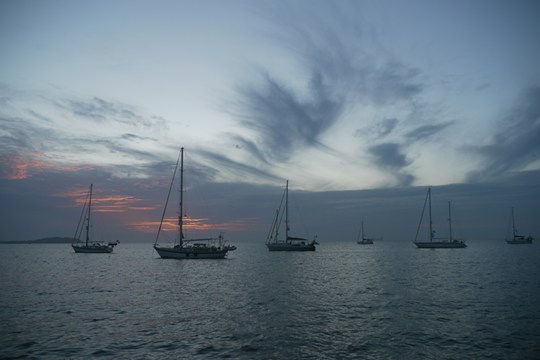
The fleet at anchor at dawn in
Dakar |