Tracking Down Saunterer - Capt. Lawrence Oates Yacht

|
Tracking Down Saunterer - Capt. Lawrence Oates Yacht
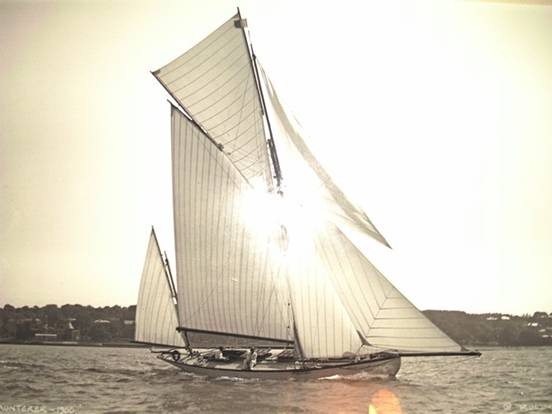
Photograph by Beken copyright
Saunterer in 1900, five years before Oates bought her
I started planning my impending expedition to Antarctica on Mina2 about three or four years ago. What triggered the timing of the trip was the realisation that January 2012 marked the centenary of Scott's expedition to the South Pole. Captain Lawrence Oates was one of the five-man Polar Party. Crippled with frost-bitten feet on the return journey from the South Pole, Oates heroically sacrificed his life in order to give his three remaining fellow-explorers a chance of survival by leaving the tent in a blizzard to his certain death with the immortal words, "I'm just going outside and may be some time".
Lawrence Oates was a member of the Royal Cruising Club, as am I, and I thought it fitting that an RCC yacht sail to Antarctica as a tribute to Oates and the other members of the Polar Party, all of whom perished.
As part of my planning, I have been researching Lawrence Oates and his yachting activities. I knew from the RCC club records that the name of his yacht was Saunterer and I had details of her size - but that was it. I was hoping that by digging around I might be able to get additional information about the yacht - who built her, where and when. If I got really lucky I might even be able to track down a photograph of her. What I was to discover was much, much more. To my amazement, I found out that not only did Saunterer still exist (there are very, very few examples of 100 year old wooden yachts still in existence), but she had recently been lovingly restored to her former glory.
Guy Savage is a shipwright who found Saunterer lying rotten and unloved in a yard in Scotland, bought her and then spent the next two years restoring her. For Guy and his wife Chloe, Saunterer is their home. When they bought the yacht, they had no idea of her history and that she had once been owned by a national hero. With the escalating interest in the Scott Expedition leading up to the centenary, they have found their home becoming a centre of riveted attention - not least by me.
Last weekend I attended a two-day conference in Plymouth on the Scott Centenary with back-to-back lectures on such diverse subjects as "Polar Medicine in the Heroic Age of Exploration" (ie, how long it takes to die from scurvy and how they amputated frost-bitten limbs without anaesthetics) to "Polar Expedition Ships" (Discovery, Endurance, Fram, Terra Nova etc) "The Scientific Legacy of the Polar Explorers" and numerous lectures on the individual party members, including Oates, given by their biographers. The conference was well-attended by about 200 people, mainly descendants of Scott's team members; scientists; polar explorers past and present; writers; historians; academics - and me.
In between and after the lectures there were receptions, and a dinner on Saturday night at which one was mingling with a fascinating selection of people who's unbelievable achievements were matched only by their modesty. There was one chap about my age who was doing a PhD on the British Graham Land Expedition of 1934-1937 and was quizzing me about how far south he might be able to get down the peninsula in a yacht. I asked him what he did when he wasn't doing research. "Oh", he said "I like walking and climbing". It transpired he had walked to the South Pole - solo. And his climbing included two ascents of Everest - one without oxygen! Then there was the guy who had been on several expeditions to Antarctica in the days when they still used dogs for hauling the sledges (not used now, as the 21st century public baulk at the idea of driving dogs in the coldest conditions on earth to the point of exhaustion and then killing them and cutting them up to feed the remaining dogs). He was telling me of one occasion when he got caught on the sea ice which started breaking up around him; physically throwing dogs and supplies from one ice flow to another and then leaping across himself, he managed to make it to land but there he was trapped for a month until the sea ice froze over again and he could resume his journey, by that time on starvation rations. Pretty humbling stuff. It was wonderful and I made a lot of potentially useful contacts.
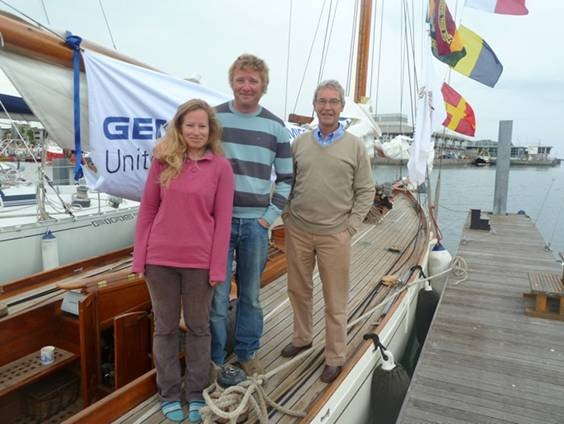
But more than that, Guy and Chloe had brought Saunterer round to Plymouth and on Sunday morning I went round to meet them. Apart from picking up lots of information about the history of the boat, I could hardly believe that there I was standing on the very same deck that Oates once trod. Guy has done a magnificent job in sympathetically restoring what is now an historic vessel, and they spend much of their time going from one classic yacht event to another.
What started out for me as a weak Oates / RCC link to spur me into committing to my Antarctic adventure has, with the discovery of Saunterer, turned into a much more personal affair. If any cream was needed on this particular cake, Guy and Chloe have asked me to come sailing with them during the summer. I can't wait! Saunterer has her own website: www.saunterer.co.uk , but meanwhile here are some pics old and new:
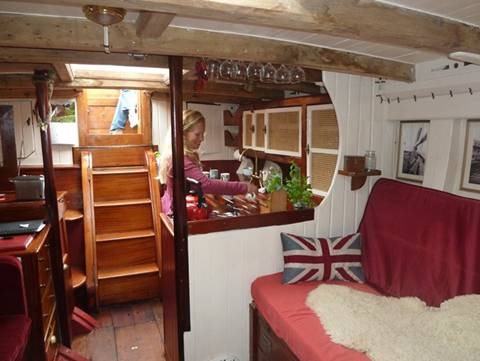
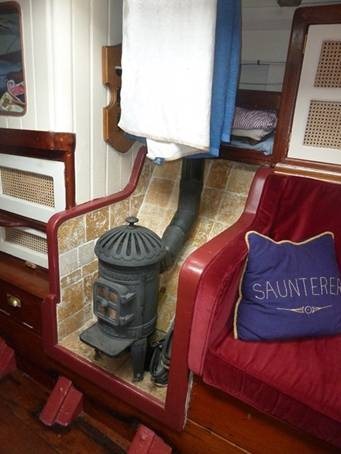
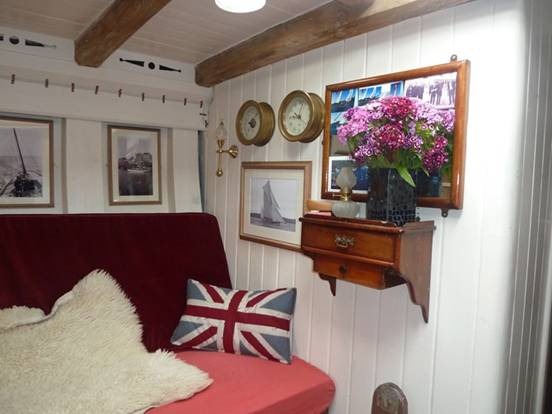
Saunterer's cosy saloon today
Standing on the deck that Oates trod - with Chloe and Guy
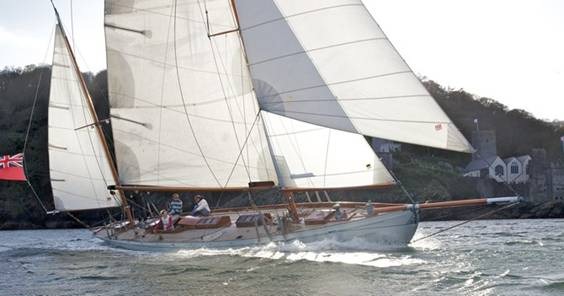
Copyright Dartmouth Photography
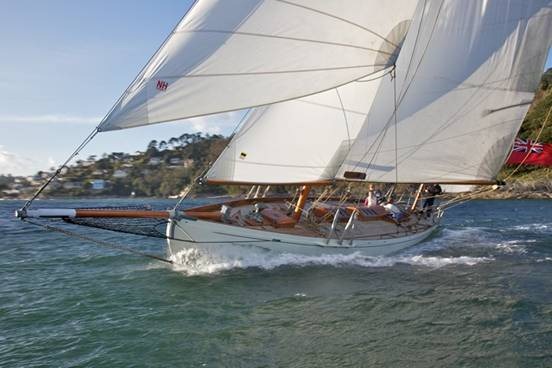
Copyright Dartmouth Photography
Saunterer in action today |