Bermuda to the Azores

Casamara
John & Susan Simpson
Wed 3 Jun 2026 18:22
The storm clouds, wind and rain that brought us into Bermuda cleared after about 36 hours, to reveal one of the most beautiful islands we’ve visited around the world. Photos don’t do justice to the turquoise blue of the sea in the white sandy bays that skirt Bermuda. We were anchored in a large sheltered lagoon off the town of St George’s. This was the original capital of Bermuda, founded in 1612, and the church of St Peter in the town is the oldest Anglican Church in continuous use in the Western Hemisphere. The buildings in St George’s are built of stone, painted in pastel colours and roofed with limestone slabs painted white. The overall effect is reminiscent of a West Country fishing village in the UK and, still decorated for the recent visit of King Charles, felt very British. 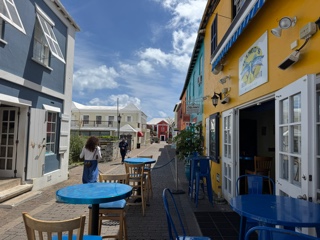 Street scene in St George’s Turquoise seas around Bermuda One of the charming things about Bermuda is the friendliness of the locals. “Good afternoon everyone” they call chirpily as they step through the door of the town shops or reach the bus stop, and everyone calls back a greeting. We caught the bus into Hamilton on Sunday morning to go to a service at the Cathedral and it was one of the warmest welcomes we’ve had around the world. The Bishop’s wife even sat with us for a good 5 minutes before the service, finding out our story and telling us hers. A baptism formed part of the service and we inadvertently sat with the baby’s family squeezed into the front pews for the occasion. I did wonder whether the choice of name for the baby boy - X’rai - indicated his parents' hope for a career for him in radiology, but it turned out to be pronounced ‘Zuray’ so maybe not. Overall, Bermuda felt a happy and contented place to be. With friends from the ARC Europe rally we hired scooters one day and set off to explore. We managed to see virtually the whole island as it is only 24 miles long and never more than 2 miles wide. The winding roads undulate from coast to coast with stunning views wherever you look. 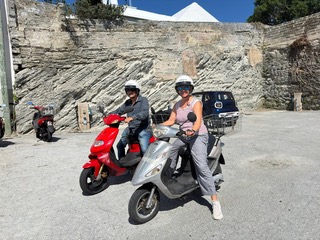 Scooter safari, Bermuda style Bermuda is the only atoll in the Atlantic Ocean, originating from a volcanic eruption millions of years ago. Due to its isolation, it was completely uninhabited until an English ship, the Sea Venture, was wrecked on its coral reefs in 1609. The Sea Venture had been on its way from England to Jamestown, Virginia to support the failing fledgling colony there, when it started to sink in a huge storm. Admiral Sir George Somers famously steered the ship onto the reef to prevent it from sinking and, miraculously, all 150 people on board survived. Reading about the shipwreck in the excellent Museum of Bermuda, I came across a quotation from one of the passengers who survived. “God, in the supplying of our wants, shewed himself still merciful to us. - Silvester Jourdain, Sea Venture passenger, 1610”. It’s an unusual name and I had a lightbulb moment, remembering discussing Silvester Jourdain with my Dad when he was researching my Mum’s family history. The Lathey family lived in Lyme Regis in Dorset, UK at about the time of the Sea Venture’s voyage. Admiral Sir George Somers was born there, and it was Silvester Jourdain’s home town too. One of Silvester’s sisters married into my Mum’s family in 1583. Silvester wrote an account of the shipwreck called ‘A Discovery of the Barmudas, otherwise called the Ile of Divels’ and his writings are believed to have been the inspiration for Shakespeare’s ’The Tempest’. Although I’m not directly descended from Silvester Jourdain, it made the visit to Bermuda all the more memorable to think that my ancestors lived alongside these great historical adventurers. The ARC Europe rally left Bermuda bound for the Azores on 21st May but, after much debate amongst ourselves and with others, we decided not to leave with the fleet as we didn’t fancy the look of the forecast for the first four days of the passage if we left on the start date. A number of other rally boats decided to do the same and, together with some independent boats that we had met in the anchorage, we eventually left Bermuda four days later. Skippers of the ‘later leavers’ fleet discuss strategy over a beer….or two The 1900 mile passage from Bermuda to Horta in the Azores requires a bit more strategic sailing than some of the ‘trade wind’ ocean crossings we have done. Winds blow clockwise around the Azores high pressure weather system that sits across the North Atlantic. Low pressure systems, with winds blowing anti-clockwise around them, bowl across the top of the Azores high in succession. The trick is to get yourself into one of the flows of air blowing towards the Azores, i.e. the wind is behind the boat, and to avoid getting sucked into the high pressure system where there is no wind. How they did it in Silvester Jourdain’s day is a miracle, but we have the luxury of Starlink internet on board and a subscription to a sailing routing/weather forecasting organisation called PredictWind. Ideally we would plot our way carefully across to the Azores so that we’re in ideal conditions all the way. In practice, we experience a range of conditions which, hopefully, are not at either extreme. Even so, with only 450 miles left to go, we have experienced lots of wind (gusting to 34 knots) and very little (currently 9 knots), as well as waves ranging from 1.5 metres to 3.5 metres high. Mick and Jo, who came with us for their first experience of ocean sailing, will have had a whole range of conditions by the time we get there. We’ve loved having Mick and Jo on board. It’s great to see ocean sailing anew through their fresh eyes and, as they’re both scientists, to see the natural world from a whole new perspective through their discussions. There have been times when John and I have looked at each other perplexed as Mick and Jo have a conversation using words we’ve never encountered before! Still, we now know why clumps of Sargasso weed form into long orange stripes like a tiger’s skin across the ocean, it’s due to wind-driven water movements called Langmuir cells, and we’re currently exploring why salt water interacts with urine to make crystals. As soon as he’s had time to work it out, Mick is going to tell us exactly how far it is to the moon …… A string of sargasso weed. There are thousands of these in the Atlantic and some stretch for miles. |