St. Pierre, Martinique

|
St. Pierre, Martinique
Lat/Lon: 14:44.56N 61:10.68W
We are on our way to Dominica for a couple of weeks. The plan originally was to set off yesterday morning and arrive in Roseau, Dominica this evening. We were only planning to stay the night here and be off first thing but the more we read about the history of this little town - destroyed in 1902 by the nearby volcano, Mt. Pelée - the more interested we became and decided to spend the day here in order to learn more. After trying (and failing) to find anywhere to clear customs, we walked up to the town museum, then around some of the ruins. To the best of my memory and with help from a couple of guide books, here is what happened. In 1902, St. Pierre was the main social and economic centre in Martinique. Known as the “Paris of the Caribbean” and also the “Pearl of Martinique”, it was home to 30,000 people and held the wealth of the island thanks to the most successful plantations being nearby. The bay was always full of trade ships from France. In early April of that year, rumblings began and the height of the mountain rose and fell by hundreds of feet. About a thousand of the wiser occupants moved out of town but the majority stayed. On the 2nd of May, a major eruption covered the town in ash and a plantation owner and his men were killed by a scalding mudslide, south of the city. On the 5th, the Guerin Estate, located to the north of St. Pierre and one of the richest in the area, was completely buried under a torrent of boiling mud, lava, rocks and gasses, killing hundreds of workers. Partly because people thought this eruption was the final one, and partly because the Governor was persuaded to sit tight by rich plantation owners who didn’t want to lose trade, St. Pierre was never evacuated. On the 8th of May 1902 at 2 minutes past eight in the morning (several pocket watches were on display at the museum, frozen at the time their owners died), the side of Mt. Pelée that faced St. Pierre exploded with more force than a nuclear bomb, releasing a pyroplastic flow of gas and dust. Travelling at 200 mph and at a temperature of 1000 degrees C, the cloud wiped out the entire city and sank 12 of 13 ships in the bay, a handful of survivors sailing their crippled ship to safety. In the museum, there were all kinds of glass and metal objects that had been melted, and the enormous church bell, made of inch-thick cast bronze, had been squashed flat by the heat and force. (Unfortunately there was a no-camera policy in the museum so we don’t have any photo’s for you.) There were only two survivors in the town. A man who happened to be in his cellar and a prisoner in a stone cell. The prisoner was severely burned and survived on a trickle of water for 3 days before rescuers found him. He quickly became a celebrity as a survivor his charge of murder forgotten. Mt. Pelée is a dormant volcano now, but is closely monitored in case it ever becomes active again. St. Pierre was rebuilt as the small town it is today, but has only a few thousand residents as many are still scared to live near a killer volcano, dormant or not. Anyway, we made it back to the boat without any major eruptions that we knew of and went for our daily swim as per boat rules, only to be stung by something. My guess is a hidden jellyfish as the stings haven’t become inflamed, they just hurt. I have looked at my dive guide and the upside-down jellyfish looks like it might be to blame as sea wasps cause you to go into shock and if we’d fallen foul of the Portuguese Man o’ War, I wouldn’t be typing - or breathing. On that cheery note, goodnight. We’ll try to check out the old Reid house so keep reading, family! John
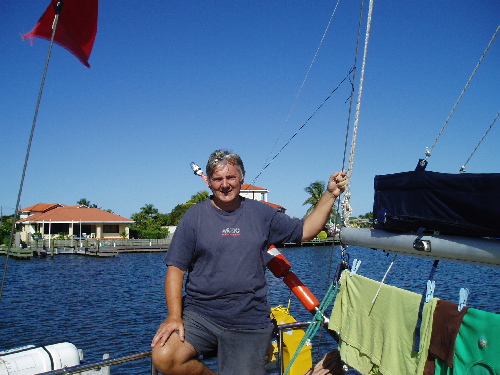
PS. After such a wordy, history lesson of a blog, you'll no doubt be expecting lots of pictures - sorry, no-can-do as we are using the sat-phone. Don't start rioting just yet, you'll get your pictures as soon as we get WiFi in Dominica. However, I can offer one to keep our Campbeltonian fans sweet;
Thank you and goodnight. |