BLUE WATER RALLY - INDONESIA - KALIMANTAN JUNGLE

|
03.00.598S 111.39.067E Friday 31st October We woke at
4.30am this morning and lifted our anchor at 6.00am having successfully filled
up with diesel last evening. We organised for cans to be filled for us and http://www.korindo-network.com/sailing_yacht_tour.htm
and you can download the price etc in pdf file or click here : http://www.korindo-network.com/ORANGUTAN-SAILING-VESSEL-TOUR-PROGRAM.pdf.
Gilang – the ‘boss’ Our four days in the heart of the Borneo jungle I would describe as a life
enlightening experience and for the first time since beginning to write this
blog I feel a real personal responsibility to ‘get it right’
– to ‘get it wrong’ would somehow be tantamount to aiding and
abetting man’s greed and the sure destruction of the wild orang-utan ape (pongo
pygmaeus) on this planet, probably within the next ten years. Massive tracts
of jungle are being destroyed every day – the ironwood timbre is valuable
for boat building and furniture – but more importantly the trees planted
in its stead provide the largest and most valuable export the country has
– palm oil. I know we in the ‘Western World’ have been
bombarded all our lives with pleas for monitory aid – so much so that
animals threatened with extinction, insects facing crisis, humans enduring
starvation and deprivation, oceans emptied of fish and mammals, even global
warming and the repercussions don’t really make the impact on many of us
that they could or should. They are things that most of our generation see on
T.V. – like war and famine or floods and earthquakes……yet
when you get up close and personal you do feel a whole lot different!
A Dayak tribal man…….
…..teaching us to shoot with a traditional poison dart through a ‘blow tube’…. The result was frighteningly
accurate! In When we arrived at the mouth of the Kumai River on the 26th
with Glendora we both ran aground – our electronic chart plotters were
not reading true and even paper charts can’t predict the moving sand
banks and bars in that shallow estuary.
…..and we too! No matter, we made breakfast and readied ourselves for our four day
adventure whilst the tide ebbed and flowed. We finally made it up the river, a
two hour journey, at sunset anchoring just opposite Kumai town – the
first of the Blue Water Rally yachts to arrive.
Wondering why our anchor kept dragging……an attachment to an entire tree was the answer…….. The banks of the river were alive with boat building, children playing,
residential homes and businesses seemingly sinking into the river.
The banks of the river alive with welcomers………
Crowded water front
A traditional fishing boat being constructed purely from ironwood We were puzzled to see dozens of very large grey buildings with no
windows (resembling prisons); these we found out are ‘rumah walet’
tall dark buildings housing thousands of swiftlets whose spit produces the high
priced nests (worth hundreds of US $ per kilo) savoured in Hong Kong and
‘Rumah walet’…. Tall building housing the swiftlets
which fly in and out freely whilst building their valuable nests We all had a good night’s sleep before being collected by our two
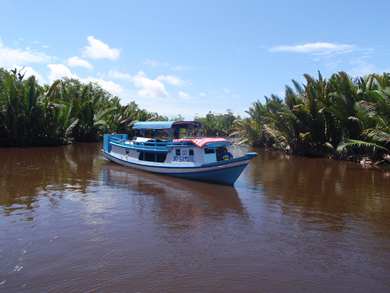
traditional river boats – Klotoks – powered by diesel engines
– at 8.00am the next morning. Oscar, Vic and Clara’s Klotok, joining ours……….. With room for four on one boat and three on the other we teamed up with
Our Captain and Kris our guide as we headed up The We all harmonised happily in very close proximity; the children
travelling and eating with us but sleeping and conducting ablutions on their
own boat. The days and nights passed seamlessly in our new universe which we
soon became acclimatised to.
The non flushing loo…..
….bang next door to the ‘kitchen’
….and the shower not for the feint hearted or shy…… The loos cum showers were challenging – a high sided wooden box
on the back of each boat with no ceiling – which everyone could peer over
from the jetties or the top floor of the boat - but again we all managed, even
enjoying a number of ‘river showers’. Mushrooms, fungi, spiders
and crew knickers pegged onto nails jostled for a place in the cubicles but
surprisingly it all seemed very normal very quickly. Slightly more difficult at
night of course but candle light hid a million truths.
Oscar’s night time shower in the pouring rain…….. The breakfasts, morning snacks, lunches, teas and suppers included a
delicious variety of scrambled eggs, Spanish tortilla, fish, chicken, shrimp,
vegetables, noodles, rice, potatoes, home made vegetable crisps, pineapples,
banana fritters, mangos and oranges.
Delicious fare at mealtimes……
…and the ritual of being ‘mother’ at tea
time…… We brought our own beers, wine and milk plus a few nibbles – they
provided bottled water and soft drinks. At night two single mattresses were
placed for each couple under a large square mosquito net ‘box’
– thank goodness I remembered sheets, pillows and towels. Our mattresses
were the only let down – it felt as though we were sleeping on twenty
year old ex army issue bags full of small lumpy rocks…..needless to say
the children had brand new plumpy pink ones six inches deep!
The children’s pink, comfy, fat mattresses having an
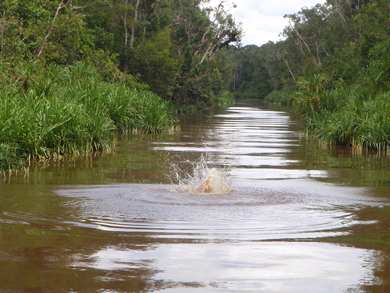
airing…. Chugging slowly up the Sekonyer River – a very small narrow
tributary leading into the Kumai river – was incredible – the light
and reflections in the dark water, the dense yucca like vegetation all around
us – the Proboscis monkeys swaying on branches just above our heads
screaming and chattering before throwing themselves into the river right in
front of the boats for a cool swim – babies attached (they wait
anxiously, knowing that the noise of the engines will scare away the crocodiles
partial to their plump flesh):
Reflections in the black inky water….
Proboscis monkeys in the trees
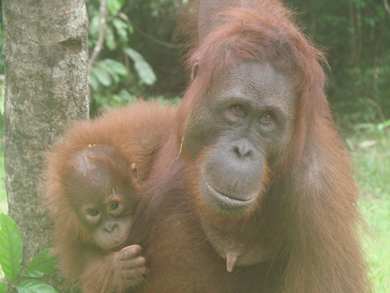
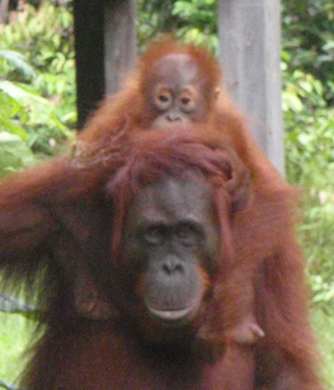
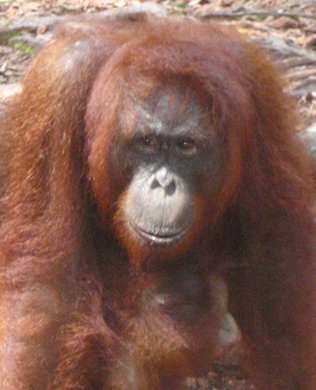
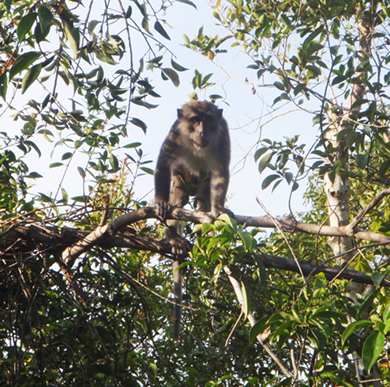
Dive bombing into the water in front of us…. None of this prepared us for the shock of seeing our first wild orang-utan……awesomely
huge! Dwarfing the tree she was standing up in – red with the sun behind
her burnishing her long hair like a hallo of glowing fire – she watched
us go by – as much fascinated by us as we of her.
….see her high up in the tree?…. These apes build nest platforms to sleep in, high in the trees –
new ones every single day! We thought the river would be full of tourists but
there were surprisingly few – small rowing canoes with villagers fishing
and the occasional local speed boat were our only human companions. We were
told the Local folk watching us go by….. There are three camps along the river; we arrived at
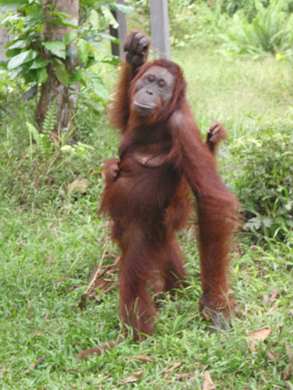
Thomas the show off on the pier…….
…..it had to be done…..
The ironwood pier leading to the orang-utan camp
Over the four days we visited all three camps with Kris our wonderful
guide, often more than once, and observed the apes for hours, spending extra
time alone with them when other visitors had departed.
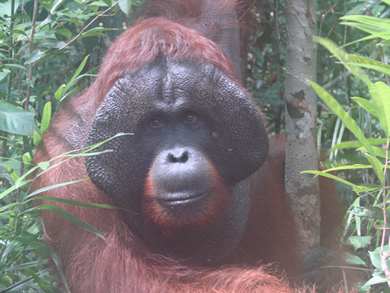
…and the dominant male….no hand holding with this guy
…just a thin blue line between us and him…..
…our jungle viewing seat…..
..helping oneself to the entire box of bananas
….no body looking…….
…..mine to share…….
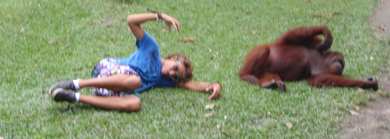
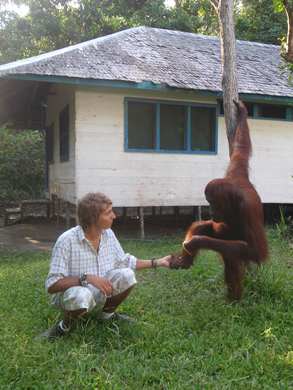
…..these are my bananas…….ok? They discourage human contact for obvious reasons including the spread
of our diseases but Samson followed us persistently and eventually with her
ranger’s consent reached out voluntarily and held our hands (with her foot)
in turn..…the hand holding had meaning – she had a firm and
friendly grip and she was reluctant to let go! It was not done for reward
– just companionship.
Our evenings were great – emotional even – sitting there
just a few feet from the monkeys we could see with our infra red telescope.
Candle lit dinners for the seven of us, cross legged around the low table,
discussing and debating until Lee would get out the guitar and play long into
the night. Our cohabiters, namely our crew, loved this addition as much as we
did and we ritualistically lit and shared our joss sticks and beer, drank our
wine and marvelled at the sheer wonder of it all:’ WE HAVE SAILED 18,000 MILES IN OUR OWN BOATS AND WE
ARE SITTING IN THE BORNEO JUNGLE’ whilst the monkeys screeched
and chattered in competition with Lee and the deafening bull frogs.
…and what a setting to spend the night…..
…the trees filled with wildlife including chattering monkeys
Candle lit dinners……. Bugs?...... We had a few……too few to mention…..no
actually there were a lot of bugs – particularly drawn to the candles at
night but nobody suffered unduly. Day two began at 5.00am and included quite a long walk (nearly three
hours) through the ‘woods’. We saw a good dose of fire ants, python
holes, tree mushrooms, monkeys, tarantula habitats, wild boar, hornets, ……and
one leech…….yes just the one……which Kris kindly picked
up and placed on his arm to show us how it attached itself to him and drew
blood. I had in my imagination a sort of tick with lots of little legs which
would attach and suck…..in fact this leech was (without any blood in him)
like miniature slinky….once suctioned on his long wiggly tail acted as an
ever moving probe searching for a new blood source… apparently once
‘full up’ they grow to the size of a finger…...quite
disgusting!
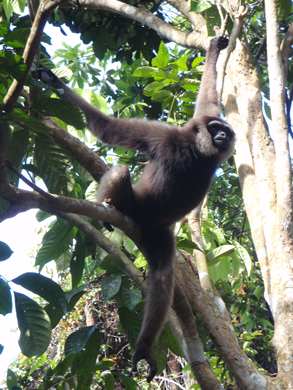
….funky gibbons
…a walk on the wild side….
…..through the jungle….
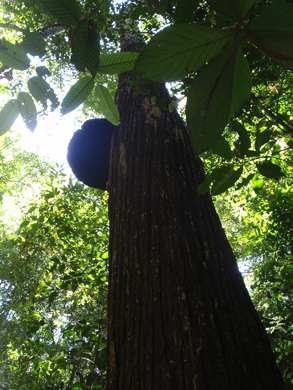
…tree mushroom which will take the weight of a man……
…the leech attached to Kris….the wiggly bit is the
tail…..
…wild boar…..
….and threatening gibbons……. Anyhow, after tramping through the swamp and experiencing lots of close
encounters and getting very hot and sweaty we unanimously voted not to do the
ten hour trek the next day which would entail waist high swamplands filled with
hundreds of hungry leeches. We already felt like pioneers….enough was
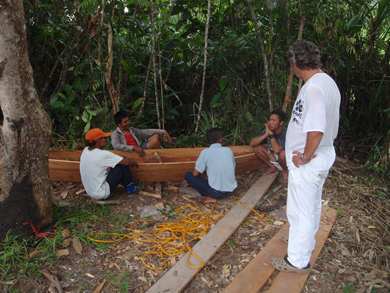
enough. So! Instead, we lazed our way down the river, visited an extremely
poor but extremely happy village, read our books, listened to the BBC World News
which was pretty incredible in our location, painted a picture, watched a row
boat being hand made and generally congratulated ourselves on our narrow
escape. We moored up beside a village overnight and buckled down the
tarpaulins when the heavens opened at the start of the monsoon
rains….even all enjoying a shower in the cubicle with extra water
pressure!
…hand making a canoe
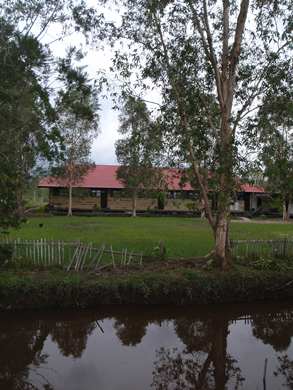
…village house beside the river
…the village school
…children playing with balloons we brought….
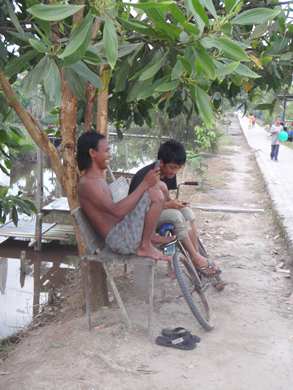
……alongside the older boys on their mobiles…
….the cleared jungle behind the village….
…and the cow in the yard…. The next and final day we were invited to visit the village school
which we were all slightly reluctant to do (voyeurism?) but then found it an absolute
treat when the children found us as interesting as we did them. Vic gelled his
hair into a pointy bit and wore his cool sunglasses and the children might as
well have seen the pied piper…..they followed him and giggled and
laughed, running back and forth to tell their friends about the apparition
which had arrived in their midst – it was all highly entertaining; the
kindergarten children (maybe fifty?) all wore a smart uniform of red shorts and
white shirt with emblem emblazoned on their top left pocket; they looked clean,
intelligent, happy and very healthy…. And why not? The little village
had water, simple electricity, satellite dishes in most of the pretty flower
and herb filled gardens, cows, chickens, dogs and cats in the yards and many
wooden boats mainly used for fishing in the little estuary. There were two
schools, junior and senior with an attractive play area in front of each.
….children behaving like children everywhere….
….what a spectacle we made too……. Worryingly the forest behind the village was gone – the illegal
loggers had already moved in and in a film shown to us at the information
centre we saw ‘secret’ film clips of the Head of the Tanjung
Putting National Park standing astride a massive illegal logging operation
directing operations…..what hope can their be for Borneo’s future
wildlife?
Our Captain on his mobile…
The ever gorgeous and photogenic Clara
…with Vic
….. and Oscar….
|