You asked for it!

|
I give in!!! OK, OK, I’m sorry that it’s been so long since the last blog. Being at anchor has a timeless quality about it (until one starts to run out of water), and all of a sudden, nearly a month has gone by and we haven’t updated the blog and I’m getting e-flack for not giving you blog addicts a fresh fix. So, I have slaved over a hot keyboard to bring you all (relatively) up to date with the current state of the sea toilet, so to speak. I have also been in trouble with David for not thanking Dave Sturdy (he of superb bow roller fame) for talking him through the alternator episode. So, thank you Dave. Land of turquoise
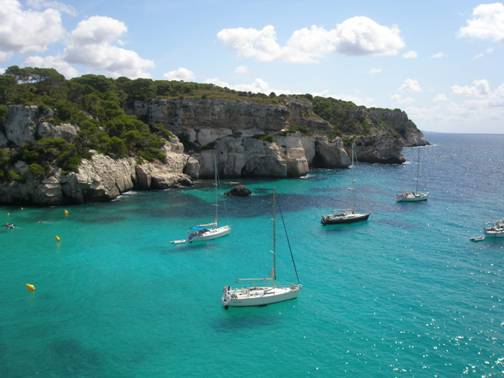
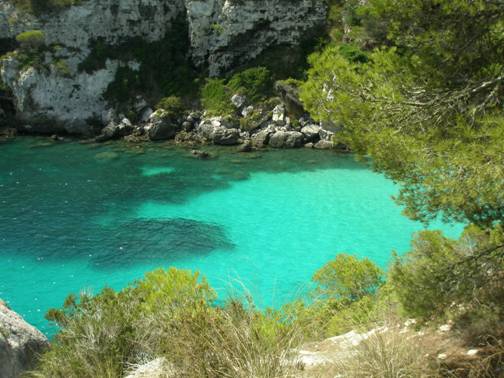
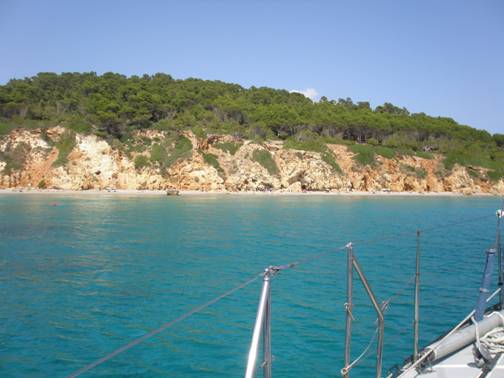
water… As the wind stayed firmly from the north, we
explored the south coast of
Cala Macarella.
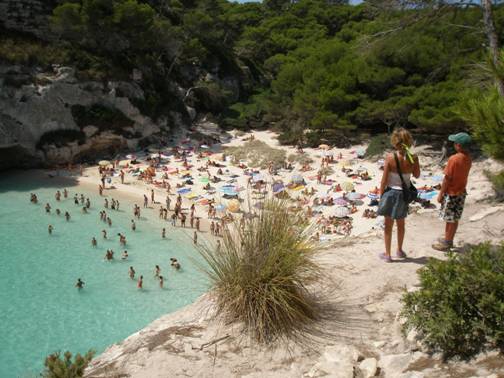
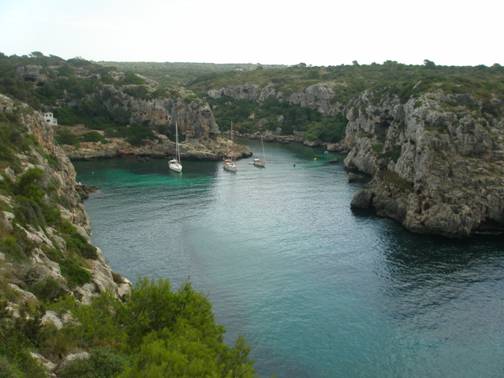
Cala Macarelleta. These coves can only be reached on foot by a 30-minute walk over the cliffs from the nearest holiday resort (Cala Galdana), a 20-minute walk from the car park – or by boat. Unfortunately, this doesn’t put people off, and we had to share the calas with hordes of other people as it was peak holiday season and a Spanish public holiday.
Sharing our anchorage with hoards of holidaymakers.
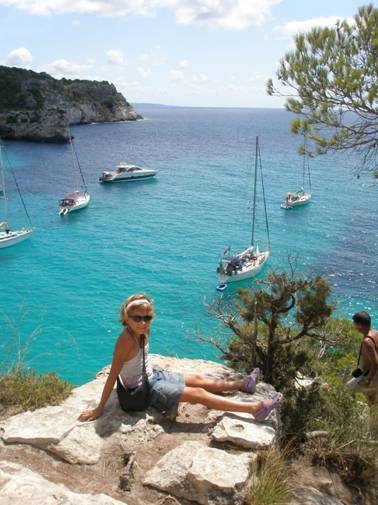
Our very own beach babe with Luckily, all the holidaymakers had homes, hotels or apartments to go home to, so in the evenings we had the calas to ourselves. This was a great place – with no light pollution – from which we watched the (partial) lunar eclipse. …and troglodytes
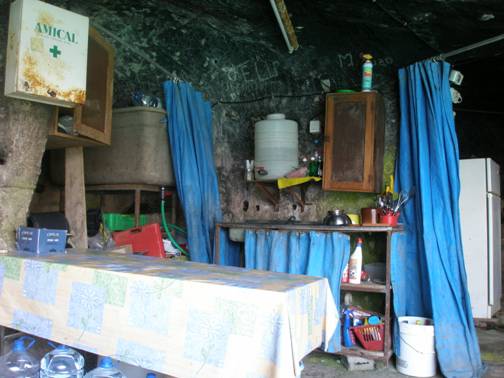
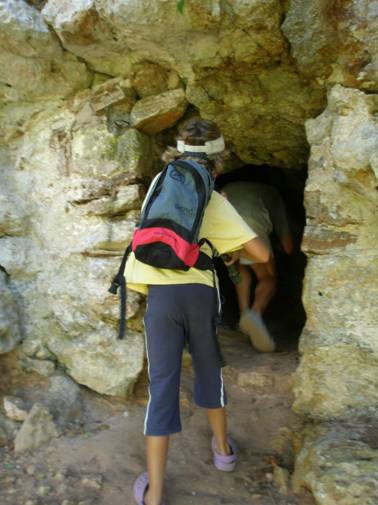
The caves in Cala Macarella are kitted out with
all ‘mod cons’ – with more room and facilities than we have on
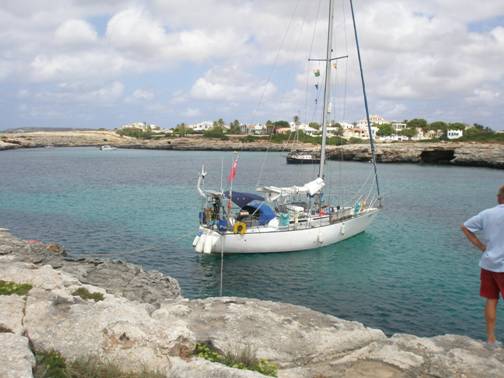
Mmmm, I think our first aid kit is in better shape though. Cala Santandría As the wind swung around to the south, we scurried around the southwest tip of the island and tucked in below Cuitadella, in the narrow rocky Cala Santandría. In contrast to the soaring, cave-riddled cliffs further south, the landscape here is low, rocky, limestone ledges. We set our anchor out in front over 5 metres of sand and backed close to the limestone ledge, using stern lines attached ashore to stop us swinging.
Our first taste of taking stern lines ashore.
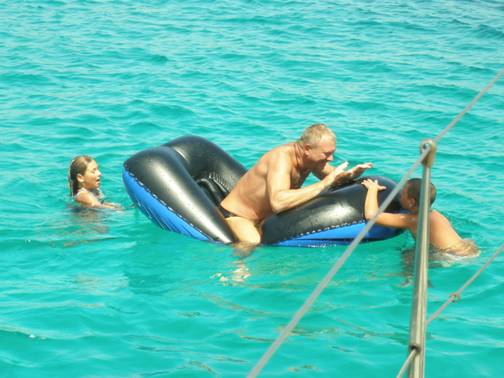
The three kids continued to have great fun with the little dinghy… …particularly once the floor gave way (there is a limit to how much abuse a little dinghy is prepared to take). The game then became diving through the dinghy – preferably from a great height.
For her next trick,
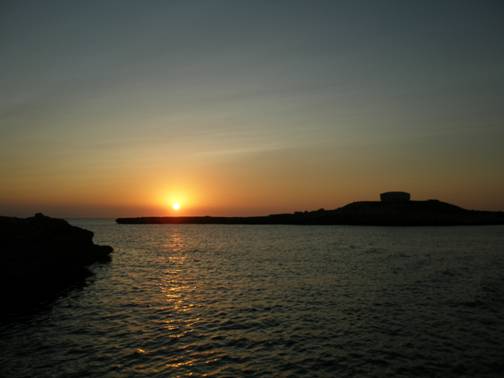
Sunset over Cala Santandría. Captain Fantastique saves the
day It was in Cala Santandría that I learned a bit
more about anchor handling. The first occasion was when the boat next door left
and took our anchor with it – I will not forget in a hurry the sound of the
windlass paying out chain at great speed when our bottom was only 1.5 m away
from a sharp limestone shelf (and David’s bottom was parked firmly on the loo –
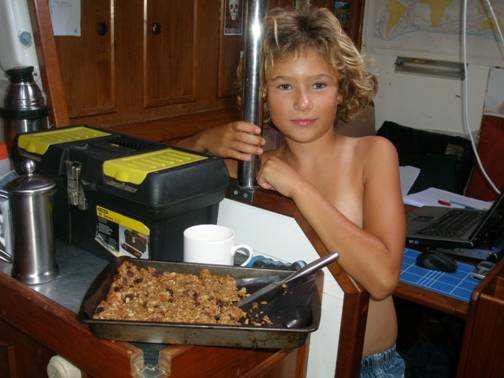
typical!). Luckily conditions were calm and Boat cuisine The children continue to practice their culinary
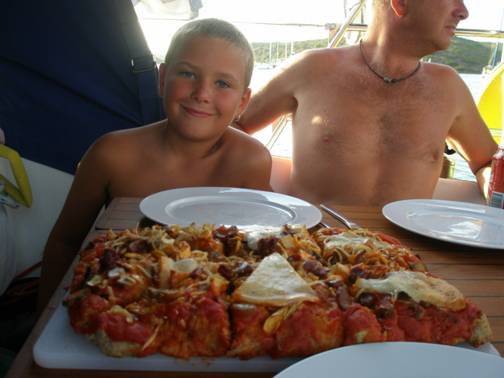
skills, and Bryn has even started writing his favourite recipes down in a
special book. I can see there is going to be a race to publish the
Pizza à la Bryn.
Flapjack à la
Sizzling bananas à la Expedition to the beach and
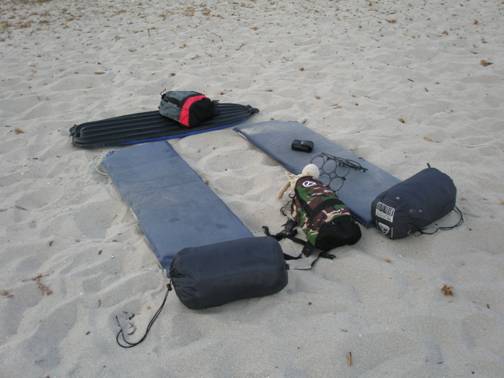
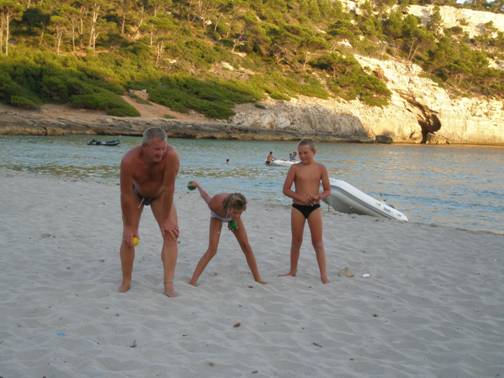
beyond Working our way back east, we stopped in the even more remote Cala Trebalùger, which is backed by a limestone gorge and small freshwater river. The expedition theme started when B&B announced that they wanted to camp under the stars on the beach. It took two dinghy loads to get all the equipment to the camp (including the boule set, rucksacks, sleeping mats, moosie, nightclothes, water bottles, torches, camera, hand-held VHF, bar of chocolate for a midnight feast), as Daddy was dispatched back to the mother ship for the sleeping bags (forgotten in the excitement the first time around).
B&B’s base camp on the beach.
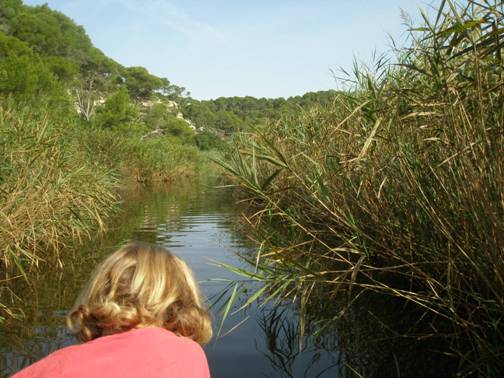
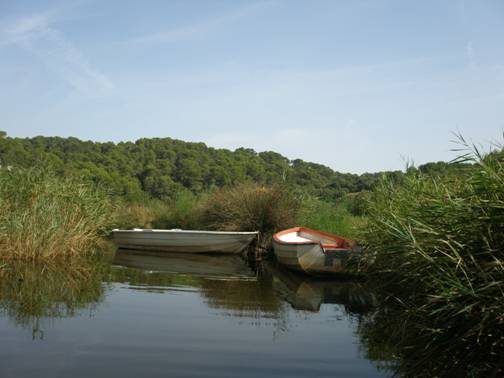
We stayed for a couple of games of boule before retiring to the mother ship to watch the camp through the binoculars. They lasted 1 hour before the mozzies got too much and we were radioed to collect them – but not before the chocolate had been eaten! The expedition theme continued the next day. We got up early to at least start in the cool of the morning. We carried the dinghy over the sandbar at the mouth of the little river, and rowed silently (well, OK, as quietly as the Smith family can) as far as we could up stream, disturbing moorhens, herons, black-legged egrets, dragonflies and water-boatmen. The still, quiet water, whispering grass and traumatized moorhens were a sharp acoustic contrast to our usual soundtrack of wind, sea, and the gentle slap, slap of waves on the dinghy’s (fine aluminium) bottom. We finally ran out of river and drifted back to the beach (munching tuna mayo butties for breakfast – doesn’t everyone have that for breakfast when on expedition?).
Rowing silently upstream…
…through a still, lush landscape…
…and whispering grass…
…until we ran out of river. That night, we shared the anchorage with one other boat – obviously Batman’s secret holiday hideout. Even superheroes need a holiday every now and again!
Batman’s secret holiday hideout. Even more caves Our next stop was Sant Tomàs, where we anchored off the beach and went on expedition in search of even more caves.
The anchorage at Sant Tomàs. We took a path that followed a limestone gorge
inland, climbing steadily for about 2 hours. Eventually we found the entrance to
Cova des Coloms (
“Do you think that vampire bats live here, Mum?” Once inside, the cave opens up into an enormous single cavern, which is also known as ‘the cathedral’ due to its high, vaulted ceiling. It wasn’t too damp inside (by cave standards anyway). The walls and ceiling were blackened and there was a faint smell of wood smoke – presumably from fires lit by people (ancient and modern) sheltering there over the years (centuries?).
Inside Cova des Coloms, you can imagine cooking sausages/wild boar over your camp fire while a winter storm raged outside.
Once inside ‘the cathedral’, the enormous scale of the cave is revealed. Heading back down the gorge, we went in search of another, less visited (for that read hard-to-find) cave, Cova de na Polida.
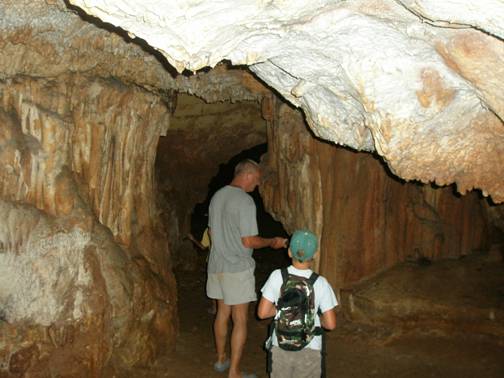
Into the unknown – luckily, we had our torches with us. Luckily, in true Famous Five style, we had brought our torches with us and were able to explore deep into the interconnecting chambers of the Cova de na Polida. At one time, this cave had been famous for thousands of stalagmites and stalactites of all sizes, some of which were incredibly fragile. Unfortunately many of these ancient structures have now been harvested very professionally – and presumably very illegally – and removed through a shaft cut into the roof.
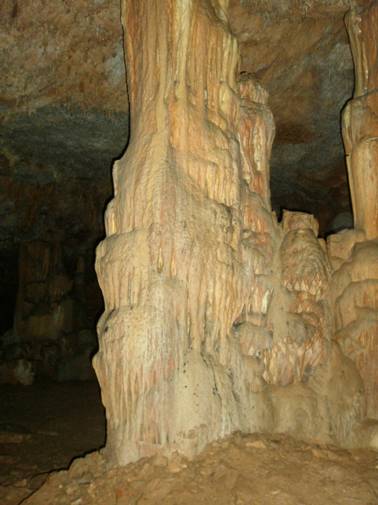
Some of the surviving stalagmites and stalactites in Cova de na Polida.
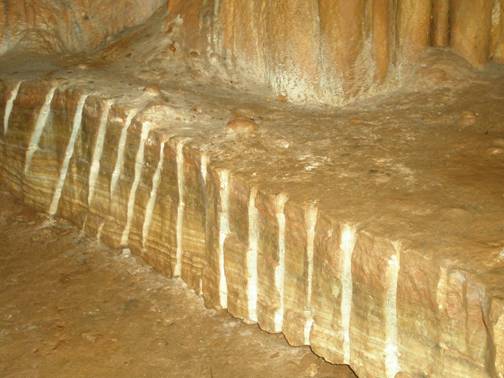
The marks in the rock showing where huge chunks had been cut away.
“School today, kids, is about how limestone caves are formed.” We meet PYXIS at
last! After leaving Sant Tomàs we headed back to Cala en
Porter for a couple of days to stock up on fresh food and for me to finish some
work. We were delighted to see a boat called PYXIS anchored there when we
arrived. PYXIS also has a blog on the mailasail website and we have been
following her progress closely as she has taken a similar route to us. We swam
over to introduce ourselves and it turns out that Karen and Richard have also
been following our blog. We met up a couple of times to swap experiences over a
glass or two of wine. Karen and Richard are also heading east towards Back to the
caves… Near Cala en Porter there is an extensive cave system that now houses a bar during the day and disco at night. Local legend has it that Xoroi (pronounced ‘shore-eye’), a Berber pirate who was shipwrecked on that coast, abducted a local girl and kept her hidden in his cave for 10 years, during which time she bore him four children. One particularly cold winter, his footprints in the snow gave away the location of the cave, enabling the girl to be rescued by her family. Xoroi threw himself into the sea.
Xoroi’s cave – visible only from the sea – is reached by flights of steps (now painted white) cut into the cliff face. Did we mention the
caves? Continuing the expedition-to-caves theme, David
and the children went off to find the most famous of
Calas Covas.
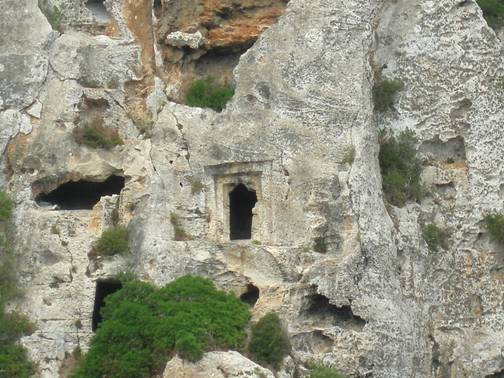
One of the caves has Roman decoration and inscriptions dating back to the 2nd century AD.
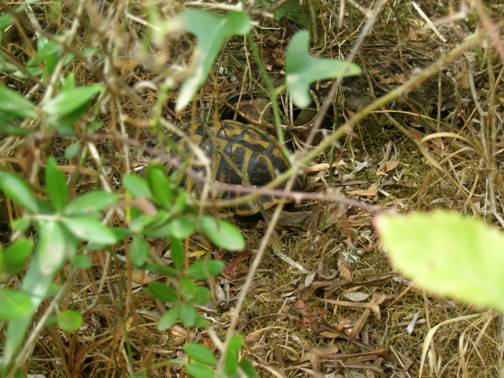
On the way back, the children were delighted to find a wild tortoise. From Cala en Porter, we headed back west to
|