Cape Finisterre – our first ‘Gre at Cape’

|
On Thursday 26th July we left Muxia in
the Ria de Camariñas heading south for the Ria de Muros. Contrary to the route
(on Google Earth) that we appear to have taken on the blog map – overland – we
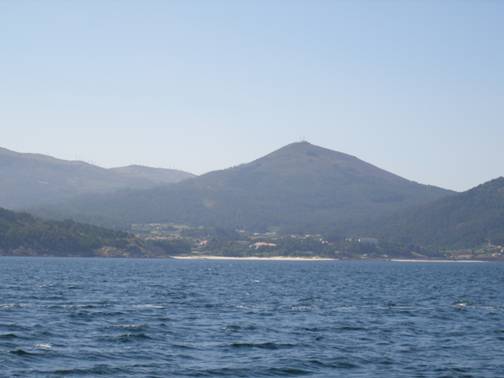
did actually sail (well motor ‘cos there was no wind) around
Rounding Cape Finisterre – our first ‘ Baking bricks, swimming crabs and fishing for
tuna With hardly a breath of wind and a sea with no lumpy bits meant that we had time for other on-board activities. Lawrence and David set up the fishing rods to attempt to catch tuna for tea, the children played on deck, and I baked the first loaf of the trip.
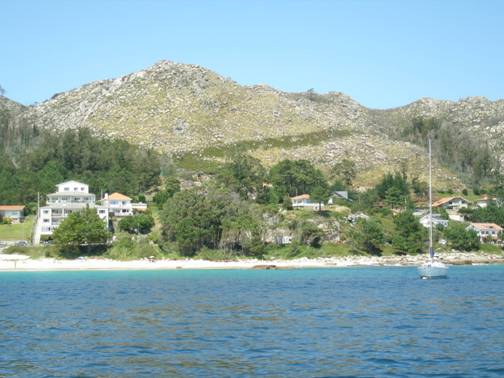
My luck wasn’t in either, as I baked the first ‘brick’ of the trip. Unfortunately the tuna weren’t biting and the loaf was a touch on the heavy side. Jamie (Oliver) reckoned that my yeast might have been a bit old side so the loaf didn’t rise quite enough. We still ate it. Just before coming into the Ria de Muros we were surrounded by a shoal of little crabs just below the surface of the water, each one about 5 cm across and swimming – sideways – like crazy. We anchored off the beach at
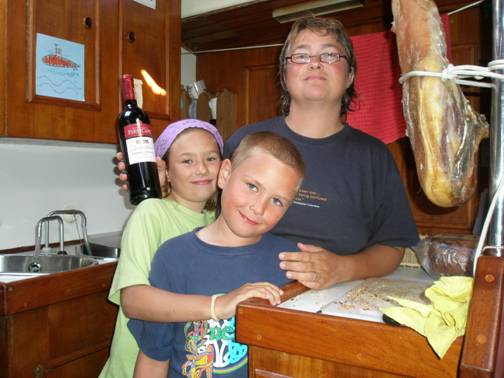
That evening we celebrated rounding Cape
Finisterre with the bottle of ‘
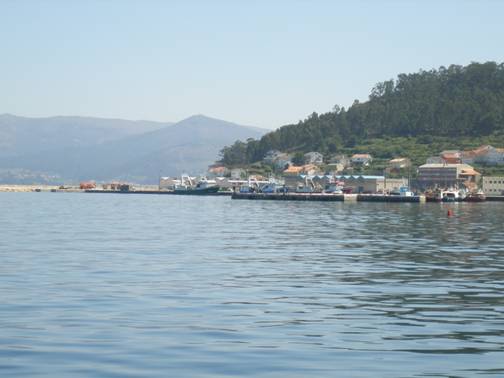
‘First Cape’ for the first Cape (the ‘thing’ on the right of the photo is a leg of Spanish ham – it isn’t as dangerous as it used to be now that we’ve stopped it swinging using a new knot thought up by Lawrence – a Ham Shank! [Pun intended]). Muros The next morning we left Exploring a new place seems to have developed a distinctive pattern. We always do a tour of the harbour (which involves in-depth discussion of the good and bad points of each fishing boat and marvelling at the sheer volume of mullet [and their diet] that seem to live in every Spanish harbour), followed by a hunt for a bar, supermarket, chandlers and internet café.
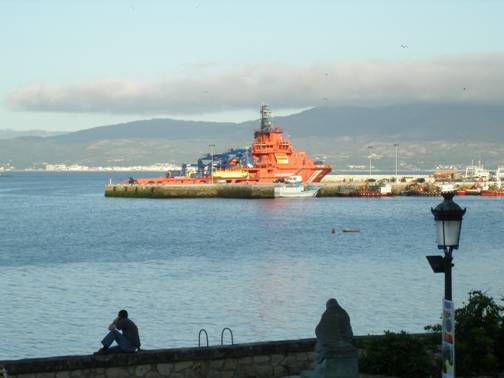
Muros. Muros was particularly fascinating with fish being landed when we got there, lots of fish stalls selling the catch of the day (which was Friday), and a huge orange salvage tug (David drooled over this for ages, and tried in vain to explain at great length to anybody who would listen how it all worked) until thirst drove us away to find a bar… We also added squid cooked in its own ink to the list of foods we have experienced. Beth and Bryn thought it was great when their teeth turned black, while I am still trying to get the stains out of their T-shirts.
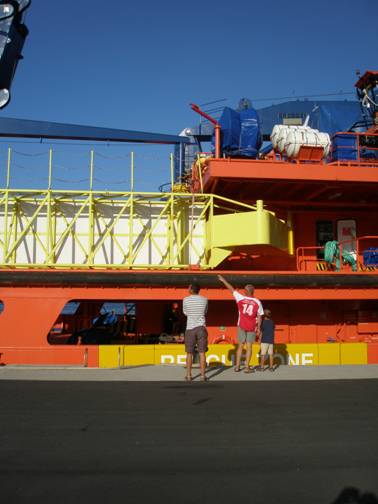
The big orange salvage tug – the cars parked alongside give an idea of its size.
Lawrence and Bryn trying to look interested while David explains where tuggies hang out their (or anybody else’s, apparently) knickers to dry… Playa de Aguieira After a couple of nights in Muros we hauled our anchor up out of the sticky, stinky black mud and crossed to the southern side of the Ria to the beach at Playa de Aguieira (an arduous 1-hour motor) for a spot more swimming and toasting on the beach. We fancied a game of beach cricket but it was far too crowded! We aren’t used to sharing our beaches!
Playa de Aguieira, a cricket-free zone. Portosin From Playa de Aquieira, we moved a little further (a whole mile) up the coast to Club Nautico Portosin, a friendly and very swish marina, with excellent showers, toilets that don’t move, and a launderette. I have a bit more to do on my project while we are here (good wi-fi internet access if I kneel in the cockpit with a towel over my head ‑ photographic evidence was destroyed under the threat of no food for a week!) and we needed to do a bit of maintenance on the engine (they have Volvo parts in stock here). Bethany and Bryn bumped into a couple of friends
that they had made while on the dinghy sailing course in Crosshaven, and added
‘ping pong’ to their list of skills. We caught up briefly with Flor and crew
(MISDEMEANOR) who were passing through on their way to Bayona after sailing from
Kinsale via the Scillies. It was Flor who recommended that we explore this bit
of the coast of Spain – thank goodness, otherwise we might have shot straight
past it on a dash to the Med. Instead of which, our progress has been limited to
just 20 miles per week since arriving in
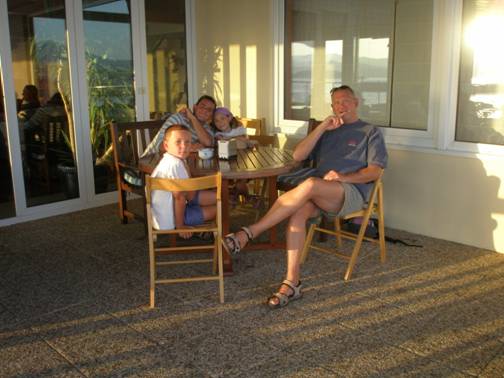
Loafing about on balcony of the Club Nautico Portosin. Dave doing his impression of Dr Evil with Mini-Me alongside (Mike Myers fans take note).
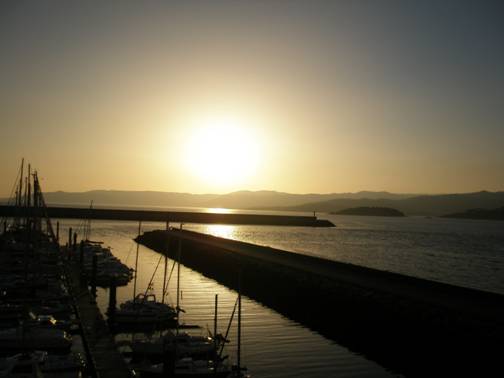
Arty photo of sunset in Portosin. Santiago de Compostela (this is the cultural
bit) On Tuesday 31st July we caught the bus
to Noia, and then another bus (after the bus drivers had had their siesta) on to
city of
The cathedral at Santiago de Compostela. Noia Noia was so pretty we went back again to have a
better look. The town was supposedly founded by Noela (daughter of Noah), after
the flood, and it has an ark as its coat of arms. The children have since done a
project on Noah’s While once a thriving fishing port (so the guide book says), the estuary is now silted up and inaccessible to anything but small boats and huge shoals of mullet. We stopped for lunch at a small restaurant and made the mistake of ordering the menu of the day, which started off with huge portions of paella and tortilla, followed by mussel pie. At this point we gave up but the food just kept on coming. We never reached the dessert tart and coffee! The staff insisted on giving us a doggy bag to take away the food we couldn’t finish. The fish, meat and vegetable market was brilliant and the children had an anatomy lesson at one butcher’s stall where all the bits of pig were on display. The stall keeper was delighted to explain (in Spanish) exactly which bits were which, while I tried to translate it all into English. It is said that the only bit of the pig that the Spanish don’t eat is the ‘squeeeeak’ – having seen this stall, we can well believe it! Still, at least it’s not raining here… |