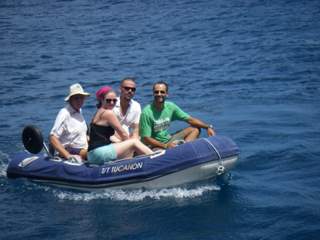
Going ashore at Baie Vaitahu

Tucanon
Dick and Irene Craig
Mon 5 Apr 2010 20:15
We went ashore and each of us had a beautiful, fragrant, fresh flower lei placed around our neck. We then completed the necessary formalities, utilizing the agent from Tahiti, that Rally control had organized for us. The agent dealt with everything thereafter which was rather wonderful because according to the information we have read on the subject, the formalities here are something of a nightmare.
We took a taxi to the town where we were able to obtain some local money. The ATM was not working so we managed to persuade the teller to let us have some money even though he wanted us to go to the post office for the currency.
Provisioning was horrendously expensive and we spent $200US on $25 worth of staples. The fruit was disappointing. I hadn't expected to be able to purchase vegetables but the books that I have been reading did lead me to believe that there should be ample exotic fruit. Not so. I did manage to find some oranges, mandarins, apples and grapes in a cooler. At a stall on the shore of the bay where we are anchored, I bought some bananas, mangos and avocados. I didn't buy the grapefruit which were $2 each.
The sea bed at our anchorage is littered with huge concrete bales, bound with chicken wire and in which a number of WARC participants have lost their anchors although some were subsequently retrieved.
Dick dove for a non WARC anchor which had been abandoned. He spent two hours searching for it one day and the next day he spent an hour before locating and salvaging a different one. On his second dive, he had been down for almost an hour and I becoming anxious regarding his safety called another WARC boat on the VHF. Just as they had launched their dinghy, Dick's head appeared above the water but he was so exhausted he found it very difficult to get back into the rib, finally managing by climbing up, using the outboard engine for footholds. Having previously cancelled the assistance, I almost recalled them to help Dick into our rib.
Because of all the diving activity attempting to locate and retrieve the lost anchors, we have been very busy filling empty bottles for other people, using our dive compressor.
While cleaning the water line of all the weed and barnacles which we had acquired over the last few weeks, Bev was more than a little surprised to see a ray, measuring around one metre across, accompanied by a baby ray, come right up to our boat. They had obviously been attracted by all the unwanted growth that was being removed from the hulls.
Wednesday after lunch we left Hiva Oa and sailed to Tahuata just over ten nautical miles away where we dropped anchor on the north west side of the island at the beautiful bay of Hamoenoa, with blue, clear water, a white sandy beach and trees almost to the waterline.
There were quite a lot of WARC boats already in the anchorage and that night there was a gathering ashore and participants sat around a fire playing guitars and singing. One guy climbed a coconut palm and threw down a number of coconuts. Attempting to cut off the tops using a machete without a handle, balancing one coconut on top of another, with light from a hand-held torch, the operator chopped off a finger from his left hand. Oisin's shirt was used to staunch the blood and our cool bag and ice blocks were used, in an optimistic attempt to preserve the finger. First aid was administered by a doctor from a WARC boat and the man was taken by boat to Hiva Oa for treatment. The next day he flew to Papete where better medical assistance was available.
While attempting to rejoin us in the bay the next morning, the boat that had taken their ailing crewman to Hiva Oa, developed engine trouble. It also now had no crew to assist the skipper/owner as his two other crew had already gone off for a couple of weeks, to explore the archipelego on their own. Rally control once again came to the rescue and Paul stepped in as crew.
Good Friday we departed the bay which was most wonderful for snorkeling. One person had even seen a shark while spear-fishing grouper.
We made passage to Vaitahu bay which wasn't at first sight very friendly and we were the only WARC boat that stopped there. Three others looked in while we were there but decided not to stop. The wind blew down from the hills into the valley and across the bay causing quite a swell and making landing look as though it would be a problem. We managed to find an acceptable anchorage and went ashore, visiting the very attractive large church in the pretty village.
Moving on from there we made passage to Hapatoni bay where we dropped our anchor having traveled just over five nautical miles from Hamoenoa bay, where we had spent the previous two nights. Three other WARC boats kept us company in the bay that night.
The snorkeling was amazing so next morning Dick and I went for a dive. It was fantastic. The coral looked like huge fungi piled one on top of another, resembling huts. The fish were something else, a multitude of different colours, some iridescent. From tiny fish, blue and yellow to large black fish with a yellow stripe. We moved through a large shoal of white fish, two or three times the size of a trout. We saw a couple of octopus and as they moved they looked like small brown bears scuttling away. This was most certainly the best dive that Dick and I have had. There were two sharks around 20metres away but we were unaware of this at the time plus a pod of dolphins 50 metres off.
When we returned to the boat, Moe and Bev borrowed the equipment and then went for a dive. Dick and I took the rib ashore and Oisin stayed on the boat.
The local people were very friendly. Most spoke some English. We bought some grapefruit and lemons from a local woman who, with the assistance of two teenage girls, picked them from their trees.
Later in the day, while replenishing provisions from my reserve stores, I found that two of the plastic boxes under the floor in the port hull, had liquid in them. On investigation, one of the tins of mushrooms had opened but there was no indication where the excess liquid had come from. I cleaned the boxes and tins, replacing them in the boxes which were then put back under the floor. We will have to monitor this and try to identify from where the liquid could have come.
Easter Sunday we raised the anchor at 6am and set sail for Fatu Hiva, a passage of around 42nm. As we moved northwards on a close reach, for an hour, until we left the island behind us, the wind gusted down from the hills at 37knots.
Once past the island, the wind blew force 5 and 6. Sailing 30º off course to make any progress, still on a close reach, resorting to the iron sail for the last hour of the passage, we reached the Bay of Virgins, dropping our anchor around 3pm.