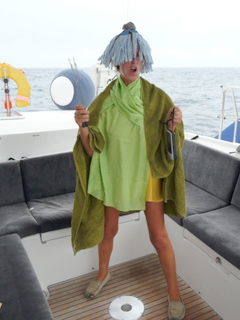
Neptune came to visit

|
Half a dozen small fishing boats, inundated with all types of rods of
various sizes, motored past us about 6.15 on Sunday morning as we were preparing
to leave our anchorage at Bahia Pinas.
We had a drinks party on board last night, for twenty people. The WARC participants from the five other boats, with whom we had traveled from Las Perlas islands. We were returning hospitality in addition to welcoming new friends. As we left the bay and I looked back at the mainland, I was overwhelmed by the sheer beauty of the vista. Heavily wooded hills to the very edge of the Pacific and behind, layers and layers of mountains, as far as you could see. Stunning! With very little wind, close hauled, we had been motor sailing for about five hours when we first spotted a black flag, standing up from the water. This was followed by small floats at intervals of about 100metres. Every mile there was another black flag until we eventually reached one of the fishing boats responsible for laying these nets, at least 5 miles long. We could see another fishing boat further to starboard and wondered if the two boats were working together. Some three miles to port, three of the other WARC boats had also encountered a similar situation. The water is now blue rather than green with plankton but despite this, a great many dolphins visited us during the morning and a whale was spotted some 100 metres to starboard. It was easily as large as our boat. The sky was mainly covered with
cloud during the first day as we motor-sailed until On the first day of the passage to Ecuador, we passed miles and miles of fishing nets, even finding ourselves crossing them on occasion, fortunately without incident. On the second day, the forecast was rain and thunderstorms but although it was cloudy all day and we had a little rain, we missed the bad weather. We continued to motor sail throughout the second day and into the third, passing several fishing boats and encountering a number of large commercial vessels. One of which kidded me that it was turning to starboard and then flashed its green light at me. The only way to avoid collision was to switch on both engines and do a 180º. Scarey! Day three was hot, sunny and the sea was flat. We spotted a whale at 6.30am, right next to the boat, dolphins during the morning and afternoon, a turtle, even a couple of sea birds stopped by for a chat. One of them continued to settle on our boat several times during the course of half an hour. Early afternoon within a proximity of 500metres, we passed two whales who flipped for us and then three more whales which also turned over for us. The most surprising visitor was the fish, possibly the size of a whole salmon, as sold in your local supermarket. It was purple with some yellow coloring but although we checked the book, we couldn’t identify it. It swam alongside the boat for over an hour before it finally disappeared. We are doing three hours on, six hours off during the night and then 1.5 hour watches throughout the day. I cannot believe that so close to the equator the weather is so awful. I have taken to wearing a body warmer and a windproof jacket when I am on watch. Each morning at We have been in visual contact since leaving Bahia Pinas, with Ronja and Noeluna until around 6pm local time on the third day. The fourth day was back to cloud
and rain, which seemed to be particularly torrential during my night watch.
However, this was the day that we crossed the equator and toasted
Thursday was our fifth day at sea and for an hour during the morning we were plagued by fishing boats and fishing nets, every which way. A nightmare! We reached La Libertad mid afternoon initially dropping an anchor, picking up two buoys and taking four lines ashore. The swell is not good and there is a lot of oil on the surface of the water. A turtle surfaced near the boat, quite at home with all the oil pollution. Dick took the rib to a nearby pontoon, some five metres away, to collect six officials who came aboard and checked passports, completed the paperwork and then one of the guys had to have an inspection tour of the boat. Soon after Dick had taken the officials back to the shore, we moved the boat to a pontoon, It was still necessary to pick up two buoys and take lines ashore as well as tie up to the pontoon but at least we wouldn’t have to get in the rib every time we needed to get ashore. At 18.30, we climbed aboard a bus
along with the other WARC participants and went to
Back on the boat soon after
The monohull moored next to us has a problem with the finger pontoon to which he is attached. It is coming away from the main pontoon and his boat keeps hitting the finger pontoon. His fenders don’t do him any favours being small in size. In fact, the three fenders on our side are actually concave! In order to help him over the problem, we tied his bow to our bow but this resulted in our boat jerking every time his boat moved causing us not to get much sleep. In order to assist the monohull further, the catamaran on his other side, another WARC boat, to whom the monohull is also attached, swapped one of the lines with one of his own in order to provide a more flexible solution. Not good. Owner of monohull returned after being ashore all day and found that the line attaching him to the other catamaran had pulled out his cleat and damaged the deck. There has to be a moral here somewhere, Saturday morning we did a major
shop at a local supermarket and ordered meat to be packaged and frozen for us
for collection on Wednesday, the day before our departure to the
Kind regards,
Dick and Irene Craig
Tucanon Website: http://blog.mailasail.com/tucanon
|