South to Moramba Bay, 14:53.45S, 047:21.34E

Meikyo
Phil and Sarah Tadd
Wed 16 Sep 2026 07:48
When we got back from our tour of Madagascar we decided to do a bit more sailing around Nosy Be before making a move south towards South Africa. We had been told that Nosy Mitsio, about 35 miles north of Nosy Be was nice and as the anchorage at Crater Bay had become uncomfortable we left our mooring and headed out. We stopped at Nosy Sakatia for a night to shorten the trip and to catch up with Laure and Stephane, Celiane and Timeo on Olena, who we hadn’t seen since Thailand, then left early for the trip north. It quickly became obvious it wasn’t going to be ba a pleasant trip. The wind was too far in the north, stopping us pointing directly there and there was a nasty short sea. Plan B was devised and put into operation and we turned to run down the east side of Nosy Be to find a quiet anchorage on an island just to its east. The next morning we made the short trip to Nosy Komba and joined half a dozen other cruising boats there for a couple of rolly nights. Sarah had wanted to have another look at some of the souvenir stalls here as they had some pretty looking wall hangings, but a closer look showed they weren’t what we wanted so we came away empty handed, however we did enjoy an walk around the shoreline and back through the village, and a meal with fellow cruisers at Yolanda’s restaurant on the beach. One of the best meals we had in Madagascar.  The women of Nosy Komba make and sell these cutwork tablecloths. They are reminiscent of ones we saw on Madeira, but not as fine  Children on Nosy Komba out fishing 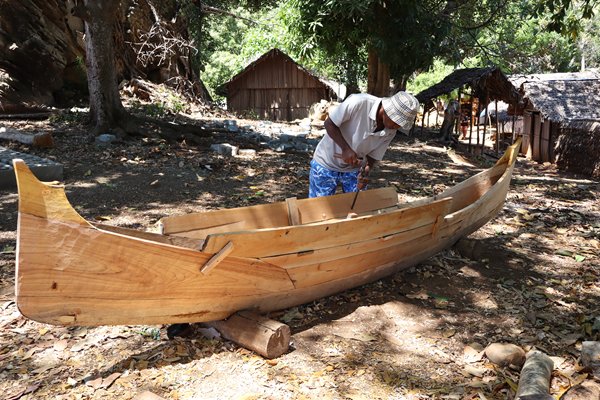 As we walked back through the village we came across this man making a pirogue using only hand tools Back in Crater Bay we started on preparation for our voyage south: dealing with departure paperwork, topping up fuel and cooking gas and a couple of trips to the market and supermarket as these will be hard to come by before we leave for South Africa, then on Tuesday we motored the 20 miles south to Russian Bay, on the mainland. This was just an overnight stop and the next day we continued to Baramahamay River, also known as Honey River due to the wild honey the villagers will trade. We were carrying a battery requested by the local school teacher, Daniel, and donated by another cruising boat in Crater Bay. The one he had been using with his solar panel had died and he only had power during daylight hours. There were four houses with solar panels in the village and they provided charging and light to others in the village. Daniel gave us a bottle of honey as a thank you for the delivery. We had been greeted on arrival by Fidel, who lived in a village slightly separate from the main one. He offered us a crab meal and a tour of the surrounding area but the price he was asking was significantly more than we knew friends had paid just a week before. His main language was Malagasy and his French was limited, which made things difficult but in the end we agreed just to the meal and had a tour of the main village with Daniel, who spoke good French. We tried to explain to Fidel that the cruisers all spoke to each the and if he started charging too much people wouldn’t come to him, but we were not sure if he understood. 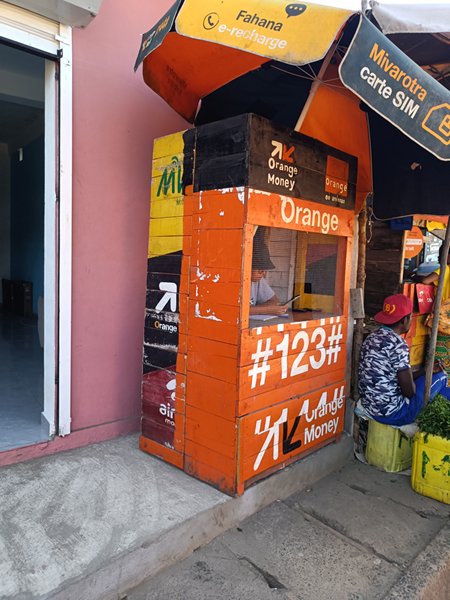 Over the last two years we have gradually had our credit and debit cards stopped by the banks so we now only have one remaining that we can use at ATMs. To try and preserve that one we took to using local methods. You put money on you Orange Money account then go to one of these booths where, using your Orange mobile, you can withdraw cash. As Madagascar is a cash economy the booths are everywhere.  Fidel's restaurant on the beach at Honey River 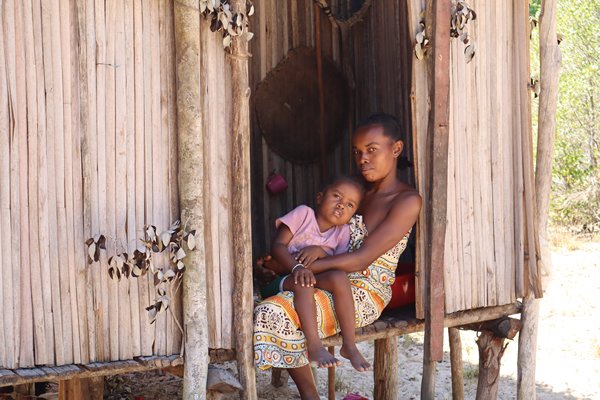 Fidel's wife and child  Phil and Daniel in front of one of the school buildings. The school was being renovated during the school holidays. With no government funding the work was carried out by Daniel and the villagers and they relied a lot on donated materials. The village school has 68 pupils up to 12 years old. After that they go on to school in Nosy Be - if their parents can afford to pay  The village had a small boatyard making dhows and pirogues as well carrying out repairs. It seemed like a busy business  Hen houses, Madagascar style After two nights in Honey River we continued south, stopping in a small bay with just a few huts on the beach and at Nosy Lava. Nosy Lava was a prison Island at one point and the ruined buildings are still visible. There is also a walk to a disused lighthouse that we would have liked to do, but strong south easterly winds were forecast and this anchorage was exposed in that direction so we moved on again to Moramba Bay to get shelter while the south easterlies blow through. For all of these day sails the weather had followed a consistent pattern with overnight south easterlies dying out in the morning so we had to motor for a while until the afternoon northwesterlies arrive around mid-day. This wind steadily increased through the afternoon giving some great sailing. Now the south easterlies were going to dominate and on some days completely kill off the northerlies. Moramba Bay is known for its kaast mushroom islets, its ancient baobab trees and the sikafa lemurs that live in the baobabs. We went looking for the lemurs on Monday but were a bit too late in the day to see them. On Tuesday the south easterlies arrived and put a stop to dinghy excursions. We are safely anchored in shallow water behind an island that is giving us good shelter and will stay here until at least Thursday when we hope the wind will decrease  Undercut cliffs in Moramba Bay form mushroom islands  Baobabs on the beach. Sadly no Sifaka in sight s/y Meikyo |