Grenada

15 December 2007 – 19 January 2008: Grenada
It got to the stage that we couldn’t wait any longer for the weather to improve for our passage from Barbados to Grenada. We had flights home to catch in less than a week, and we wanted a few days in Grenada to tidy the boat before we left her. So with a less than ideal forecast we sailed from Barbados after a 30-knot wet squall passed over us. Within 10 miles of the island we were clear of the clouds formed by the Atlantic Ocean winds passing over land and back in blue skies and blazing hot sunshine. It was as windy as forecast, but also very rough. Unlike mid Atlantic where the swell was long, shallow and always from the same direction, these waves were short and steep (up to 4m high) and from all directions crashing into each other with a plume of white water. In the short 24 hour passage between Barbados and Grenada we experienced the worst seas since leaving the UK. My enduring memory is looking behind the boat as we careered into a trough wondering where the wind had gone, and realising that the 8m wall of water behind us was sheltering the boat from the strong wind coming from astern. Yet again, Rahula performed magnificently, casually rolling above the waves. The Autopilot kept steering throughout, though he did drive a bit of a zig-zag as each wave threw the boat off course.
We sailed between northern Grenada and the Grenadines, in a beautiful sheltered channel full of marine life and an undersea volcano (which luckily didn’t erupt as we passed near it!) (It had a cool Caribbean name – ‘kick’em Jenny’…J). James caught another Mahi Mahi, and we finally relaxed as the swell abated in the lee of the island, giving us a pleasant sail past the Grenadian coastline. Unlike Barbados, which was relatively flat, Grenada is made up of towering mountains shrouded in tropical rainforest, reminders of its volcanic past. We finally arrived at the capital, St George’s, and anchored in the sheltered lagoon, all that is left of a volcano’s crater. As we were tidying the boat someone from a boat anchored nearby rowed past us in his dinghy, and James asked him where the immigration office was. The guy rowed over to talk to us, and after introductions and general chat asked us how we liked our Banshee. We were taken aback as few people recognise Rahula’s model, and asked how he knew what she was. “I used to build them!” came the reply. It turned out that he used to work at Palamos Boatyard, which built Banshees in the 80’s. He asked us what number Rahula was, and when we told him she was the 7th boat built, he immediately retorted with “Does the port daggerboard case still leak?”. Since we bought the boat 3 years ago we have been bothered by a small amount of water collecting in the bottom of the port hull, while the starboard hull always remained bone dry. James went through everything in the port hull to try to find where the water was coming from, to no avail. Eventually we decided to live with it. Then here was someone who said the leak had been there since the boat was built in 1989! So we shall continue to live with the leak!
Once we had cleared in to the island and recovered from the tough passage it was time to attend to the boat. We were booked in at a boatyard on the south east corner of the island to have the engine serviced. We sailed for St David’s Bay the following day, but struggled to make any way against the still strong Easterly winds and steep swell. It would have taken us all day to cover the 15 miles to the bay’s entrance, so we decided to turn around and reschedule the service, rather than pound the boat to pieces. We returned to the Grenada Yacht Club in St George’s and concentrated instead on preparing for the trip home.
|
|
|
|
St George’s
Lagoon |
Grenada Yacht
Club |


We had a wonderful two weeks in the UK, visiting family and friends and attending a great wedding of some close friends. It was really nice to see everyone again, and we only hope we didn’t bore people with too many cruising stories. To all those we didn’t manage to see, we are really sorry. We returned to Grenada on 6 January and found Rahula safely and sound where we left her. (Phew…Despite the fact we left her on a swinging mooring in Portsmouth harbour through summer sun and winter gales. When we left Rahula in St George’s in the care of the great Yacht Club, I felt guilty and worried about her. I suppose it is something like leaving your child with a baby-sitter for the first time; you know she’s safe and that you deserve the break but you still feel like a bad parent! To offset this a little, we spent a good day and a half scrubbing, cleaning, and polishing her so that when we did leave she looked amazing, even the languid security guard at the Yacht club made a comment! J) . It was good to be home and back in the hot Caribbean!
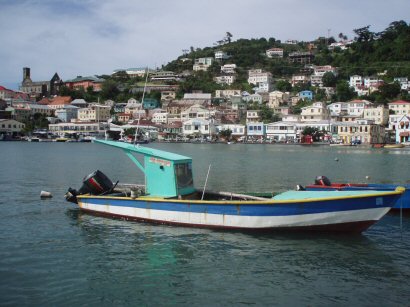
We now had time to spend a few days sightseeing around the island. We walked around the pretty town of St George’s, named after King George III. The town has two main waterfronts; the lagoon where all the yachts are anchored, and the Carenage, home to the local fishing boat fleet. Separating these two waterfronts is a small set of big ship docks. The Carenage’s curved waterfront is lined with old warehouses and merchant shops still used by businesses today. Many of these have been well restored, and set against the backdrop of colourful Creole houses make a picturesque sight. (Most memorable for me was the Careenage Café which made amazing fruit punch that you could stand a straw up in, and the Nutmeg Café, which was on the first floor of a waterside mews with huge open windows looking out over the Careenage and serving delicious club sandwiches; who says I only think of my stomach…J) Unfortunately there were still signs everywhere of Hurricane Ivan which ravaged the island in 2004. We saw several schools with roofs missing and clap board houses roughly patched up with any old bits of timber. This is despite the fact that some parts of the island seemed quite wealthy and the economy thriving. We assumed that the large immaculate houses belonged to foreign owners, with the funds to patch up any hurricane damage.
|
|
|
|
St George’s
Carenage | |

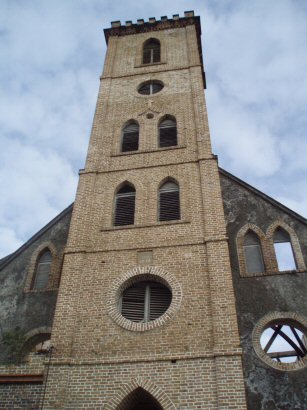
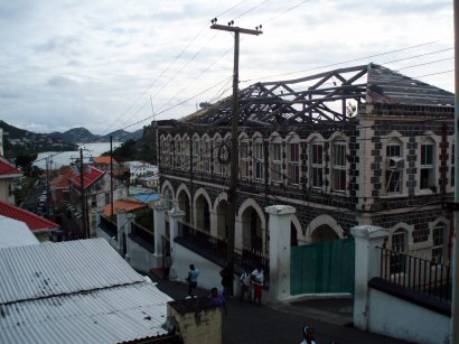
On our meanderings through the town we popped into the Grenada National Museum, housed in an old Creole house that used to be the French military barracks. The museum housed a random selection of artefacts from Grenada’s history such as Carib pottery, rum making utensils and whaling tools. There was also a room devoted to the island’s flora and fauna that told James which fish he is likely to catch when we sail along the coast! From the museum we followed the road up the ridge which separates the town past countless churches, many still in ruins after the hurricane. The cathedral stood at the highest point, its attractive brick shell still dominating the town. There were posters outside describing the reconstruction project planned, but no sign of any workmen. From this vantage position we had a clearer view of the destruction wreaked by the hurricane, newly painted rooftops contrasting sharply with empty hollows. On the other side of the ridge was the cruise ship terminal, complete with an air-conditioned shopping mall full of tourist tat. One street back from the seafront was the main market square, noisy fragrant, and full of exotic fruit, reminding us of our time in The Gambia (although without so many dead dogs and flies and a bit more liberal with the Rastafarians selling fruit…J).
|
|
|
|
St George’s Cathedral |
Church and
Ruin |
|
|
|
|
St George’s Roof
Tops | |


We rented a car for a day to explore the rest of the island. We found a highly efficient company who delivered the car half an hour early, completed all the paperwork in 10 minutes and provided a hassle free car return (highly unusual in the Caribbean!). We had booked a two-door car, and were expecting the usual useless Renault Clio (Gutless cars which need to be in reverse for most hills, I’d never buy one no matter how coquettish Nicole is…J) we had been given on other mountainous islands. Instead, we had a 4 wheel drive Suzuki Jeep, which was better suited to the local terrain (it had a V6 as well, yippeeeee…J). We set off immediately along the coast road and then into the mountains, heading for Concord Waterfalls, a set of three waterfalls along the Black Bay River. The road to the lowest waterfall twisted through the lush tropical forest filled with wild nutmeg and cocoa trees. We parked at the end of the road, put on our walking shoes (unusually organised for us, we normally end up doing this stuff in Flip Flops…J) and set off along the path leading to the other waterfalls. As we reached the path a local stopped us and asked when we were going. We explained, and he replied “alone?” and raised a speculative eyebrow. Weary of the you-must-employ-a-guide-to-go-anywhere attitude we encountered in The Gambia, we replied that we were more than happy to walk the path alone. The local warned us that we have to cross the river at several points, and sometimes it is difficult to find the path, but wished us a nice day. How difficult could it be, we wondered?!
Ten minutes later, we arrived at the first river crossing. It had rained for most of the night, so the river was flowing pretty fast and all the conveniently placed stepping stones were covered by a torrent of water. We were going to have to get our feet wet, so in we waded. The rocks were pretty slippery, but we made it to the other bank. As we continued further up the river, the path became more and more overgrown and the river crossings more haphazard. We stopped at one deep crossing point wandering how we would get across, when a local farmer in big black Wellington boots strode up beside us. He bounded across the river, soaring from one submerged boulder to another like a gazelle. “Hold your breath as you jump!” were his parting words. So we waded in, held our breath, and leapt inelegantly across. We were definitely wet now. After the second waterfall (obviously the end of the line for less hardy tourists!) the path became almost non existent and we followed the sound of the river up the valley though dense undergrowth. Then we caught a glimpse of a huge cascade of water rushing down a sheer cliff. We made it! We scrambled the last 100 meters up boulders scatted along the river to a lagoon at the bottom of a huge waterfall. We were totally alone, so we stripped off and jumped into the freezing cold water to wash off the mud we had accumulated on the walk up. It was really refreshing, though I didn’t like the water being so murky that I couldn’t see all the monsters lurking on the river bed… As we swam it started to rain really hard, and what wasn’t wet before got drenched. As we still had a whole island to explore and the place was full of mosquitoes, we reluctantly got dressed and headed back down the river.
|
|
|
|
The Road to Concorde
Falls |
The First River
Crossing |
|
|
|
|
The Second
Waterfall |
The final scramble to the
Third Waterfall |

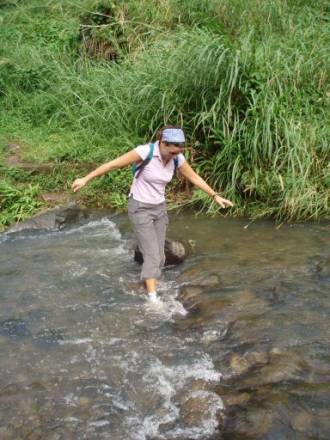


The walk back was easier, if a little muddier. As we passed over a small bridge we noticed a bag of peeled Cassava roots lying as if discarded in the water. We stopped to look at it, and as we walked away a head popped out from under the bridge, and a deep voice boomed “Good morning to you!”. That is how we met Ants, a local musician, who collects and sells Cassava roots when the going is tough (I would actually say he is more Cassava gatherer than musician but hey…J). He was a charming man, and we had a nice little chat about his music – like heavy metal-funk-jazz apparently. Like many people we met, he dreams of going to London to make lots of money. We tried to explain that London is so expensive you end up spending all that money just living, but to no avail.
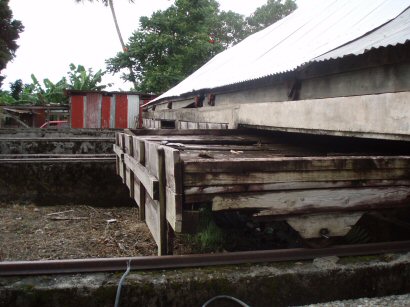
Grenada is known as The Spice Island, and produces a third of the world’s nutmeg, as well as mace, cinnamon, cloves and cocoa. It is a little known fact that mace comes from the same plant as nutmeg, and we heard a great story about a London bureaucrat sending a notice to the island’s farmers that the international market price for mace was increasing and that of nutmeg was decreeing so the farmers should grow more of the former and hold on to the latter! We felt we had to visit a spice plantation so we followed the western coast road north to the Dougaldston Estate. We found a very run down estate, full of half standing buildings and rusting machinery. It was fun wandering around the grounds trying to identify what each lump of rusty metal once did. The focal point was a large tin shed, which had rows of boucans underneath. These were vast trays for drying cocoa; they were pulled out from under the building to catch the sun, but where on wheels so they could be rushed back underneath in case it rained. Inside the building sat a group of old ladies, and as we entered one led us to a table covered in various branches and jars. She then proceeded to describe how each spice is extracted from its parent plant. We got to sniff the contents of the jars, and the strong smell of the various spices stayed with us for the rest of the day (in the case of the Cocoa I think it will stay with me forever, there must be some sort of endorphin releasing agent in that stuff. I nearly slapped Amelia’s hand away when she took the jar from me for a sniff, it really was like nothing you could buy in a shop, tastes awful raw though, yes I did try it despite being told not to!…J). At no point were we charged an entrance fee, so at the end of the talk we bought a handful of spices produced on the estate. The cocoa makes a particularly tasty cup of hot chocolate!
|
|
|
|
Spice Sorting
Shed |
Boucans |
|
|
|
|
Old Water
Wheel |
Spicy
Lady |



While driving along the winding coastal road we came across a large crane parked in the middle of the road, and workmen busy replacing a telegraph pole. Half the road was coned off for the crane, so James carefully steered around it to overtake. As we levelled with the crane there was a loud crash and the Jeep fell down with a lurch. The nearside rear wheel of the car had dropped into the deepest storm drain I have ever seen! (Typically helpful of a woman; seeing it after I drove into it! J) James tried to drive out, but the car was not moving, and we were worried about scraping the underside that was wedged on the road. There was a huge lorry behind us, and the driver was soon out to offer his assistance. Within two minutes all the male occupants of the queue of cars behind us came to look and suck through their teeth. Someone had the bright idea to bounce the car out of the hole. So a bunch of burly men crowded around it, and bounced it until the suspension jingled under the strain. Amazingly the car nearly bounced high enough to clear the tyre out of the hole! But it was still in the hole. Then James suggested putting a plank under the airborne tyre and driving it out. But no plank was forthcoming. Then, men being men, the best solution obviously involved the use of brute strength. So the now assembled crowed of about 20 people gathered around the car and bodily lifted it out of the hole. Then all the men gave James unwanted directions on how to steer the car clear of the storm drain, and we were on our way again. The car was barely scratched, and the hire company never noticed a thing!
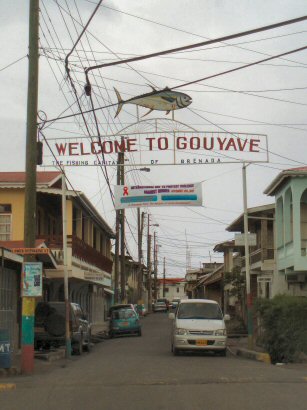
Further north along the coast we drove through Gouyave, “The Fishing Capital of Grenada”. This was another pretty little town, with colourful houses, lovely wrought iron balconies, and more ruined church towers. We stopped there for lunch, visiting a small bar on the seafront. When we asked the lady behind the bar what she had for lunch she reeled off a long list of dishes – chicken, fish, rice, macaroni cheese, salad and more. When we asked for a chicken and a fish, we got plates loaded with a portion of all the dishes she listed! It was all tasty, but very filling! We returned to Gouyave later in the week for the Friday Fish Festival. This was our first organised “yachtie” excursion, and we chatted to lots other cruisers in the bus on the way to the town. Stalls had been set up along two streets, selling a variety of fish dishes from Lobster chow main and tuna kebabs to deep fried everything. It all looked delicious, and as I was with a man with an appetite the size of an elephant’s (it’s a shame that is the only comparison…J), we started at one end and worked our way down… The whole thing was an exercise in attracting the tourists, and there wasn’t much of an atmosphere. (Except for the obligatory drunk, who I’m sure was being paid to be there. He was dancing to the loud reggae booming out of the western hemisphere’s largest speakers that were about 4 inches from his ear. But this was no ordinary drunk, he was the genuine article; the ‘Caribbean-had-too-much-local-home-brewed-rum-that-would-down-a-hippo’ drunk. They are easily spotted by their ability to remain standing with their eyes closed while swaying from their ankles to angles beyond what Newtonian physics allows. Seen upright on the far right of the photo below)
|
|
|
|
The Road to Gouyave |
Gouyave’s Friday Fish Festival |

The northern shores of Grenada were the location for one of the saddest moments in the island’s history. The French had invaded the island, and were fighting the local Carib tribe for ownership of the land. The Caribs retreated to the cliffs at Sauteurs, and when they were surrounded by French troops threw themselves over the cliffs into the sea rather than be killed by the French. The site is now home to a monument for the fallen and a small museum about the Carib way of life.

Leaper’s Hill
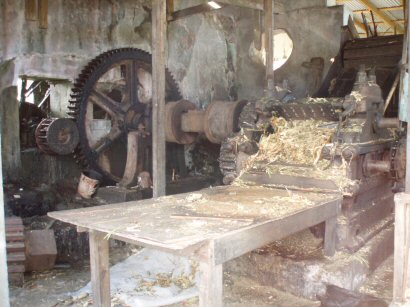
By now the sun was well past the yardarm, and it had been a while since we had been to a local winery / distillery (after Port in Oporto, Sherry in Porto Sherry, Madeira in Madeira…). So we headed for the River Antoine Rum Distillery, which uses old-fashioned Caribbean machinery driven by a water wheel to make its rum. We were guided through the rum making process from crushing the sugarcane, boiling the juice, fermenting and sampling. It was interesting to see all the old machines in operation and ponder about how inefficient they were. There was also little regard to Health and Safety and we strolled across rickety planks covering holes and looked down at the filthy boiling vats. But as the rum produced was 138% proof, we figured not many bacteria could survive the process! We bought a bottle to add to our growing alcohol souvenir collection, but don’t dare open it without a fire extinguisher to hand!
|
|
|
|
Crushing Sugar
Cane |
Boiling the
juice |
|
|
|
|
Fermenting cane juice
(nothing is added to start the process!) |
Distilling |

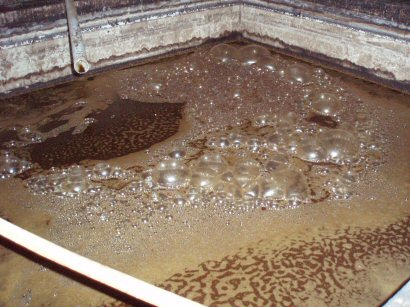

Having sampled the local rum it was time to head back to St George’s. We were on the less populated side of the island, and the roads were a web of single lane tarmac, with no signposts to guide the way. At this point, tired and woozy from the rum, my navigation failed, and we got a little lost. All things have a silver lining and in our meanderings through the backwaters of Grenada we stumbled across the old airport. There were still a few planes parked by the runway, slowly rusting to nothing as cattle grazed on the grass. The runway was still in good condition, and no doubt the location of many a teenage drag racing session. James revved the Jeep in anticipation, but it really was time to go home.

Pearls Airfield
We drove back through the centre of Grenada, climbing along some of the tallest mountains in Grenada. The road snaked its way through the lush interior, filled with large trees, waterfalls and lakes. At the top we had a wonderful view down to St George’s, lit by the sun setting over the Caribbean sea. It was magical, and the perfect end to a great day’s sightseeing.
We finally made it to St David’s Bay a few days later and had our engine serviced by Grenada Marine. On the way there and back we got to explore some of the other bays along the south coast. These narrow bays provide perfect shelter from the Easterly winds but often require careful navigation though unmarked reefs at their entrance. Luckily as the wind was still blowing strong we could spot most of the reefs by the breaking surf, though once we got an unwelcome view of some coral a bit too close up... We spent a couple of nights in Clarke Court Bay, a tranquil large bay with two small marinas and a village. We anchored in the centre of the bay, and went snorkelling in the sheltered reefs on the edge of the bay. We went for dinner at the Whisper Cove Marina, and had a wonderful meal prepared by Luke, a French professional chef. He and his wife Marie have been cruising on their large catamaran for many years, and stop every so often to work and earn money for the next trip. They had some fascinating stories to tell, and we bored them with our experiences. We bought Luke’s recipe book so that we could try to recreate the delicious dishes, but we also liked his tips for foraging for food – James is looking forward to catching and cooking some sea urchins! We also stopped for a night to anchor off Hog Island. This was a very crowded anchorage, full of boats that had been there a long time – we spoke to one American who had been anchored there for 5 years! The bay had a pleasant beach bar, but not much else.
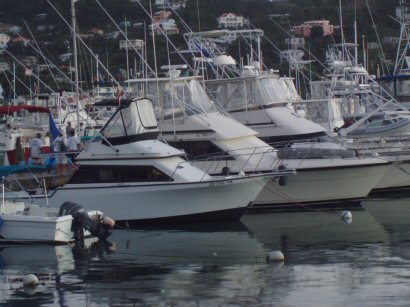
On our return to St George’s it was time to think about continuing on our journey west. A bad weather front kept us on the island for a few more days, and allowed us time to see the Grenada Billfish Tournament in full swing (bad weather my eye, A never did look at the forecast, tee heee! The tournament was great sport to watch, not the fishing you understand, but all the Sports Fishing boats that had come from far and wide and filled –and I mean filled- the pretty little Yacht Club. Now I’m a sailor really and power boats for pleasure have never really spun my props, but these were coool; the real competition here was how tall the towers were and how much stainless steel you could cram onboard and how many rod holders, looking like rocket launchers could you bolt on and the most important one was how big your engines were. But all the boats looked purposeful and sea-worthy which did do it for me a little…oh and seeing the fish weighed was also quite fun…J). We went to see the weigh-in at the end of the first day, and marvelled at the huge fish caught on relatively lightweight line (James insisted that none of the fish were that much bigger than what he catches! A). We also managed to spend a few nights at the yacht club bar with Martin, a German we’d met at the Fish Festival. He is great company with a dry sense of humour, but as he is a charter boat skipper there is little chance we will get to see him again (unless he quits his job and comes sailing with us!). In our last few days we befriended Stewart from Lancashire, who was sailing in a pretty monohull he’d built himself in South Africa to a very high standard. While James marvelled at the workmanship and systems onboard I could see the glint in his eye that warned that another “Jamesey Project” was on the way… It was definitely time to sail west to new horizons.
|
|
|
|
Grenada Billfish Tournament at the Yacht
Club |
Weigh-in |