The Gambia 3: Janjanbureh & Basse

|
071023 – 071026 The Gambia 3: Janjanbureh &
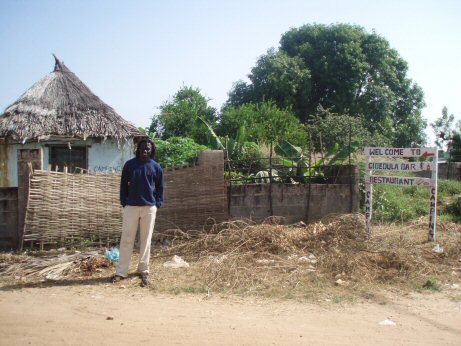
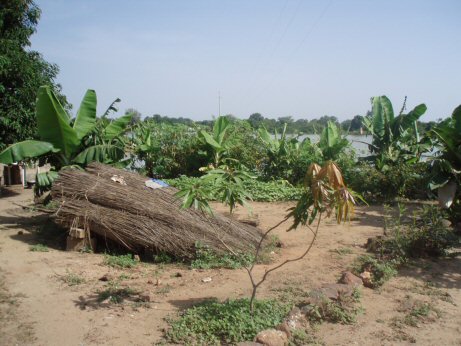
Basse We ventured ashore to Janjanbureh in search of the usual provisions and an Internet Café. We were unsure where we could land the dinghy, as there wasn’t the usual collection of fishing boats guarded by village elders or a handy lodge near the town. There was a pier with a very busy ferry crossing so we initially headed for that, reluctant to leave our precious dinghy near so many transient people. We then spotted someone waving at us from a small slipway on the river leading into what looked like his back garden. We headed for him (deciding what the heck, we’ll pay someone to look after the boat), and on landing ashore met Cho, a chilled Rastafarian Gambian who was to become one of our favourite Gambian “friends”. Cho offered to look after our dinghy while we went into town, and rather unusually for The Gambia, asked for nothing in return. He owned a plot of land on the river which he planed to convert into a camping lodge, and so was keen to attract tourists. At the moment, to earn money for his venture, Cho grew bananas, potatoes and, judging by the smell and group of young men hiding in a clearing, maybe something more exotic. One of these young men (who seemed more conscious than the rest) came over to meet us, and offered to show us around the town.
We saw all the town’s sights in about 30 minutes. These included a colonial lamp post that has lost its head, a rundown timber house typical of the type built by the early settlers, and the Freedom Tree Monument. This commemorates the time after the British ban on slave trading when the islands became a refuge for runaway slaves; any slave who touched the tree had their names recorded by the British soldiers at the nearby fort and were granted their freedom. We also came across the oldest Methodist Church in sub-Saharan Africa – phew, I was getting church withdrawal symptoms as we hadn’t visited a cathedral in a while!
The market was still going on so we joined the throng of women and bought some fruit and vegetables. Our attempt at changing more money ended in disappointment when we could not negotiate a rate as good as the one we got in Banjul, so we decided to wait for a better offer and only changed a little. We also failed with our mission to publish the last diary and some pictures, as we were told the electricity was down during the day so the Internet Café was only open in the evenings. Drinking water was easily obtained from a standpipe in the street, and James got diesel from the town’s petrol station. The petrol station comprised of an old man sitting under a Baobab tree surrounded by 5 and 20 litre vegetable oil drums filled with diesel and petrol. He fills these up every morning from the petrol station on the nearby highway, then sells the fuel on to the bush taxi drivers for a considerable mark up. The river water was fresh and pretty clear, so we used it to give the boat a good clean, have showers and do some much needed laundry, Gambia style. (Laundry is my ‘Part of Ship’ and in the Gambia I
developed, the perfect lazy yachtie’s 10 step method for hand washing: 1. Find a
large black tub labelled ‘Biohazard’ floating past and grab it with a boat-hook,
it should be about 30 litres to cope with about 6kg of laundry.
2. Fill it
with finest River Gambia water, add detergent and laundry [after pre-treating
those stubborn stains]
3. Cover
with black bin-liner to keep the bugs out [well most of them anyway] and leave
in direct scorching African sunlight.
After a few hours the black bucket will have absorbed the sunlight and
heated the water to about 50 deg C.
4. After
about 6 hours, agitate laundry slightly, treading as per wine-grapes works well
[no need to work up a sweat] 5. After 24
hrs drain water and wring out clothes, replenish bucket with fresh River Gambia,
re-cover and repeat step 4. 6. After
another 24 hours, give another rinse until water remains nearly clear and wring
out clothes [careful of those delicates] 7. To save
bother of clothes pegs and for added security, thread thin rope through clothes’
arms, legs etc and spread rope between shrouds, mast
etc. 8. Leave in
scorching African sun for about 10 minutes or until
dry. 9. Open
hatch above the main cabin and dangle one end of rope onto the bunk, release
other end of rope and elevate, allowing clothes to fall onto the
bunk. 10. Fold and
stow clothes, ensuring Amelia’s are on the wrong shelf, remain inside out or
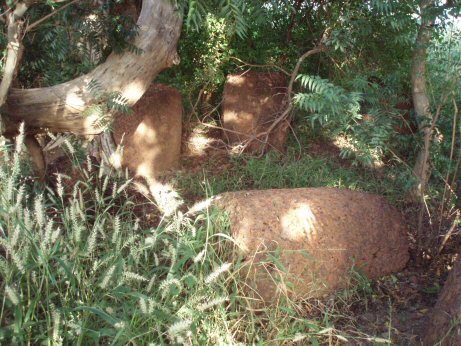
still have bugs in the knickers… I’m always available for further domestic tips…J) In the afternoon we visited the only other attraction in the area, the Lamin Koto stone circles. There are a number of these ancient circles dotted around The Gambia, and no one really knows who built them and for what purpose. We had a pleasant walk through the bush with a guide we picked up at the Janjanbureh Lodge on the north bank of the river, past cous cous, rice and maize fields. The circle was hidden from the main road under the branches of a large tree, and, well, it was a bunch of red stones, in a circle. We went, we oohed, we took a picture, we left…
Lamin Koto Stone Circle We then returned to Cho’s place across the river for our pre-booked slot at the Internet café. As we arrived I moaned about the fact that I had broken my favourite sandals on our walk through the bush. A tall, lean, black man, standing at the river’s edge in his underpants having a wash, turned towards me and through a haze of soapy suds covering his face exclaimed that he was a shoe surgeon and could fix my shoe for me! I was too stunned to refuse, and handed over my worn out sandals (which I have owned for 5 years now, and are probably past their best…). Then arose the question of what I was to wear on my feet to walk through town to the Internet café. By this stage a small group of the aforementioned random stoned men who hung around Cho’s place had gathered, and they pondered my dilemma. Then Cho exclaimed that he could lend me his sandals, and promptly fetched a pair of posh walking sandals, which fitted me perfectly. On our return I was handed a neatly stitched pair of shoes, as the shoe surgeon applied the same fix to the other shoe, lest that should break. I gave him a few Dalasis for his trouble, admiring the repair that will probably last me another 5 years! Internet Café is a rather grand name for an old computer housed in a community centre office. There was no sign of any coffee, or a sniff of a broadband connection. We battled though the slow dial-up speeds, cursing at all the graphics on the web pages we were trying to navigate which slowed things down. We had forgotten the bad old days of dial-up Internet! It took us 30 minutes to send one email, so we soon gave up, hoping we would find a better connection when we returned to the coast. Unfortunately, it seemed that the whole of The Gambia is still happy with dial-up speeds, so we never found our high-speed nirvana. That night Cho cooked us dinner. We had “ordered” Domodah, a traditional Gambian dish made of peanut paste, palm oil, tomatoes and meat. He was so keen to please us that he threw out all the hangers on and set up a table in the clearing in his garden, complete with a clean tablecloth. When darkness fell, he lit candles all around, and placed one on the table in a cut down water bottle. As a starter we had some sweet Arabic tea, then he served us a HUGE portion of stew and rice. It was delicious, though neither of us managed to get through the mountain of rice (for those of you that have never seen what I can get through in a sitting, this is really saying something…J). Desert was fresh palm wine, tapped out of the tree that afternoon. As it hadn’t had a chance to ferment it wasn’t too potent, and tasted like a refreshing cordial. Cho was keen to impress as we were his first real customers. We were happy to oblige, and were touched by his sweet keenness. We promised to recommend the Gibedula Bar & Restaurant to every cruiser we meet heading for The Gambia. So here it is – if you’re in the area, visit Cho for some great food and company! The next day we decided that as we couldn’t reach the
upper reaches of the river by boat we would go to the last big town in the
Gambia by road and visit the large market which was supposed to be excellent for
cheap souvenirs. We met up with our
guide from Janjanbureh camp (who assured us that he did not charge for his
services, and was willing to accept anything we had to offer) and took the ferry
to the south bank of the river. We
then had a half hour bush taxi ride to Bansang, followed by a longer journey in
another taxi to Basse. The journey
wasn’t too awful, and did not involve much hanging around. The bush taxies were a mechanical
miracle, proof that Mercedes vans just go on and on. One of the buses we used had no key
ignition, and the engine was started by shorting two wires poking out of the
dashboard; the engine was stalled by blowing into a small pipe. Another could only be jump started, and
the poor fare collector had to jump out each time it stalled and push a van full
of at least 20 people until the van jolted and the engine fired. All the vans had huge cracks across
their windscreens, no suspension and dead gearboxes that crunched each time a
new gear was selected. These MOT
failures were often driven at breakneck speeds along barely tarmaced roads full
of potholes. Some of the holes in
the road were so big and deep they were practically bore holes! To avoid the potholes extra lanes were
carved on either side of the road by cars veering into the dusty verges. So many cars had used these bypass lanes
that the earth had worn down well below the level of the road surface, so when
we used them, one wheel on the road, one wheel off the road, the van tilted at a
dangerously acute angle. Every so
often attempts had been made to repair the potholes using broken sea shells and
cement, but this soon worn through as well. There was also no real side-of-the-road
driving convention. It appeared
that vehicles generally took the side of the road that had least potholes, and
if you met another can coming the other way whoever blew his horn and flashed
his lights the most (if either were working at all) seemed to win right of way,
sending the other vehicle into bumpy middle of the road (as we were on the
verges…). To complete the African
cliché we also shared (in very close proximity) these buses with a woman
who breast-fed her baby nearly the whole way, and another women who carried a
live chicken in her hands as if it was a handbag. (Amelia must never complain
about my driving again!
J)
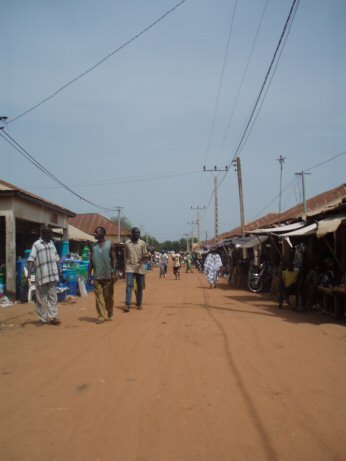
We finally arrived at what seemed to be the end of the earth (and is practically the end of The Gambia). Basse was a large, hot, dusty town with a very busy commercial area, full of stalls selling kitchen utensils and colourful printed cloth. There was rubbish everywhere, a sign, we have discovered, of an affluent area in the Gambia (as it means that there are people around who can afford to buy things in packaging, rather then the locally produced goods). There is no such thing as a municipal rubbish collection, so it all gets thrown in the street, and occasionally a shop keeper will sweep the area outside his stall and burn the pile of rubbish. It soon became too hot to be walking around, so once we bought a few souvenirs and had some lunch we headed for the bush taxi garage for the long journey back.
The return journey wasn’t as simple. We ended up hanging around Basse for an hour waiting for the bush taxi to fill up, as the driver refused to leave until he was full to capacity. We sat in the hot van waiting for people to turn up, buying frozen Baobab fruit drinks to cool ourselves from sellers hawking on the street. The journey was also marred by the fact that our guide started dropping some very unsubtle hints that he expected paying, and that the last time he took someone to Basse they bought him a 50KG bag of rice. When we asked how much such a bag would be, we discovered it was the equivalent of a month’s salary in The Gambia! We had always intended to tip him for guiding us, but we refused to pay that much as we were running short of cash ourselves (a difficult commodity to obtain in a country with no banks!). We gave him what we felt was right, and vowed to always agree a price beforehand with any person we employ (a strategy that we had adopted on arriving in The Gambia, but for some reason this one slipped through…). From then on we also refused to hire a guide, and found that we managed perfectly well on our own, without getting mugged, lost, or ripped off. (The economic logic of employing a local guide to help you get around and get “local prices” rather than “tourist prices” never made sense to me. These guides always demanded a higher payment than what they saved us when haggling for things, and I found that I was better at haggling than most of them, as it was my money we were spending! A.) We finally arrived back at Janjanbureh at 1830, much later than we expected, sad to have missed our pre-arranged afternoon beer at Cho’s. We popped by Cho’s place on the way back to Rahula to apologise for not coming by, and he immediately invited us in. We were tired, dirty and hungry and Cho offered us the use of his bathroom (the slip way on the river bank, where everyone else seemed to wash) and mentioned that he was cooking bush pig. His friend had bought the pig from a guy who shot it that day and was carrying back to town slung across his bicycle. Too exhausted to cook, we happily accepted, and had another delicious meal under the banana trees in Cho’s garden. When we asked for the bill Cho refused to charge us, but we insisted on paying, if only to contribute towards his lodge setting up fund. We awoke the following morning to find the boat absolutely covered in dead beetle like bugs. There were so many of them the cockpit floor was almost black. It was time to leave and head back down the river to the open ocean where there aren’t any bugs. In the morning of our departure while waiting for the tide to turn we popped back to Cho’s place to say goodbye. We made him promise that if we ever return we will find his lodge up and running and earning money. Somehow, we doubt it. It just isn’t in the Gambian psyche to be businessmen. |