Day 2

|
Position
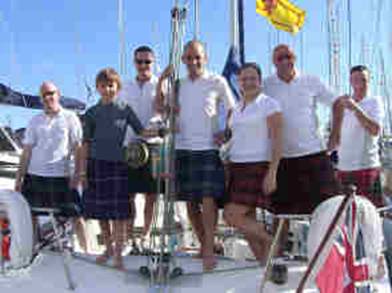
at The crew of Duckwall Pooley. A Beneteau First 42S7 which is in our
class. They have spent 4 years moving it from the
Donald, where’s your
troosers? As dawn
broke on 27th we woke up to huge seas of 3 – 4 metres, with the wind
still blowing at 20 – 25 knots from the north-east. The movement of the boat in
these seas made it very risky to fly a spinnaker, for fear of wrapping it around
the forestay. We decided to stay with our No. 1 headsail instead, and were
making a steady 8 knots. A quick
examination of the damaged spinnaker confirmed that we would use all of our tape
in making a quick repair, and in all probability it would not be able to handle
winds greater than 15 knots. It was re-packed and will go to the sailmaker in
We turned
our attention, for the first time since starting, to our overall race strategy.
Essentially there are 2 main routes for the race. The northern one, which is
almost a straight path to As we
progressed down the African coast on port tack, it became clear that we could
not pass to the west of One thing
which we underestimated was the amount of battery charging which is necessary
for the many electronics the boat carries. We had estimated 2 hours of charging
per day. We need to charge for 5 hours. This has an impact on diesel fuel
consumption, but we have sufficient in reserve to handle this increased
requirement. Not having
had a hot meal for 48 hours, the skipper offered to cook last night; no mean
feat with the very unsteady motion of the boat. We all enjoyed an excellent
Irish stew at During the night we
ran a competition on who could surf a wave fastest. Mik and Ron won with 15.8
knots (liars!). In the morning we
were treated to a circus act of porpoises swimming alongside the
bow. |