Life on a remote island

Casamara
John & Susan Simpson
Tue 3 Feb 2026 19:21
Island life doesn’t come much more remote than on St Helena. Set in the South Atlantic, St Helena is 1200 miles from Africa and 2000 miles from South America. It is famous as the place to which Napoleon was exiled after defeat in the Battle of Waterloo in 1815. He died there 6 years afterwards, but more about Napoleon later. From Namibia it took us seven days to reach St Helena, quite a lot of it motoring as there was no wind. Who knew that so much of the South Atlantic could be so still and flat? From 40 miles away we could see St Helena towering 800 metres above sea level. It is a very big chunk of volcanic rock, though its total area is only 47 square miles. As the sun set we made our approach and dropped anchor off Jamestown, the capital, in darkness. 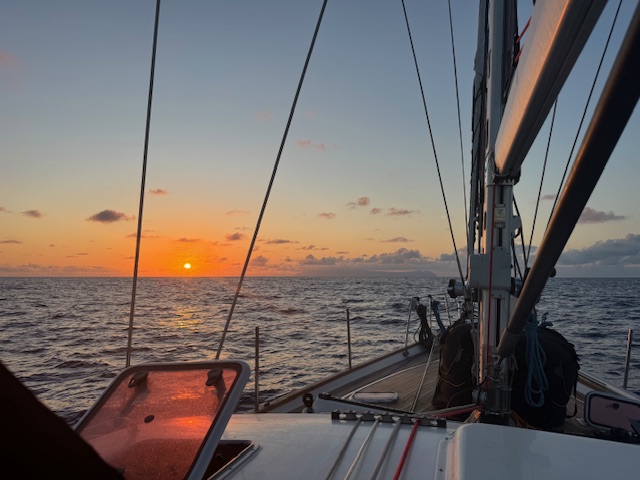 Approaching St Helena at sunset Once we’d completed formalities the next morning we were free to explore, and took the ferry service which picks you up from your boat and drops you at the landing steps on Jamestown Quay. Kyle, the ferry owner, did a masterful job managing the landing process in the swirling water. A gantry strung with knotted ropes hung above the steps, giving away the fact that getting ashore is not for the faint hearted. 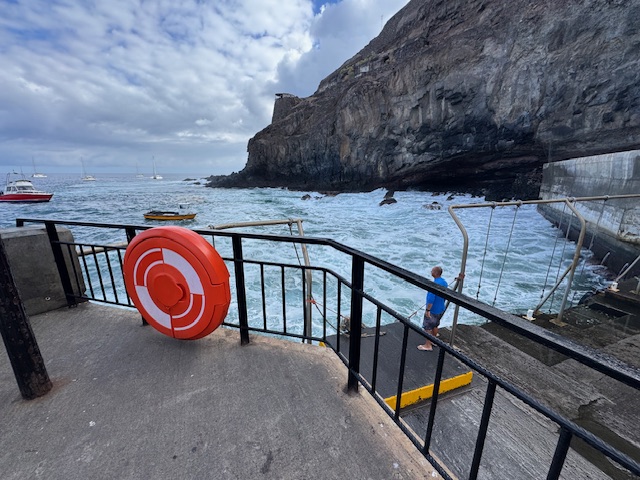 Jamestown landing steps Jamestown is a quaint little place, a bit like stepping back into England a few decades ago. It’s mostly a cash economy so John had to queue at the Bank to pay for the fuel that had been delivered to Casamara in the anchorage by bunker barge. He had to draw the cash out of the Bank in order to pay it back to the bank teller to pay the bill! The grocery shops accepted only cash (the British £) or payment by the St Helena tourist card, a card that you load with cash to pay as if by card. The shops were running low on goods as the supply ship was due to arrive the following week. Many of the shops sold fresh produce grown in the owner’s garden, but there wasn’t much variety on offer. We stocked up on potatoes, bananas and tomatoes. We’ll have to be a bit creative with tinned and frozen fruit on the way to Brazil, our next long passage. 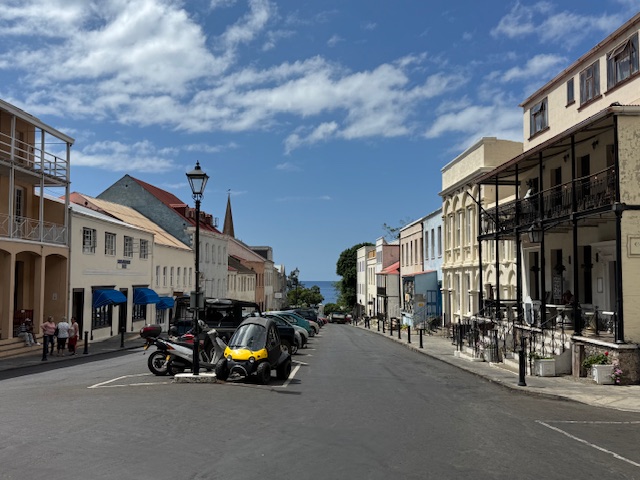 Jamestown High Street ‘Jacob’s Ladder’ rises from Jamestown’s central square. Once a funicular railway carrying supplies to the top of the hill, it is now a fearsome looking 699 step staircase that has become something of a tourist attraction. Runners from all over the world come to try to beat the latest record for ascending. The fastest time to date is 4 minutes 40.75 seconds. Our resident runners, Andrew and Traci, gave it a go, declaring it to be much harder than expected! On Sundays wherever we land, John and I try to attend a service at the nearest Anglican Church. We were given a very warm welcome at St James’ Church, the oldest Anglican church in the southern hemisphere, built in 1774. We sang from the same hymn book used at the church we go to at home in Winchester, and even met a lady who’d lived in Winchester for 20 years! We noted that the prayers had a local touch in praying for those who’d had to leave the island for medical care. As the congregation was quite elderly, access to healthcare must be a bit of a worry. One of the parishioners thanked us for visiting and said what a boost to the islanders it was to see the anchorage full of the World ARC Rally yachts. She remarked how lovely it was to have the town’s streets so full of people, which given that we’d remarked how quiet the place seemed, was surprising. At the latest count there were 4,500 people living on St Helena and the yacht crews numbered approximately 80 in total, so our visit briefly increased the island’s population by nearly 2%. As it happened, that was the last the people of Jamestown would see of the yachties and the last we would see of life in St Helena. As we enjoyed our post-church coffee at the St Helena Coffee Shop, Kyle the ferry man approached to say he needed to take us back to the boat as a swell had built up that would soon make it to dangerous for his ferry to operate. We were confined to our boats for Sunday afternoon and overnight, and by Monday morning conditions had not improved. We’d booked a tour of the Napoleonic sites on the Monday but had to cancel as Port Control had closed the ferry service. We might have visited the Napoleonic sites over the weekend, except that they only open to visitors on certain weekdays! So we will never know how Napoleon was treated by the British whilst in exile on St Helena. The closest we came to Napoleon was singing the ABBA song ‘Waterloo’ whilst partying on Amelia, one of the other boats! 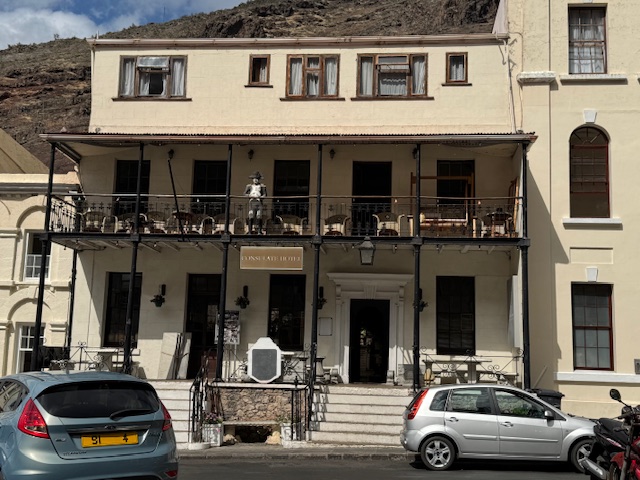 A figure of Napoleon permanently looks out from the balcony of the Consulate Hotel John managed to get ashore in our dinghy to clear us out through Customs and Immigration, and we left St Helena realising how much life there depends on the weather and state of the sea. Although an airport has been built quite recently, even that is prone to closure due to wind conditions. At times the islanders must feel totally cut off from the outside world. Next stop is Recife in Brazil, approximately 1,900 miles away. |