Memories from Over the Khunjerab

|
Lat:
36:41.166666
Long:
74:48.416664 Memories from Over the Khunjerab
12th December 2006
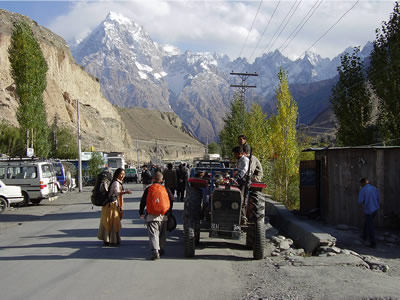 Nearly all Pakistani’s have a heart attack when I tell them I’m 27,
single and without child. I was sat on the bus in the thick of it all, heading
once again towards Rawalpindi. I glanced out of the window, I was back. Back in
the land of minarets against the sunset, the wail of the Muezzin carried on the
wind and the generosity of a nation unfurled in every new encounter. A thousand
memories danced by the glass; horse stealing in Pari, the flaming heart of the
Kohistani, the windy nights of Pathan and above all the memories of taking two
Afghani horses through it all. Nearly all Pakistani’s have a heart attack when I tell them I’m 27,
single and without child. I was sat on the bus in the thick of it all, heading
once again towards Rawalpindi. I glanced out of the window, I was back. Back in
the land of minarets against the sunset, the wail of the Muezzin carried on the
wind and the generosity of a nation unfurled in every new encounter. A thousand
memories danced by the glass; horse stealing in Pari, the flaming heart of the
Kohistani, the windy nights of Pathan and above all the memories of taking two
Afghani horses through it all.A memory is a creation of new synaptic connections between the neurons of our brain, caused by the stimulation of nerve cells in our bodies. We remember things most easily that involve all our senses, so the more senses you trigger the easier it is to remember. That same memory may then be felt across your entire nervous system as the chemicals in your brain lie on the surface of every cell in your body. The seven weeks I spent in Pakistan and India were like a rollercoaster ride of memories and lessons from the past two years. Seeing the sights and sounds of each country made me realize what it was I loved about each and gave me a strength that I’ve missed being in China alone. Sometimes direction is the hardest thing to follow and motivation only matters when channeled in the right direction. It was Ramadan in Pakistan when I arrived in Rawalpindi, a special time of year as the entire Muslim Ummrah fasts as one and celebrates its daily break together. As the sunsets across the landscape, the Muezzin’s calls echo across a nation and a carnival mood grips the air. I was glad to be in Pakistan rather than china, where the call of the Muezzin is an echo in the soul rather than a reflection of the landscape. I was glad to visit friends once again, to relive and share new tales and catch up on old news. Clear Steps ForwardChanges have visited Pakistan since I last have. Mobile phones have appeared along the length of the Karakorum Highway (providing a major boon to the communication starved communities of the upper parts) and peace has finally settled across Gilgit. October 08th also marked the one year anniversary of the South Asian Earthquake (74,000 dead, 70,000 injured) and the Government claims reconstruction is now underway. Not content with resurfacing the entire KKH on their side, the Chinese are now surveying the Pakistan side to widen the road at key points from tip to tail. This is a boon and a bust for local people. A boon because it will save local lives and increase trade. A bust, because trade from Pakistan is practically negligible and the only people to really gain from this are the Chinese and well-oiled Pakistani politicians. The more extravagantly planned rail connection between Islamabad and Kashgar may prove more productive. Three weeks passed quickly and the commentary that PTV justifiably required for their film on last year’s ride was completed. The copy of the tapes I needed sat in my bags and the Indian border now stood in front of me, but a stone’s throw away. A Truly Indian AffairI’d forgotten that current seat on an Indian train meant ‘current for as long as a place on a bench was free’ and I spent an intrepid night of feet behind my back, heads in my lap, a leaky window and the drip, drip, drip of water dropping gently down my spine. As we pulled into New Delhi train station from Amritsar, the carriage was so tightly packed that I had to physically pick people up and hurl myself off the train to avoid ending up in Bombay. Festival fever gripped the capital as I wandered through downtown Delhi, on route to a meeting with 25th Frame Productions. The Hindu celebration of Diwali was only a few days away and the Muslim holiday of Eid-ul-Fitr was shortly after. Delhi Metro had finally been completed and I was frankly amazed as its efficiency. When it was being built the planners had been given free reign to get things done properly and even Indians can’t quite believe the results. The street cows have also now been micro-chipped… Festivals of Light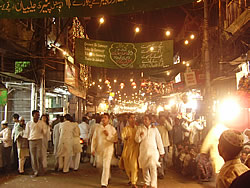 When the night of Diwali truly arrived the full might of India’s chaos was unleashed on the streets. I reminisced of the same night, two years ago when I soothed a troubled mare through the lot. Boys, adults, cows, and the insane gathered in any space available to unleash a full blown war of fireworks on anybody in sight. Bangers, crackers and anything live were suddenly thrown off balconies into the waiting throngs below. Dogs pelted as rockets sought their rears; Catherine wheels shrieked across the floor for delighted young children to dance in their middle, cycle rickshaws ran the gauntlet through series after series of aerial bombardments. An incessant smoke pulsed with the deafening roar of a thousand projectiles and an elephant then paraded through the middle of it all. And this year was supposedly less frenzied than normal! Eid-ul-Fitr was slightly more subdued than Diwali, but no less vibrant. The three day festival marks the end of Ramadan and the breaking of a month of fasting when all are free to feast. I was in Old Delhi for the celebrations. A thousand festival lights strung across the streets and the air buzzed with an expectant excitement. The poor clung to nearby restaurants awaiting their dues and the faithful enjoyed the relaxing of restrictions that Ramadan had imposed. It was a stark contrast to the solemnity of last years Eid in Pakistan. I climbed up to Delhi’s ancient Jamma Masjid - a forerunner to Pakistan’s Badshahi Mosque - and sat in the open hall to enjoy the pure acoustics of the Imam’s singing and the simple quiet above the din of the city. In many respects, the Muslims of Old Delhi are much the same as the people of Pakistan. The food is the same, the architecture the same, religion the same, the people the same. The war between the two Governments is self-fulfilling in that the power-struggles of the few corrupt the ambitions of billions. Before leaving India, for two days I stayed at the Golden Temple in Amritsar and proved that despite my previous visit, I still had much to learn. For two days I found an inner-calm to my thoughts, an anchor of solidarity in the oneness of people, their belief and sense of duty to others that I’ve never experienced anywhere else. Above all I embraced their acceptance. Washing-up time was always my favourite time of day! Shattered ReflectionsThus I began the return journey to Kashgar. A week had passed since I entered India and once again I was crossing that all too familiar border. Once again it opened my eyes to the differences between the two countries and quite frankly, Pakistan appeared poorer. The neat green fields and trade-heavy road on the Indian side gave way to a much bleaker road in Pakistan. Buffaloes, cows and donkey carts graced the road much more than trucks or buses. The impression of surviving one day to the next was much stronger in Pakistan and India appeared almost orderly by comparison. 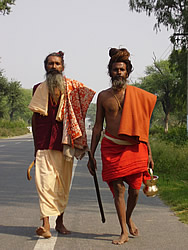 This was an important point considering the business men I was traveling across with. Though India has its own share of problems with power struggles, it seems that Pakistan has more of them in a much smaller space. Whether landowner, business man or politician, there are too many vested interests. Too many people who want to see life remain the same and the Government has to lay incentives if they expect others to follow. China has a big advantage over both countries in that the Government has an immense hold on the economy and mind of the population. When China moves forward, it moves forward as one. In South Asia it is the individual that is king and the Government unwilling. Life detained me for a week after my arrival in Lahore. On a two hour call-in radio interview with Pakistan’s FM 103, passions rose high on the topic of education and with the twilight of Thursday came the arrival of Sufi night. The Spiritual Side of IslamThis certainly wasn’t my first visit to the Shah Jamal Shrine, but it was the first time I’ve committed it to words. Sufism is the spiritual side of Islam, a quest that takes devotees a lifetime to achieve. Another facet of Pakistan life that fails to make the international headlines and yet is infinitely the most intriguing. For the virgin visitor, the shrine is the easiest access point to the mystical underbelly of the country and every Thursday night Lahore’s Backpacking hub, arranges transport to the self-styled ‘Sufi Night’. Imagine… Amidst the leafy bows of the Shah Jamal Shrine, Sufis spin and whirl to the ascending beat of the Dhol drummers. The rhythm pounds through the room, echoing through the rivulets of souls sealing one man to the next with the hope of a connection with God. A state of being so void, empty and precise one can almost feel his breath. Smog lays heavy and the glimmer of a hundred spliffs dot the haze. Pale faces peer up from a sea of brown as the beat picks up and the quest for ascendance reaches fever pitch. Waves of crescendos clatter the divide, as another and another Sufi master fall pray to the sound. Waist length hair spills out parallel to a whirlwind of movement as feet, body and arms celebrate perfect unison at the heart of the Shrine. Long robed Kafirs move in an asynchronous blur; white beards whipping the air as their human forms disappear. A horn resounds and with one huge step, Gonga Sain enters the Sufi ring. He whirls and dances. He assumes a feline grace. Oiled black hair and long red robes swirl in a fusion of symmetry as his mighty Dhol drum flies out in front, cutting a swathe through misguided Sufis. As he moves, the crowd responds and heads on all sides whip back and forth in search of their own spiritual intensity. Men dance in the aisles and in spite of myself, I pump my fists into the air to the full surprise of nearby locals. The full pulse and power of the shrine carry away the most ardent non-believers to another plain and to even write this down as words is to defy the experience and the feeling one achieves. Lahore then disappeared for the last time behind me and over two weeks I drifted slowly North into the mountains of Northern Pakistan. Business beckoned in Islamabad and there were places to visit before I reached China, first being the former epi-centre of last year’s earthquake in Balakot and final being the Afghanistan border itself. Recovery from Disaster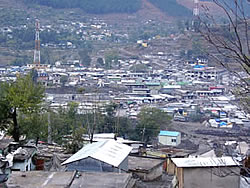 Virtually the whole of Balakot’s bazaar had been rebuilt from the ashes of decay and devastation of one year earlier. Thin metal sheeting moulded around wooden frames in a vague resemblance of the former town centre and the speed of recovery was breathtaking. I can remember the distant memory of life at the time, as people clawed together the ruins of their lives to somehow survive the coming winter and the loss of entire families. Yet today only order stood where chaos once reigned. Last winter was a mild one for the people of the Earthquake zone and the truth is they were lucky. Roads remained open, aid was delivered and fatalities were few. However, life hasn’t gotten any easier. People are very much on their own as obstacles rise like a rash on the rehabilitation area. Following the quake, 80,000 complaints were registered against the distribution of the Government’s reconstruction subsidy and the amount has proven far too little against the rising costs of building materials and labour in the area. Dissemination of information is also a huge problem. Many people were not informed when home inspections were being carried out and thus missed out on subsidies by not being present. Subsidies are released in stages in compliance with the Government’s building regulations but the one-size-fits-all design approved by the authorities, doesn’s meet every situation and uncertainty exists as plans continually change. In Balakot, a new city is being planned but so far no construction work has seen daylight. This winter is predicted to be far worst than the last and over 2 million people will be living in temporary shelters. Reconstruction may take up to eight years to complete and although preparations are being completed, as always it’s the people who will suffer the most. Read the full update: One year after the Earthquake The Chapursan ValleyArching high above the Karakorum our jeep now sped, racing quickly towards my final rendezvous with a unique friend high on the Afghan border with Pakistan. The jeep wound up the hard mountain road from the border post at Sust and headed deep into the mountains to the North. Desolation screamed around us. Far below, the river thrashed wildly, cutting a whip like path through the boulders and harsh ruggedness of the wind scarred valley around and the land spoke of a cruelty that only truly mountainous places can bring. It was nighttime when we reached the village of Karmin at the heart of the Chapursan Valley. 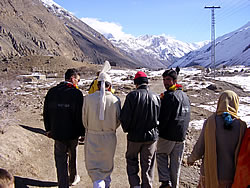 The Chapursan Valley is an almost mythical place secluded high in the confines of NW Pakistan amid the snows of the Pamirs and Karakorum. It is a world apart from the rest of the country and part of the fabled Hunza Kingdom of old. A touch of isolation and a reminder of the aching vastness that only stinging solitude can bring. I spent four days in the valley and the time drifted far too quickly. The friend I? come to visit was a man by the name of Alam Jan Dario. It has always been my good fortune to know Alam Jan and we’ve been in touch for almost two years. Alam is Pakistan’s only Long Rider and is a well-known musician, poet and explorer. Every Summer Alam rides high into the upper echelons of Afghanistan’s Pamirs in the Wakkan corridor to see family and friends and he’s the leading drive for responsible tourism in the valley. Spending the night in the company of the jeep driver and his family, my first morning in Karmin was spent visiting the village school. Straight away, F.G. Middle School, Karmin was an intriguing example of a partnership between the Government and Community in running a school. Yet what was really interesting was the unprompted action and success of the community to take educational matters into their own hands in schooling their own. This school faces logistical problems just like anywhere else in Pakistan (e.g. lack of skills and teachers), but unlike the rest of Pakistan, this school was prepared to solve them. Read School Report 11: A Wakki Uniqueness Chapursan is the kind of idyllic place you hope to see but never find. Local people are Ismaeli Muslims and speak a Tajiki dialect called Wakki (after the Wakkan corridor in Afghanistan nearby). Villages are small and every house has an open-door. Alam’s home was a typical dwelling in the village of Zhudkhon at the far end of the valley near Afghanistan. Foreigners often stay with Alam’s family in the ‘Pamir Serai.‘ Thick stone walls and juniper wood beams wrapped his house in warmth against the biting cold outside and a huge pan of tea sat boiling on the central stove as I entered. For three nights I slept on the floor with Alam’s family near that stove and I can assure you there’s no better place to slumber in the entire world. 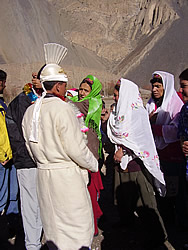 Over the next few days I learnt a lot about Chapursan. I attended a wedding in Karmin and was amazed at the measure of respect and appreciation for elders and each other in the valley. I accompanied Alam Jan on mountain bikes and spent a night by a shine called Babagundi on the Afghan border. I shared food with everyone we met, drank litres of tea (a very Wakki custom) and wished I was a small cat next to a fire in a shepherds hut on a cold day. We also met the man who’d taken my pack mare, Kabul across into Afghanistan this year. Sherbaz had originally bought Sparks and Kabul off me to use for horse trekking with tourists. However, the tourists never came and in a grass starved landscape, the mares became a liability. Alam Jan is a good friend of Sherbaz and through his contacts; Kabul is now home in Afghanistan, where the people of the Wakkan corridor need strong mares for breeding - I even met the very man who’d taken her - and Sparks should be heading that way come summer. Wakki people are renowned for their love of horses and both couldn’t be in a better place. Return of the IbexUp on the Khunjerab Pass and the Chinese border welcomed once more; a floating amphitheatre of fluted peaks rising through the icy stillness of a dozen small glaciers emptying onto the road. Nearing the summit, our bus passed a herd of Ibex grazing high on the scree slopes above, bathing the valley with their presence. It was a moment of majesty since many of these regal animals walk the line of extinction and heading slowly back towards Kashgar, I took it as a promising sign of things to come. Tribute:I’d like to pay my respects to Long Rider Tim Cope, whose father suddenly died in a car accident whilst Tim was crossing Asia on horseback in the footsteps of Genghis Khan. Tim has been in the saddle for two and a half years now and was in the Ukraine when he received the tragic news. For his strength, courage and all he has achieved, I wish him well. |