Business in Beijing

|
Lat:
39:55.801560
Long:
116:24.000540 Business in Beijing
6th October 2006
 The land outside raced by as our train chugged East towards
Beijing. It was a mammoth journey of 3400kms (2100miles), and three solid days
of sitting. Life waved goodbye to my buttocks and time ticked slowly by. The land outside raced by as our train chugged East towards
Beijing. It was a mammoth journey of 3400kms (2100miles), and three solid days
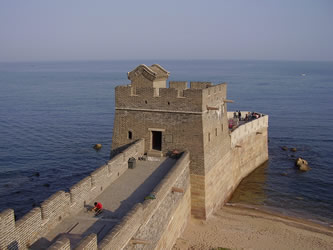
of sitting. Life waved goodbye to my buttocks and time ticked slowly by.Last year I was overwhelmed. The taxation of school visits, riding, filming, fundraising and an Earthquake was a lot to handle and it meant that the documentary's commentary had suffered. With time now available, I was journeying to Beijing to secure Pakistan and Indian visas and buy the equipment I needed to complete last year?€?s filming and discuss the journey ahead. It was also important to do this now while memories were still intact and not affected by any further riding. Xinjiang by Rail It was 9th September. Kashgar?€?s crowded train platform waddled forward for the first stage of our journey to Urumqi in Northern Xinjiang. China?€?s largest province doesn?€?t have many rail hubs and for all connections out, Xinjiang?€?s capital was the only source. My train ticket cost only 78 RMB (??5) for the delight of a thirty hour journey on a bench that promised to be an adventure in its own right. Long sojourns don?€?t play well with the body but then the best experiences are often on the cheapest and most uncomfortable journeys. For the next hour the mob of expectant passengers sat, taunting irate floor sweepers with mountains of chewed sunflower husks spat on the ground. Although I arrived 45 minutes early, I was still stood at the back of long queue that wound its way around the front of the station. Usually boarding a Chinese train is a bit like boarding a bus; i.e. a mass riot and I have to wonder if it was only because the crowd was 99% Uighurs that resulted in this crowd control today. The train was clean and I settled down to the usual barrage of inane questions such as sex, height, marriage status and children. These of course contrasted strongly with my questions on the political status of Uighurs in Xinjiang and the exploitation of local society, which funnily enough resulted in a rather muted response. As the hours rolled by I was press ganged into singing local songs on the guitar, drinking free alcohol and being dragged the entire length of the train to eat free meals of laghman. That was until hell, (otherwise known as night), arrived. I was sat squashed between a fidgety old woman and a young mother with a bawling baby. The giant man-cum-bear on the seat behind snored louder than the train engine and all I could do was just sit, eyed glued open, praying for morning. At 3am I tried concentrating on learning Uighur to tire my mind and it worked… that was until 6am when everybody else miraculously woke up at the same time and every double window on the carriage blasted open. Girl Soldiers of the Train Twelve hours from Urumqi and the train left the desert world and ascended into the sub-alpine meadows of the Tian Shan ranges. Odd Spartan households, speckled green clad hills and shepherds with their flocks lazed idly below. Each hour our carriage was swept clean by its own Chinese girl super-attendant, irate to varying degrees depending on occupants and general DNA makeup. Nobody was allowed near an open door except perhaps in a train station and if anyone (Uighur especially) parked themselves near one they got literally screamed at until they moved. Thus on a Chinese train (in Xinjiang) make sure you do none of the following: a). Feel the need for fresh air from a window on a sleepless night b). Allow any foot or body part to stray into an isle or c). Never ever, ever lose your ticket. One unfortunate soul on our trip was unfortunate to fall into category C and was promptly thrown off the train. Bizarrely his ticket had been checked by the same conductor several times previously but he broke a rule and suffered the boot. Which Chinese City? Urumqi was about as memorable as every other city in China; cranes rising above the cityscape like weeds, explosive growth, mass humanity, a metropolis of skyscrapers, business and wealth. Perhaps a nice place to work, but not a memorable one. Buses were only one Yuan anywhere and the only notable thing I did whilst there, was visit a hip ex-pat bar called ?€?Fubar?€? on Urumqi?€?s bar-strip. Great Journeys used to be measured in years rather than days and whilst the trip to Beijing was hardly comparable it was indeed spectacular. A ripped terrain of rugged rocks and gravel dunes were the only features in an otherwise desolate waste as the train sped East. It wasn?€?t difficult to imagine the complications of past travellers in negotiating the Gobi desert and the sight was a sure remainder of the challenges ahead. Fifteen hundred years ago, it took Huang Xsang four years to cross China on his famous ?€?Journey to the West.?€? Today that same journey took two days and the only difference between the end of our journey and the beginning was a name. Once again crane towers dominated the horizon, large motorways roared beneath us and humanity spewed forth from every nook and concrete crevasse. This was Beijing. Bureaucracy in Beijing 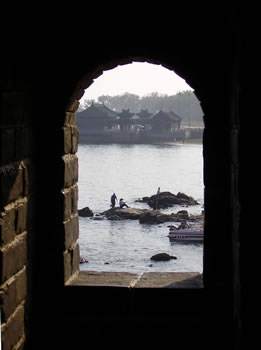 Beijing was a confusing blend of fancy cars, embassies, massive construction projects and endless, endless streams of bicycles. As one German I met put it, ‘Beijing the stately city’ and indeed it isn?€?t as fast as you?€?d expect. Bicycles are slow, the people move slowly and even the traffic seems in no hurry. With the arrival of the Olympics in 2008, half of Beijing appears walled away and the sound of sledge hammers and drills fills most street corners. Yet boarding a bus is anything but sedate. At every five minute stop, people surge onto the vehicle like it was the escape from hell, elbowing each other out of the way to make room. I quickly learnt to find the right bus routes to minimize this charade of ?€?convenient?€? travel as much as possible. My first job in the capital was to obtain a visa for Pakistan and the Pakistani embassy was one of the most lax I?€?d ever visited. People were allowed in with their mobile phone and everyone seemed very laid back. Interviews for visa applications are normal and on my turn the consol asked me “How is India different to Pakistan?” Jaw drop! “Both are very different, but I?€?d say Pakistan is more relaxed than India,” I replied. The Consol continued, “Well, I?€?d say Pakistani?€?s were more emotional and sentimental than the Indians.” Without anything else to add I just nodded and he awarded me a thirty day visa which I collected the following Monday. Impressions of Beijing I spent a week in Beijing chasing up odd jobs, buying what I needed and enjoyed the ease of travel around the capital. The Metro was excellent and only cost a flat fee of 3 Yuan (20p) to travel anywhere. Accommodation was also reasonable and the food always good. There were some odd habits to get used to though - especially in Internet caf??s. Beijing?€?s internet bars provide a number of different companions for the average web-surfer. These include: 1). Hawking, spitting half-naked man who may spend up to several hours coughing up huge wads of flem and letting them slip slowly onto the floor to then casually rub in the mess with his foot. 2). Karaoke champions who enjoy bursting into full song in the most out-of-tune voices known to man. This goes for all karaoke bars in general. 3). Porn surfers - who, without a care in the world, merrily whittle away the time openly investigating the world of hardcore pornography. Bogus Tea Connoisseurs On the 18th September I met up with a friend I hadn?€?t seen in over 3.5 years. It?€?s always great to catch up and seeing Roy was awesome. We both had numerous things to do but it was on Wan-fu-jing, (Beijing?€?s upmarket shopping district) that we both fell foul of two bogus tea students. I don?€?t even remember their names, but the two girls that greeted us on Wanfujing just wanted to practice their English. This is completely standard all over Asia, so what was the harm in one cup of tea? Any self-respecting restaurant offers tea for free and so the most I expected to pay was 10 Yuan for one at the ?€?tea house.?€? Yet at ours the price was a minimum 40 Yuan (??3 for water and leaves). Our companions were suspect when each one ordered ?€?West Lemonblade?€? tea at 80 Yuan a cup and an assorted plate of fruits for 180 Yuan. Jaw Drop! An average meal in China costs only 10-20 Yuan and this was all a farce. When the 480 Yuan bill came several hours later, “it?€?s a Chinese custom for the man to pay for the woman, or else the woman loses respect,” echoed across the table. Well we didn?€?t and after paying for our own teas, plus a bit extra, we left the girls to pick up the fruit we?€?d never even realised was meant for us. I have little doubt that both fiends were in allegiance with the “teas from the farthest corners of Asia transported by buffalo” tea house and we were having none of it. Wan Li Changcheng The Great Wall of China has to be one of the greatest achievements of mankind and only in a country like China could such a huge engineering challenge be realized. I?€?d wanted to visit the start of the Great Wall ever since reading about Robin Hanbury Tenison?€?s horse ride along it. It personally seemed fitting to stand at the beginning of China?€?s most famous monument and then spend three months teaching at the end of it. We were visiting Shan-hai-guan fort, built during the Ming Dynasty in 1381 to guard the Eastern most extent of China?€?s defenses and China’s Northern most entrance until the late 17th Century. The fort is now more of a city but a lot of character still remains. The Great Wall forms the city?€?s Eastern boundary and many of the interior fortifications and gates still straddle the streets. In spite all the postcards and TV footage, I still found it awe-inspiring to see the wall march from the sea and snake from hill to hollow over the mountains that rose ahead. During the time of the warring states in the fifth Century BC, many of the towns of Northern China and their trade routes were walled against attack. As each warring state defended their territory, it seemed only natural that when one conquered the country, they would apply the same principle. For the next two thousand years the wall was rebuilt and extended and many of the sections remaining today, date from the Ming Dynasty (14th-16th Century AD). However, despite its incredible cost, the wall was always more of a deterrent than a successful line of defense, failing to withhold the Mongol hordes, the Manchu armies and later the Japanese. As we eventually stood on Lou Long Tao (built 1579 AD), where the wall meets the ocean, new waves of tourist hordes removed the whole significance of the ‘Old Dragon?€?s Head’ erupting from the ocean. But I was still happy to have seen it. From end to end, the wall extends 6000kms from the East coast through to the fort of Jiayuguan where China ceases and the barbarian wastes begin. It?€?s a symbol of unity for the Chinese nation and today as a handy souvenir snap for the tourist. Out of China 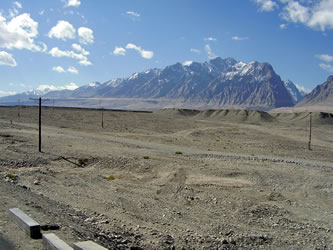 Collecting my Indian Visa passed without incident and I boarded the train across China. The journey was over as soon as it began and we were soon chuffing into Urumqi station. Since there were no trains running to Kashgar I took the first sleeper bus and arrived in town 24 hours later on the 29th September. More than anything else I felt glad to be back in Xinjiang after almost two weeks away. I relished being able to eat Laghman amongst the company of ?€?barbarians of the west?€? and hearing another language. There?€?s something about the wild, raucous nature of the people of Xinjiang (Uighurs) that appeals to me the most. I only remained in Kashgar long enough to secure Pakistani Rupees and a ride to Taxkorgan near the Pakistan border. The night was alit with a million stars as we shot across an icy plain hedged by snowy peaks. It was cold. The road had recently been tarmaced and we reached Taxkorgan is under five hours. The hotel manager was a little disgruntled when he checked in our carload that night and I spent the night in a cold dorm with two snoring locals. The morning was the usual shambles that borders inevitably bring. After X-raying my bags and checking if I had SARS, I sat like a fool with the other foreigners for a further 3 hours while customs decided which bus we should take and how to load our bags. To top that, two scruffy fellows doing the loaded demanded payment for their ten second work. As one local Pakistani aptly put it, “give them money and they?€?ll load anything… a plane or perhaps an atomic bomb!” |