Tracks in the Desert

|
Lat:
39:28.998000
Long:
76:01.998000 Tracks in the Desert
16th April 2006
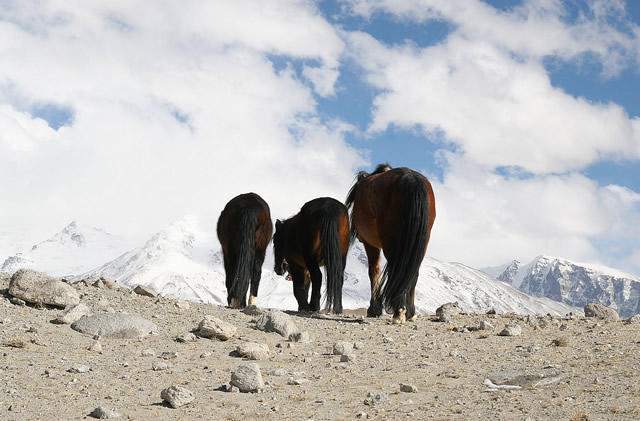 Individuals have long hiked goods across the harshest expanses of
Central Asia seeking their fortune in trade from one side of the world to the
other. Those individuals belonged to a another time, a 1000 years ago. That time
was the Silk Road and those harsh expanses lay in Xinjiang, China. Individuals have long hiked goods across the harshest expanses of
Central Asia seeking their fortune in trade from one side of the world to the
other. Those individuals belonged to a another time, a 1000 years ago. That time
was the Silk Road and those harsh expanses lay in Xinjiang, China.Xinjiang is by definition almost timeless. To the North and South, two great mountain ranges lock this region away from the world and at its centre sits the deathly wastes of the Taklamakan desert, the second largest sand shifting desert on Earth. Since the time of the Silk Road, traders have been forced to divert their caravans around this monstrosity at the heart of the province. Beginning (or ending) in Kashgar, two routes were established to the North and South. While the Southerly route was infinitely more hostile, it was preferred by the caravans as its remoteness gave some protection from bandits and thieves. Sweeping into KashgarOur vehicle was the only soul on the road as we raced towards Kashgar. The remaining section of the Karakorum Highway from Taxkorgan passed across a tundra of rolling snow dunes and choppy peaks Clouds and glaciers poured down to meet the road as small groups of lopsided Bacterian camels lurched alongside. It was breath taking. Still, this was nothing compared to Muztagh Ata - Father of the Ice Mountains. The summit of this 7546m giant was cloaked in cloud as our road skirted its feet. Glaciers radiated out from its top in deep rifts and mist ebbed at its flanks. In all my travels I’ve never seen such an amazing spectacle or experienced such a breathtaking journey. Eight hours later we pulled into Kashgar. The Great GameDuring the time of the Great Game, British and Russian counterparts fought to outwit each other in an international struggle for land and power. The city of Kashgar lay at the hub of the political struggle but the real battle lay amidst the high mountain passes and desert wastes of the region. Famous explorers like Hayward, Sir Francis Younghusband et al faced equally cunning Russian adversaries. The interests of British India faced the territorial ambitions of the Russian Czars and much was at stake. In Kashgar both Russia and Britain established consulates and some of the greatest horseback adventures ever written came out of the period. The old Russian consulate that was once so important during the Great Game has now been converted into the Seman Hotel (watch how you say it!) Coupled with cheap dorm rates and warm rooms there was only one destination for me here. On the crossroads of Asia Kashgar has always been an important Silkroad city. For travellers entering the desert it was the last bastion of civilisation before their long journey East. For those leaving the desert it was a welcoming home. A perfect place to spend the Xinjiang Winter and one to prepare for the next stage of the ride. Like many other Xinjiang cities, Kashgar feels more like Central Asia than China. Kebabs sizzle on street corners, donkey carts roam the streets and men in large furry hats congregate the bazaars. Most of the local population (as in the majority of Xinjiang) are Uighurs who have more in common with Turks than Han Chinese. The ‘old city’ is still a maze of muddy streets, mosques and raucous shopkeepers selling their wares. Yet the entire province of Xinjiang is quickly changing. Uighurs and HanThe ‘Xinjiang Uighur Autonomous region’ is perhaps still the only region of China where a ‘minority’ outnumbers Han Chinese. Yet you’ve just got to look around Kashgar to see that can’t last for long. After the new railway line was extended to Kashgar a few years ago, floods of Han settlers poured into Kashgar looking for new opportunities. Kashgar has become even more polarised with Han Chinese colonizing new areas of the city and Uighurs remaining in the old. Today, the wide streets, beauty parlours and supermarkets of ‘New Kashgar’ drastically contrast with the winding muddy, but characteristic alleyways of the old. Large new developments have erupted around the outskirts of Kashgar and as elsewhere in China much of the old architecture, lovingly preserved in other countries, is lovingly ripped down by the Chinese. As I wrote in my diary at the time, Kashgar “hints at a former timelessness that is fast disappearing.” Scruffy, bearded, fierce looking Uighur men now mingle alongside impeccably dressed Han Chinese. Many Uighurs can only speak a smattering of Chinese and this obviously stumps their job opportunities despite efforts of the Government otherwise. Uighurs are obviously poorer. I have seen many Uighurs on donkey carts but never any Han. Time spent Most of Xinjiang operates on two timezones, Beijing Time and Xinjiang time, which doesn’t half make life confusing at times. Whereas local shops and businesses operate on Xinjiang (local time), Banks, offices, trains, buses etc. all operate on Beijing time which is two hours later. If I ever have to check the time of anything I always have to check which timezone someone is refering to. Frankly it’s ridiculous. Local time reflects daylight time which affects when people wake up and finish work. Even Government institutions seem to have partly realised this and operate on slightly modified hours. Banks for example open at 10am Beijing time and close at 6.30pm, instead of earlier hours. First impressionsAs I checked in, the Seman Hotel felt like the big old state building it once was, more suited to emissaries and diplomats than a shabby traveller with a truckload of horse equipment. The building was topped by a Soviet style blue tiled dome, with a high ceiling lobby and marbled floor. Yet, the room rates have been ridiculously cheap, approximately ???1.50 per night. The staff here have also been great. Although there are two beds in my room, I’ve hardly ever had to share it with anybody and every morning a piping hot water thermos is left inside the door (great for coffees!). During my first day in Kashgar the biggest difference I noticed was the lack of staring on the streets. Nobody in China can speak English, which also provided a welcome relief from having to share the same silly small talk with every Tom, Dick and Harry who can speak even a smattering of English in Pakistan. However, sit down for 5 minutes with any personal item at all here and you’re in trouble. Locals don’t hesitate to rifle through your bag, pick up your book, laugh inanely and then pass it over to their mates. Xinjiang is a predominantly Muslim region and many of the Uighurs, Kazaks, Mongols etc.. that live here are so. However, China has always been careful about religion within her borders. Gone are the Muazzins call to prayers I used to love hearing across the skylines of Pakistan. Gone are the open displays of worship so evident in other Muslim countries. Still, Uighur women in Kashgar don’t cover their faces and only wear a type of handkerchief around the heads. Women also share an equal role with men in daily life, both in Kashgar and out. It was at first a shock to experience after hardly even seeing a woman for over a year in Pakistan. As time scudded byTime passed quickly in Kashgar and I almost missed the arrival of the Muslim holiday of Eid-ul-Adha (’Corban festival’ in Xinjiang) in January. Despite a lack of celebrations in ‘New Kashgar’ the old town was bustling. In comparison to the activities in Pakistan at this time of year, Kashgar had little to offer. Still, piles of sheep skins stacked high on street corners and a small market formed at the centre of the old town where traders attempted to profiteer from the last minute sale of sheep, goats and pieces of their hacked up brethren. As sheep were slaughtered, their skins were quickly removed and stacked, steaming, on nearby carts to be taken away for sale. Of the two lucky beggars that were wise to come out today, I saw people queuing up to give them money. Each beggar had a veritable mountain of decent sized notes and didn’t even have the time to count it. Uighurs have few holidays every year and as the day ended a thousand people gathered outside of Kashgar’s Id Kah mosque (China’s largest) to dance and celebrate. Towards the end of January, Chinese New Year hit Kashgar. This was the first year that the Chinese Government apparently legalised the sale of fireworks and boy did the local Han ‘minority’ make the most of it. As midnight for the year of the Dog drew near an arial bombardment fell on Kashgar. A deafening assault of firecrackers, falling stars and banging erupted simultaneously into the air for perhaps the best firework show I’ve ever seen. It didn’t end that night either. Over the following two weeks gangs of kids were setting off reams of Chinese fire-crackers at every opportunity. During all these months in Kashgar I spent a lot of time working on a new format for the R4E website and by mid-March I’d finished. Around the same time, the Taklamakan desert decided to pay Kashgar a visit with a howling 24 hr sand storm. The whole world suddenly went red. Visibility was reduced to under 5m, traffic disappeared and only the bravest and foolhardy ventured outside. In fact sunlight was so reduced it was like a 24 hr Solar eclipse. Into the TaklamakanOn the 01 April I packed my bags and headed out into the Taklamakan desert. Travel plans are going well but I wanted to see the terrain before I will make my final departure. The road from Kashgar to the ancient city of Khotan ran right along the original Silk road route along the South side of the desert. After two hours we left civilisation behind and entered the world of the Taklamakan. Aside from the odd dusty village every few hundred kilometers only dunes kept the road company for the next seven hours. Odd groups of Bacterian camels, shedding their Winter fur sheltered by the roadside. Any preconceptions I’d had about taking horses on this journey evaporated as quickly as the water does. It will have to be camels.  Khotan has a history as one of prime Bhuddist centres of learning on the Silk road but today it is just another ‘chinese city.’ Over the past few years the local cadres have leveled every old nook and cranny. Today’s Khotan is a one of typically wide streets, tiled buildings and large paved ‘peoples squares,’ just like any other city in China. There was none of the old charm of Kashgar’s old-city. I spent a week around Khotan, meeting up with friends, journeying into the desert and searching for the modern treasures of the Silkroad that weren’t easy to find. I made one interesting trip out from Khotan to the desert village of Silawat towards the interior. Village life in Xinjiang is a marginal existence dependant upon runoff from the mountains to the North and South of the desert. Over thousands of years locals have harnessed the power of this runoff into clever irrigation channels that feed tiny strips of life that run into the desert. Our road was one such trickle completely reliant upon the accompanying Karakax River. Beyond that only the desert lay. Nobody spoke English on the journey there, which made getting further into the desert all the harder. Eventually through a combination of my own admittedly bad Chinese and Uighur I managed to secure to bikes and we sped off into the desert. Standing in the middle of a desert, one feels ‘lost’ or possibly overwhelmed. I could stand here or at the desert heart and feel no difference. Only dunes radiated out on all sides. In an unchanging landscape, time and monotony were one and the same. Civilisations come, civilisations go but the desert will always remain. Just take a look at a map to see all the ‘ancient cities’ that the Taklamakan has claimed to see what I mean. Getting back to Khotan was difficult. Locals here have a tendency to tell you anything even when they don’t know the answer. In Khotan I met up with a friend and spent a few days looking for Jade (Khotans most famous export), Silk and visiting some of the areas ‘Ancient Cities’. Many have been almost completely claimed by the desert. Such as Melikeawat (22kms) which was now just a collection of rounded house walls and odd shards of pottery. Voyage to the hillsBefore returning to Khotan I decided to disappear into the Kunlun Shan mountains on the Tibetan border for several days. I was aching to get back to altitude and the Kunlun Shan are one of most unexplored regions on Earth. Pulu village became my destination to begin hiking, yet getting there was the first problem. Travelling to the next major town of Keriya was easy. Here two adages proved true. First maps cannot be trusted. Second, locals advice is always better closer to the source. I made the first 55kms through a series of mini-vans, hitching and plain walking. At Nurmamet village, a desolate sandy road sped into the mountains towards Pulu. The map had shown a good road all the way. No two wheeled vehicle could easily make this journey and locals said that the remaining 38kms could be walked in six hours but I wasn’t sure. At 8pm a six-wheeled military transport rocked up and whisked me up to Pulu at around 2000m. Pulu proved to be a true doorway to the Kunlun Shan. Sand & gravel hills surrounded a neat little Uighur village that nestled at the foot of several 6000+ peaks in the distance. Green valleys and pastureland extended North whereas to the South was just rock, sand and tamarisk.  The furthest village reachable in a day was Checkleba, approx. 30kms distant. Poplars and muddy ditches lined the main gravel road out of the village as I hiked alongside the Keriya River and into the hills. Donkeys are used for everything here from riding to pulling ploughs. I often saw villagers cutting crops and bundling them onto the backs of donkeys, three bags at a time. Then with a yell and a thwack the animal was sent off to automatically wander back to the barn where it was later unloaded. The Kunlun Shan is just entering Spring and the ice on the upper Keriya river was just beginning to melt as I passed the village of Lush. In places the ice was up to 2ft thick making walking on the river much easier than hopping between the boulders alongside. This was really another world from the sandy wastes of the Taklamakan. Beyond Lush the valleys opened out and the rock pillars of the mountains truly began. It was a world of high alpine prairies that roamed between the feet of ice giants. Locals seemed to emerge from the darnest of nooks and crevasses riding their trusty donkey steeds down to Pulu or further up to higher pastures. This was everything I’d read about the Kunlun Shan and more. Lush also marked the final village and after 4 hours walking and several wrong turns later the village of Checkleba was nowhere to be seen. Somehow I’d reached the head of the dirty glacier high above the valley floor. Tiers of ice and rock formed a 6507 mountain above me. Just below a high grassy meadow rolled (the kind that sees sunshine virtually all day long) and a lonely shepherd shared his pot of tea. Getting back to Pulu by foot was easy, but travelling back to Keriya wasn’t. The next day there was no transport available and bad weather was brewing. That could mean being trapped in Pulu for days. Hiring a donkey proved too expensive as was a motorbike. The only thing to do was walk. On the road to NowhereThe path I took, dodged tiny rice field with cobbled stone walls until the green faded and the desert truly began. The weather was cloudy but sunny once I left the hills and only the rolling monotony of the desert remained. I’m not going to dwell on this walk here. Just imagine endless horizons of hazy gravelly dunes, tamarisk and a river valley that zigzagged somewhere into the distance. As I left the hills, the road became sandier and harder to navigate. Desert hermits occasionally emerged from a bush somewhere but I hardly spoke. Walking though the desert was like walking on a tread mill that never ends. Your legs tell you you’re gong somewhere but your eyes show you going nowhere. Two Chinese army jeeps passed in due course but they were packed. The journey took 9 hours in total and the last four were of a civilised horizon that never seemed to appear. I spent the night with locals in Nurmamet and caught a shared car back to Keriya. When I finally reached Kashgar a silly taxi driver forgot to open the boot and sped off into the night with my bag. I had his registration number and several hours at the police station later I was finally able to get some sleep! DepartureThe web site is now updated and I’ll be sending Newsletters out from here-on. If you’d like to subscribe, just enter your email in the box on the left-side of any page of this website to hear more from the ride. Plans to leave remain somewhere around the end of Summer 06. Stay tuned for more. RECENT NEWS: Heinrich and Monika Tettonborn rode from Urumqi, in Northern Xinjiang to Ghulja in the far West, on a fascinating horseback adventure in 2005. Their tale could be a foretelling of what this ride has to expect and is available on the Long Riders Guild website here. |