Permission to Ride my Camel Please

|
Permission to ride my camel, please?
37°, 58.889 N, 76°, 52.388 E
Mountain Trails
For days since
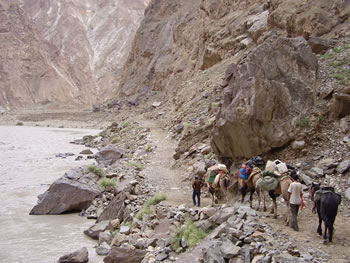
The roads through the Pamirs flow
through an incredible series of gorges along riverside and mountain top. Riverside roads are usually
unconditioned jeep tracks that resemble little more than slightly elevated river
beds next to mountain torrents.
Huge boulders from above and seasonal flooding from below are as much a
threat to traffic today as eons before. Yet these were the Natural defenses From Taxkorgan our road followed
the Taxkorgan river East across the Pamirs to its confluence with the muddy
Leaving
Washed Away
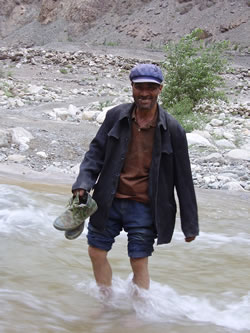
Unfortunately, the mountain stream we’d forded earlier had doubled in depth in the three hours since we’d crossed. Conditions from weather to water are extremely changeable in the mountains and nothing can be taken for granted. The bottom of the ford was lined with concrete and the water was running hard and fast. I sent Korban straight over pulling the weighted camel train behind. I was more concerned about the camels at that point and hadn’t given much consideration to myself. With boots slung around our necks
and trousers rolled up, Rosa and I braced together and set off across the
stream. The undercurrent was strong
and a third of the way across This wasn’t the movies and over I went, crashing 20m down stream with the other boulders and debris, powerless to the torrent and losing my head beneath the water with frightening regularity. The only thought I had at that point was not to give in. I regained my senses and managed to grab underwater boulders and pull myself along the current until the stream pooled and I clambered out. Stupid and silly! I was shivering from the shock one has after an unexpected threat. Rosa was still on the other side and though I debated sending Korban across on the heaviest camel to retrieve him, neither of us were in a state for rescue so I sent Rosa back down the road to a mine worker’s yard for the night hoping the stream would be normal by morning. We pitched our tents nearby and I fell asleep to the rumble of rocks pounding down the nearby water course thankful that I still wasn’t one of them. Gorge Country
I’ve encountered many individuals on the roadside over the last few weeks bearing jagged chunks of rock with thick veins of jade or other. If lucky the vein will be complete and yield a good price for the finder. A profound lack of jobs in the region means that many people resort to looking for stones to supplement their incomes and given the popularity I can only assume that many are successful. Back in ‘small
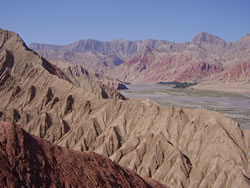
Despite the maelstrom on our right, the next day’s riding was one that continued to bear the fruits of gorge country. Huge pillars of granite rock towered on either side of the river echoing the crash of the nearby water. In some places crumbling and in others heaped with sand deposited over millennia by the river to create vast table plateaus riddled with caves. Into the Dragon’s Lair Our trouble began at 1930 when a
passing jeep we flagged down turned out to be a passing police car. We were heading towards Kosrap, a place
where rumours of unrest earlier this year had sparked further rumours that the
village was restricted for foreigners. However, like many places away from
centers of authority in
In the police vehicle I was told
I “you can return tonight”. In the police station I was informed “you can return
tomorrow morning.” Then all my
equipment and a bewildered Korban suddenly arrived in the middle of the night
leaving The next morning, the police
allowed Korban to rejoin Meanwhile HQ in Akto (nr. Kashgar), had told Kosrap to bring me in for questioning. The presence of my video camera made them squeamish so all my luggage had to come to. The camels had arrived in town, and with them secured, I became a problem to get rid of as soon as possible as I was rammed in a jeep and off-loaded back to civilisation. Current events aside, Kosrap was a beautiful mountain village of low mud-brick homes and winding alleyways. Two huge recently slaughtered sheep hung from an outside butchery when I arrived and the bazaar was the kind where every face was a familiar one. Activity moved everywhere from bustling shops to the piety of the local mosque. Still, most of all I was shocked. As a reflection on caravan travel, I was stunned to discover that the village was almost 100% Uyghur after several weeks of Tajik villages. Time with the caravan runs slow and such a change of population after several weeks was a big thing to accept at the time. Leaving the Mountains
We arrived in Akto with nightfall and the next morning travelled slowly from one place to another until I was finally plonked in Artush. There several bigwigs quizzed me on my purpose, donations, camera and equipment. A translator reviewed my latest tape and I was clear to leave. After a courtesy lunch, I was dumped unceremoniously in Kashgar with an inaudible sigh of relief. The verdict: make your own way back to Karchung where you will meet your camel drivers and caravan. You can continue your journey from there. I was a liability they wanted rid of and I never saw those officers again. The Road to the End Within 24 hours I was back in Karchung. Rosa and Korban were on their way down to meet me but I was bitter. The arrest meant nothing, but the 100kms I’d lost meant everything. I wasn’t allowed to complete my own journey due to events beyond my control. But then, one should never get too complacent. Mere hours after arriving in
Karchung, a harried phone call from Korban informed me that
The road up was bleak and I
missed all the enjoyment of the journey down. I had no intention of staying, intent
only on dropping off bags and cash but On August 18th, we
began a footsore 45 km hike down to Karchung from Aratash. Korban spent most of the day back in
Kosrap reclaiming unreturned belongings and we arrived together 13 hours later
at The Kewip Doctor
Amidst a patchwork of multi-hued canopies and stalls, Tahorchi Korban (77) sat with his wife and a hodge-podge of medicines from all over the world. Patients sidled up from all sides to gawp or receive attention. The Kewip doctor’s (local doctor’s) fee was the medicine he sold and he had something for everything. Dried snake (Igiri) for colds and shivers, thistle flowers for sore throats, dried rat droppings for rashes and antibiotics for everything else. Sunday was a relaxing day at the market. Monday was an unwelcome arrival. A Storm in a Horseshoe Boran hated it. He hated being strung up like a side of
beef between two poles, but there was no other way to do it. The experts knew what they were
doing. Boran’s front right shoe had
snapped in two at the front whilst grazing and needed replacing. I had several spare horseshoes from
No horse like’s its feet tampering with and Boran least of all. Yet Xinjiang farriers have a ruthlessly effective way of dealing with this and spare no horse leniency when it comes to getting the job done. Without giving him time to think, I led Boran between two large goal posts outside of the farrier’s village shop. His bridle was quickly tethered to a crossbar above and a thick rope circled around his body. Two large loops were then passed under his chest and lower belly, suspending his weight off the ground and effectively immobilizing the equine. The horse did all he could to escape, bucking, whinnying and sinking on his haunches to put weight on this front feet but he was tethered beyond movement and wasn’t going anywhere. This was a procedure common throughout Xinjiang and though I felt sorry for him, the farrier took only ten minutes to trim the hoof, level it off and place a new shoe on it. Given all the hassle I’ve had with previous horses, the whole operation was like lightning and I appreciated the work done, even if the skill lacked. Permission to ride my Camel,
please? I’d been back from the farrier’s
shop no more than an hour when the phone rang. “Police here, come quick,” Korban
breathlessly announced. I rushed
over for more fun. “Where’s your
permit,” the officer demanded. “You
should have a permit from Urumchi, where is it.” I had no permit, nor never
had. I’d been plainly told before I
left by KMA that none was needed.
My route passed through areas freely open to independent travel and there
shouldn’t have been a problem. I
did have paperwork stating my itinerary and purpose as well as my own
information leaflets, yet neither was good enough for this weasel like man. ‘Out of the
frying pan…’ I thought. ‘Would I
ever make it to As the afternoon wore thin, I suggested meeting in Yarkand the following morning when I hoped to recover the mobile numbers of the officers who’d cleared me to come to Karchung. I handed over my passport and arranged to accompany an officer down. I wasn’t going anywhere. The next
morning, the local police officers were all out stone prospecting and didn’t
return all day. At Taking a Stance
Boran and the
camels are presently staying with Alim and Kamil Jan, the two lads who brought
us to their house in the middle of the night several days ago. Ironically it was the boys’ father, who
had notified the police about the camels in his donkey yard some days ago. Yet there was no malicious intent and he
was only doing what he deemed right.
On the 22nd of August I had a fun final day with Korban and
Rosa in Yarkand and I’m presently waiting for news of my applications from the
military office in In retrospect,
given the inadequacy of my previous paperwork, my run in with the police in
Karchung was bound to happen sooner or later.
At the end of the day, Marco Polo needed permits, turns out so do I! |
 The river had flooded.
 No human,
machine or camel train could make it across the divide.
No human,
machine or camel train could make it across the divide.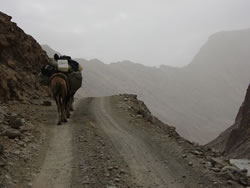 The
following morning the ford was normal and I woke to find
The
following morning the ford was normal and I woke to find
 On
the other hand, the police felt differently.
On
the other hand, the police felt differently.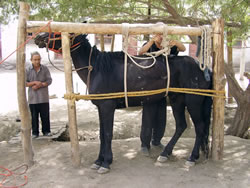 Thus
we left the mountains.
Thus
we left the mountains. Sunday was market day and everybody was in town.
 Am I
angry? No. Am I determined? Yes. Determined to see this through to the end and
get my camel caravan back on the road to
Am I
angry? No. Am I determined? Yes. Determined to see this through to the end and
get my camel caravan back on the road to