January 2, 2005

|
Another overdue update from Auckland, New Zealand
FIJI, pt 1 We arrived in Fiji early in November & wish that it had been sooner as it became quickly apparent that one could cruise there for a whole season & only scratch the surface. Not only is the beauty of Fiji endless, but it is very inexpensive. We checked into the country at the town of Savusavu -- a favorite with cruisers as it is friendly (everyone says bula/hello as you pass on the street) & the location is at the mouth of a river so it's very calm. (The moorings are so secure that many cruisers were spending the cyclone season there despite Fiji being on the cyclone path.) We spent a week there hanging out with other cruisers at the marina lounge & local yacht club, and enjoying the good Indian restaurants. (The Fiji population is about 51% Fiji-Indian as Indians were brought in to harvest sugarcane in the late 19th century. While many Fiji-Indians have enjoyed business success, they own a very small portion of the land & were only recently entitled to vote.)
We took a cab ride up the coast where we checked out an upscale Cousteau dive resort & took in the scenery of the Hibiscus Highway. The pic below shows a traditional bure (or house made of coconut thatch, fern fronds & timber), though we didn’t encounter these too much as they were being replaced by cinderblock structures that can withstand any cyclones.
Each morning we listened to a resident expat, Curly, with his own little VHF radio show coming from his houseboat (an unusual vessel for the S. Pacific). Curly was quite an information hound, announcing everything from the cruisers kids club meeting to Fiji cooking classes at a local restaurant. We made daily visits to the local market where I spent time in the crafts section talking to local women & checking out the great baskets as well as endless array of seashells.
At the market, we also met a lively woman named Tima at her kava stand. (Bob was quickly becoming obsessed with kava & wanted ground kava to make kava to drink on the boat. For the non-initiates, kava comes from the root of the pepper tree & is a mild intoxicant used in ceremonies by village chiefs.) Tima wanted to come visit the boat so we established a time for her to visit the next morning. When we picked her up at the dock, she was laden with fruit & veggies from her family's farm - a very generous gesture. She was pleased to share her recipe for, palosami, sautéed coconut prepared in the leaves of the ubiquitous taro plant. (We missed the part about steaming the leaves in the coconut, so our version turned out to cause major scratchy throat!)
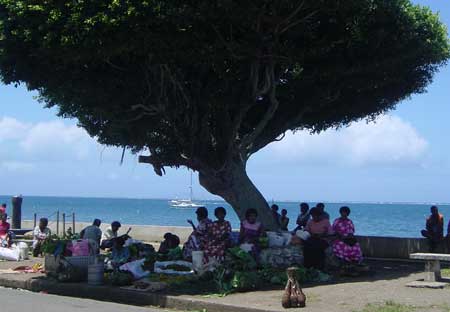
After Savusavu, we made a stop off the island of Nanenalala where the cacophony of birds awoke us each morning. We would later learn that we missed some of the best diving in Fiji around the passes to the lagoon here. We next went on to Makongai which had once been host to the country's leper colony. We didn’t land here, but had nice snorkeling. Both stops were scenic & peaceful as there were no other boats around. Our next port was the old whaling capital of Levuka which still has many clapboard structures on the shore & a great little restaurant called the Whales Tail where we ate twice in a 24 hr period as it was so good. We rented bikes & headed up the coast. We decided not to stop at any of the villages along the way as custom dictates that one should be invited to a village. Levuka had been the original capital of Fiji, it is now small and not big enough to support a real market. The women just spread their fruit & veggies on the sidewalk each Saturday. In the pic below, you may be able to see the huge taro in the foreground & Althea in the background.
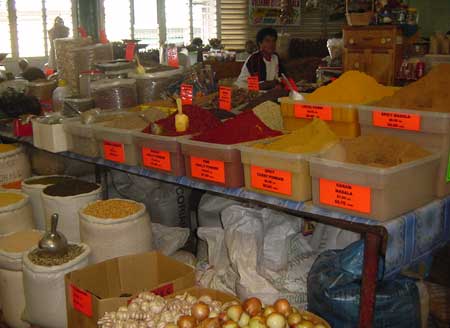
We moved on to Suva, the current capital of Fiji, where we found real supermarkets & stayed at the friendly Royal Suva Yacht Club. They even had a machine at the bar that dispensed mango daquiries - yum! After much comparison shopping, we invested in a large kava bowl that is decorated with mother of pearl inlay. The bowls are made from one piece of a wood called vesi and are traditionally used in men-only ceremonies. Each kava drinker uses a communal bola cup (made of coconut shell) & dipped into the large bowl where kava powder & water have been mixed. We have plans to have a kava party once we return to Berkeley but who knows if we'll ever find ground kava in California as it only seems to be sold in the U.S. in capsules or small tincture bottles. I would guess any of the 2 dozen or so kava dealers at the local Suva market would love to be exporting the stuff to the states & Bob took one dealers business card with thoughts of at least importing kava for his own personal use. The spice sections of the market were extensive & specialized in various bulk Indian spices sold wholesale & to the public. We thought the array was worth a shot.
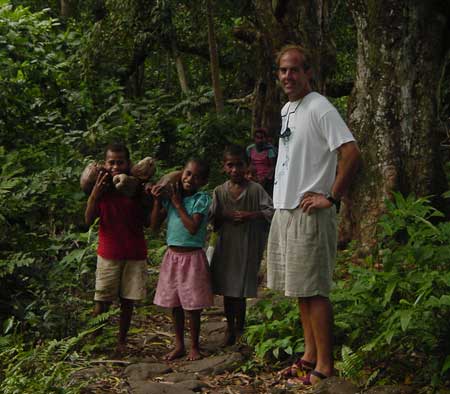
While in Suva, we found a dive company that was available to certify us for a bargain price. We arranged for the dive boat to meet us every morning in the lagoon off the small island of Yanuca. As we had the little bay to ourselves every night, we couldn't imagine a better place to get certified. All of the dives featured giant coral heads that were absolutely covered with colorful, soft coral for which Fiji is known. The dives all had great names including 'Fantasy' where we saw huge sea fans, lettuce coral, trigger fish, blow fish & many swim through tunnels; Golden Arches where we spotted a lion fish (beautiful but very poisonous); & Big Moy where we were entertained by the little blue ribbon eels that would poke their gold heads out from the rocks. The underwater scenery was really stunning. We had a total of five dives with this company -- they were all a treat & we were very excited to finally be legitimate certified divers. We took time for a hike to the little village on the other side of the island where we found children en route who were gathering coconuts for the evening meal. As with all Fiji children we had encountered, they were incredibly happy & seemed to lead a very unpressured life.
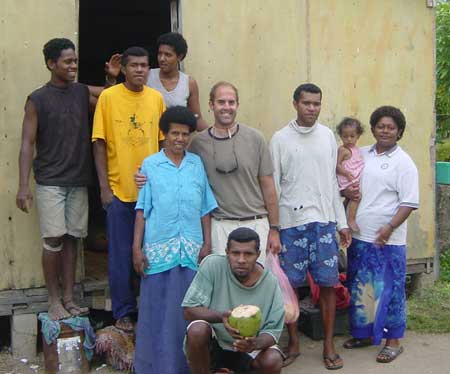
Our next stop was the island of Ono where the villagers were very happy to see us. Before we went ashore, I had to dig deep in my wardrobe to find a long skirt (below the knees) that would meet the customary expectations of the conservative villagers. One young guy, Nabouwala, came out to greet us.
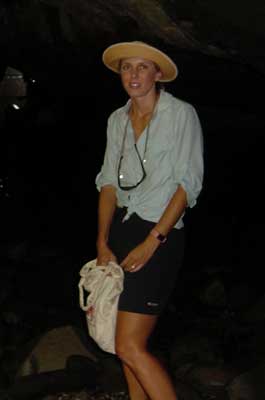
Nabu took us on a guided walk to show us his family's farming area where they grow taro & pepper trees - the source of kava. Our next tour was to a cave where we floated the dinghy through until we came out in a verdant garden-like setting just under the cliffs. The cave picture of me doesn’t show much but does prove that Bob is capable of taking photos =)
After a dive that included lots of swim throughs in underwater caverns, Bob joined Nabu at his favorite spearfishing shot. The fishing wasn’t a success but we had a great time with Nabu & Jalesi, one of his brothers joined is onboard for a cold Fiji bitter beer. The brothers were very psyched as beer is a rare treat. When we said goodbye to the Nabu’s family, we left them with some goodies: batteries for Jalesi's tatoo machine, lemonade mix, flour & a huge coke. In turn, they gave us tons of fresh fruit from their trees.
Our favorite stop (so far) is coming up next.
|