EMYR week 5

|
We were not sorry to leave
It was very different from what
we had experienced to-date. There were no shops near the marina at all which
made it very difficult to obtain bread. On the way back to the boat on our last
day in Before the rally commenced, we
had been advised that once out of
The crowning glory was the price of fuel. A notice was displayed in the marina that the price of fuel to all EMYR boats was to be a multiple of 3 times the cost of fuel for any other boats. It was still relatively cheap compared with Turkish prices but left a bad taste. Many of the boats had no option but to refuel. We left Lattakia just before
We hadn’t gone very far when we received a call on the VHF from our twin catamaran. They had caught something around their port propeller and were having to get in the water to sort the problem. We stood-by in the event that they might require assistance, until they called to let us know that all was well. I was on the midnight to 3am
watch and when I went to the flybridge to take over from Lucy, the milky-way
stretched from north to south, or south to north. It was unlike the view that I
had marveled at, while we journeyed to
I must have seen the milky way
many times as a child but do not remember it at all. My first recollection was
seeing it last year as we crossed from
At about We were amazed at how the
coastline of
We filled the tanks with fuel on arrival although the rally leader was not amused. A number of boats had already refueled and he wanted the rest to wait until the day of departure. We would have concurred but it was something of an unknown quantity, regarding the number of boats which still needed fuel and could have meant hanging about all day, with an unacceptable departure time. Unacceptable to the rally leader and potentially the Lebanese authorities who insist we leave during daylight hours. As it happened, the wife of the rally leader made the final decision so at least we were pleased. While we were at the fuel pontoon, an official came along and asked for copies of the boat documentation plus copies of the owner’s passports. This is routine although usually, we have to take the documentation to them. We tied up alongside the very
wide pontoon, just opposite the swimming pool. Dick received congratulations,
from the rally leader, for the very skilful way he had brought the boat to its
mooring so I then told the story of the occasion, while on rally
Within the hour, 2 custom’s
officers came aboard and entering the salon, sat on the sofa. I had been
nominated captain for this exercise as we anticipated it would be easier for me
to deal with them than Dick. The formalities over, I then had to show one of the
officers around the boat, opening this bag, that drawer or cupboard. He kept
asking me to give him something. I told him I had nothing to give. He asked for
money, I said I had none. He asked for whisky, I said I didn’t drink. He took my
EMYR 2008 baseball cap and gave it to his companion. (Fortunately, Lucy managed
to obtain a replacement for me before we left the country.) I signed the
prepared document and they left the boat. Haven’t had that sort of treatment
since we were in
Our joy at being 25 metres from the swimming pool was soon subdued when we heard that we could use the pool for 25 US dollars per person, per day. However, if we did wish to use it, we were not permitted to cross the pontoon and the grass between our boat and the pool, we had to leave the marina and enter the facilities from the main road access. Beautiful people promenaded up
and down the pontoon attired in very European style swim-wear. None of the
covering up of the local women as seen on beaches as we traveled along the south
coast of We left the marina after dark and walked to the Hard Rock café, about half a kilometer from the entrance, where we ate our evening meal. I could only eat a little so asked for a doggy bag. The plastic box containing my meal, had been placed inside a brown paper carrier bag, printed with the legend “Hard Rock café”, and underneath in smaller capital letters “BEIRUT”. Monday morning, Lucy and Caroline
took the day trip to Dick stayed on board trying to
fix things and I traipsed from one side of the marina to the other, to find the
marina office. We needed to obtain the necessary details to enable us to connect
to Wifi and the internet, also to phone home. Finding that this facility was not
available, I then trekked around the
Tuesday morning, Lucy and Caroline went off on an excursion to Baalbeck which is supposedly the most outstanding example of Roman ruins to be found in the whole region, perhaps more impressive than Athens or Rome. They also visited Anjar. A major tourist and archaeological site as it is the remains of an ancient, exclusively Arab city. Dick and I walked from the marina about half a mile, downtown. We passed many hotels and buildings which had obviously suffered bomb damage but were now being renovated but very sympathetically such that, if one wasn’t aware of the situation, it would not be possible to see that the reason for renovation was due to war damage. There are still a lot of hotels and buildings which remain in ruins, or partially ruined, due to bomb damage. Every 50 metres and under almost every tree, there seems to be a security guard, a soldier or a policeman, heavily armed. Many streets and areas can only be entered into, or exited from, by passing through a security barrier. Crossing the road is like taking your life in your hands. The driving is fast and aggressive and I am sure that they get extra points for knocking down a pedestrian. The city appears to be very European. Many of the street names and advertisements are displayed in English. Most people to whom we have spoken speak Lebanese, French and English. We hailed a taxi, which took us to a huge supermarket on the outskirts of the city and where we spent around 210,000 pounds. Thank goodness these were Lebanese pounds and not British pounds or we would have been in deep trouble, or very hungry. It was great to stock up with provisions, the like of which, we hadn’t seen since we joined the rally. The owner of the swimming pool has now given permission to participants of the EMYR, that we may enter their club from the pontoons and cross the grass. They have even permitted us to enter the club area at no charge, though it will cost 10 US dollars per person, should we wish to swim. That charge covers access to the pool for an entire day. Tuesday evening, we boarded the
coaches, to take us across pop-star. When we had entered Lebanese
water, we were 6 miles off-shore as requested. However, when we left the
country, at 18.45, the Lebanese navy insisted that we followed a course of 270
degrees until we were 12 miles offshore. We were instructed that the last rally
boat reaching the co-ordinates, given to us by the navy, was to call Lebanese
naval control and inform them that we were now all 12 miles out. The wind was
light and we motored through the night. Between At 6.15, we entered Israeli territorial water and called the Israeli navy to advise that we had now entered their territorial water. This was done at 5 mile intervals, until they responded. Three times they called us on the VHF, not quite understanding that Richard Craig was also known as Dick. As the sea was flat, I took
advantage of the situation and managed to wash and dry a load of washing
en-route. We hadn’t been permitted to hang out laundry while in the marina at
We reached
We passed the entrance through the breakwater and made our way down the river, where we rafted up to the starboard side of an old steel, sailing vessel, tied up alongside the quay. Our twin catamaran rafted up next to us, on our starboard side. During the afternoon, after
checking in the passports, booking the excursions and collecting the passports,
which had deliberately not been stamped, for our own convenience, we joined an
afternoon excursion around Next morning at Returning back to the marina, the mountain road was very steep and winding and the coach, despite being driven very slowly, scraped its underside on the road, on two occasions, as the driver navigated the bends. Saturday morning, off we went to
Acco where we were pleasantly surprised by an incredible reception arranged by
the senior advisor to the mayor, in the garden of the ancient
The site was magnificent and in
amazing condition, with tunnels which ran 700 metres to the sea. Unfortunately,
the visit to We left
We have at least 2 boats in the
rally, which have a dog on board. One of these dogs tends to go on all of the
excursions with its owners. The other dog was left on board while its owners
took part in the overnight trip to
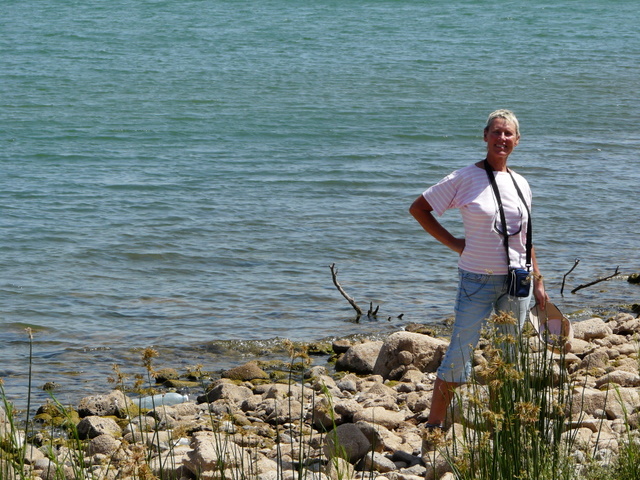 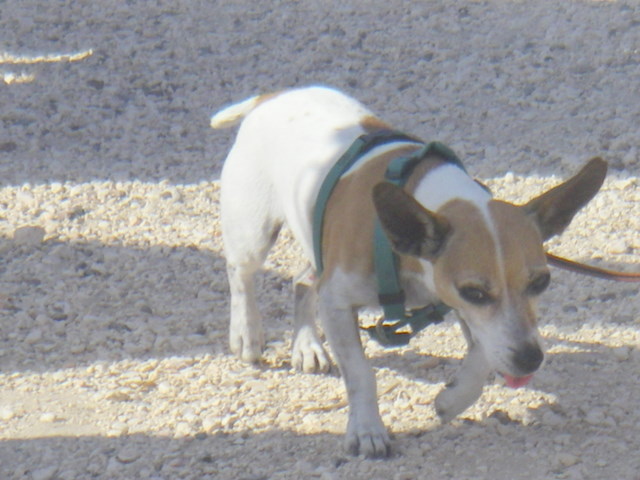 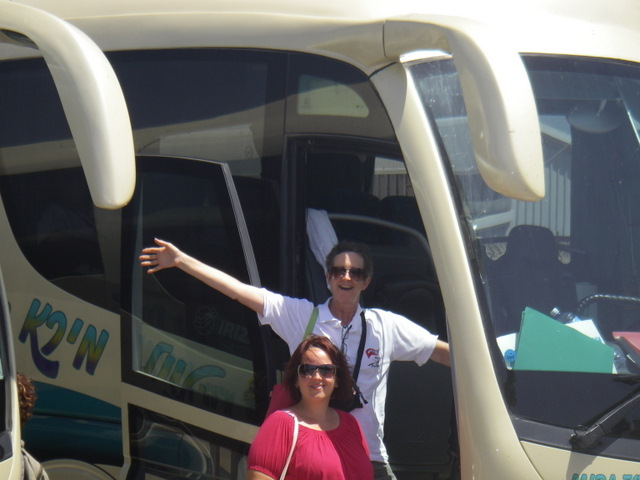 Above:- Irene, Sea of Galilea, EMYR dog on Golan Heights, Lucy and Caroline
leaving Kibutz
|