Organising the Caravan Part 1

|
Lat:
39:28.980000
Long:
75:58.020000 Organising the Caravan Part 1
14th July 2007
 It’s a tremendous time at the moment, sort of like sitting in an
airplane waiting for a skydive. I arrived in Hong Kong on the 22nd February and
left on the 4th June 2007 and now with days to go the whole R4E expedition is
about to kick off. It’s a tremendous time at the moment, sort of like sitting in an
airplane waiting for a skydive. I arrived in Hong Kong on the 22nd February and
left on the 4th June 2007 and now with days to go the whole R4E expedition is
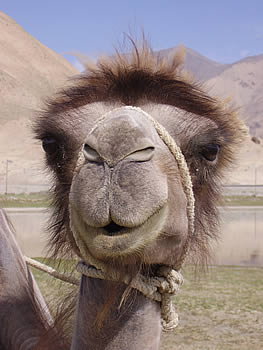
about to kick off.Yet how do you organize a first expedition? Where do you start? With long term logistics such as equipment, permits etc… mostly organised, the past month has been primarily a time of lists upon lists of immediate items needed such as food, animals, tack and labour. And most important of all was time. Time to check the route, time to film in Kashgar and time to ensure everything is bought and working before departure. Time has always been a luxury in my final days before crossing Pakistan and India, and it wasn’t going to limit me again. Karakul SensibilitiesWas choosing a camel driver going to be a simple case of line the candidates up and choose one? I’d have like to think so as I arrived at Karakul Lake with Maria on the 13th June, unprepared for touristic sensibilities and collapsing camerawomen. Karakul Lake is a tourist hotspot in the centre of the Pamir Mountains at an ethereal 3500m above sea level and around 400kms from Kashgar. Tourists from across China and overseas flock here to pray for a clear blue sky and a picture with the might of Muztagh Ata above them and the crystal blue waters of the lake behind. The lake is also near to Muztagh Ata base camp and home to the once nomadic Kyrgyz population. During the summer high season big expensive expeditions gather in the Pamirs to attempt the Muztagh Ata and Kongur Shan peaks. The local Kyrgyz provide the expertise and their camels give the transport. And yet tourist dollars bring a tourist way of mind and this is unfortunately how many Kyrgyz think. China is the sort of place where the sponge of bureaucracy soaks up much of the profits from big expeditions and little money trickles down to the local populations around Karakul. With the bus loads of tourists arriving daily, Kyrgyz see tourists as a valuable opportunity to make money which I don’t decry. It’s the attachment of money to every little offer of help, small service or otherwise that I don’t like. The greedy local rubbing his index finger and thumb together at me and saying "how much" in whatever language. Many things justify an expense, yet the kindness of the human heart should not. There are of course exceptions, which I’ll come to later, yet very few things in Karakul come for free and the offer of payment is never refused. Choosing a Camel Driver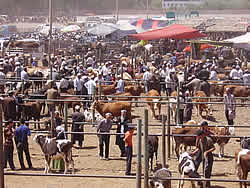 The basic offer tabled was a journey together from Taxkorgan to Dunhuang, about halfway to Beijing and approximately 2500kms distant. Included was a salary, food, insurance and all the equipment they would need. Camels were and are alien creatures to me at present and camel trains need camel drivers. Their safety and my own at the start of this journey is imperative and a good camel driver’s expertise is imperative over the first four months of the ride to Dunhuang. I had arranged to meet two local Kyrgyz camel drivers through a contact of Kashgar Mountaineering Adventures at the lake. Both of these dollar hardened vets wanted more than double the local price and I even had to hire the yurt we were meeting in! Still, all clouds have a silver lining, and mine emerged through Zaire and his family. As negotiations quickly collapsed, a young man in a Kyrgyz cap and jeans came forward to offer his services along the road to Dunhuang. Although this was not meant to be, my friendship to him, his yurt and family was and began a series of repeat visits to Karakul that proved exceptions do exist and that help can often come from the most surprising sources. A New HorseBuying a horse is always exciting and though not Peshawar, Kashgar’s Sunday market was an engaging place to be. After scouting the local equine scene the week before I knew what to expect on my second visit on June 17th. 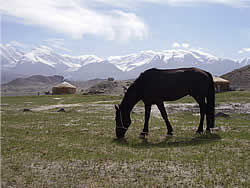 Kashgar’s Sunday market is a huge Central Asian affair playing host to a mix of nationalities and minorities from across the region. Thousands of people gather to barter, buy, borrow and gossip over a huge range of goods that spill into the streets and remind you that China is somewhere far away. About ten years ago the animal section of the market was moved from central Kashgar to the outskirts to create more room for people and establish some order to chaos (and in the process removing much of its charm). But the animal market is still an old piece of the Silk Road even if locked behind four walls. Mayhem and bargains rolled into one. Weathered faces, bubbling cauldrons and thousands of bleating, baying, complaining, sheep, goats, cows and equines being paraded and fought over. Horses are located at the very top of the market away from the bedlam. It’s usual in this region for a middle man to negotiate the sale between the buyer and seller. In this case I was accompanied by Semet Sadik, an old Asian horse hand and quite different to the veterinarians who helped me in Pakistan and India. As in Pakistan, it’s not about how well disciplined or behaved your horse is, it’s about how fast it can gallop and how strong it looks. Physical strength towers over mental ability. The most crazy horse in the land may also be the most highly valued and one of the first one’s I tried almost killed me. 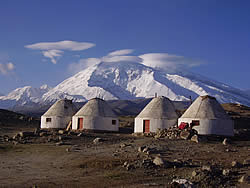 "Bullet" was all crimped mane and fancy tail and the most expensive horse on the lot. Yet almost as soon as I boarded the phantom brained brute, he bolted, stringing me along somewhere after his tail and leaving me plastered against the far brick wall. It was only a bruised ego I suffered and after him there was only three other horses worth considering. There were around 25 horses gathered and Semet Sadik had already been over them with a keen eye. He told me he could tell the age and type of horse from his eyes and of the three only one showed any promise. Not only did the final horse look strong, he was the only one who allowed me to walk and trot him around the upper paddock. To me, he had more brains than the other three combined and after some protracted negotiations Semet helped seal the deal at around £230 which fit my budget exactly. As a finale, we sealed the deal with a touch of the seller’s hand to the ground to show solidarity and finality in the earth and we soon had the horse on a truck to Karakul. With the buying of the horse there was no turning back and stabling the horse in Karakul would help acclimatise the animal to high altitude and get him accustomed to the camels - whom horses generally dislike. Why do I Care, I’m a Camel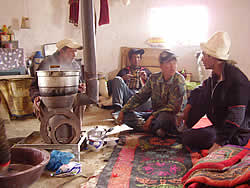 The horse arrived several hours before we did at the white washed walls of Zaire’s brother’s yurt in Karakul. Night time is cold at 3500m and with the words "and you can stay with us for free", we didn’t linger very long outside after the stallion was unloaded and put out to graze lakeside. Zaire’s brother Manas lived by the lake with his wife Ayesha and their three year old son Mustaffa. They made a living selling bric-a-brac items from Kashgar to tourists at the lake. Like most Kyrgyz dentistry was an unaffordable luxury and Manas?toothless grin was one of the highlights of my stays there. Both Manas and Ayesha lived in a one of the newer concrete yurts abundant by the lake. Many Kyrgyz today live in village house in the winter and a summer yurt like this one in the summer. Traditional camel hide yurts are still more popular but the concrete ones are inherently more practical. We arrived back in Karakul to visit a ‘Monday camel market’ follow-up to Kashgar’s animal market the day before, yet what we perceived was something far different. It was simply a fact that every day camels and their owners gather by the lake to give rides to tourists and not an ancient camel market as I’d been led to believe. Nevertheless, it was nice to believe so to some extent. To me camels are one of the most alien creatures on Earth, their cries of protest reflecting another world far away and a direct reminder of the alien lifestyle I’m about to embark on. Make no mistake that this final section of the journey is a completely different story to India or Pakistan. Experience from these latter two countries will only get me so far and finishing this journey in one piece and accomplishing everything else is the challenge now. What had begun as a beautiful morning quickly turned into a day of intermittent squalls and gusts. Between 30 and 40 camels were huddled by the lake giving reluctant rides to occasional Chinese tourists. Most were in various stages of molting with huge clumps of fur hanging off to create some rather amusing new hair styles. 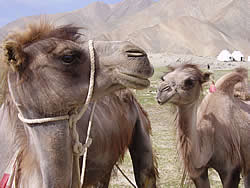 I needed two camels to carry the expedition’s luggage for the next four months to Dunhuang (where I can exchange or buy more). A medium camel can carry around 100kgs of equipment, food and water per day without hassle over a long distance. On offer were various sizes, the only problem was choosing one. As far as camels go, I know little and though Zaire was present, he was mainly a yes-man and only occasionally offered an opinion. However, this was a good place to choose one. Many camels had straight humps, broad chests and strong legs from a life of rich grazing and carting tourists several hundred metres up and down the lake. Sealing the DealBy lining the beasts up next to the lake it was possible to see which was bigger (although as soon as one was lined up, another was being towed away for another tourist to ride!). Riding them showed their temperament and good old gut instinct settled my mind on the first one. The owner was brought forward and the deal struck. The second camel was harder to find. Many of the camels were being taken home early due to the wintry gusts blasting us all morning and only small and furless ones seemed to be left. Although I was assured otherwise, I didn’t feel comfortable taking a completely molted camel into the icy cold of the Kunlun Shan. Suddenly, out of nowhere, a shaggy monster loomed over the crowd. This brute could carry a small truck and was perfect for the journey. The owner on the other hand was unwilling to sell. Yet patience is a buyer’s reward and a seller’s frustration and his price came down to a more modest £300. Zaire agreed to keep both camels and the horse with Manas and we were soon on the road back to Kashgar to buy food, sort out finalities and decide on a camel driver for the next four months. |